Tuesday, September 28, 2010

Unsolved Murder Mystery of Black Dahlia and Torso Slayer

She was known as the “Black Dahlia”. She had jet black hair and preferred black dresses and lingerie. Those who knew her best said she had a tattoo of an exotic flower on her inner thigh. She wanted desperately to be a Hollywood actress, but her fame would not come from the movies. It would come from her death, a murder which has gone unsolved for 60 years.

Elizabeth Short(July 29, 1924 – ca. January 15, 1947) was an American woman and the victim of a gruesome and much-publicized murder. She acquired the moniker The Black Dahlia posthumously by newspapers in the habit of nicknaming crimes they found particularly colorful. Short was found mutilated, her body severed at the waist, on January 15, 1947, in Leimert Park, Los Angeles, California. Short's unsolved murder has been the source of widespread speculation along with several books and film adaptations.

On a cold morning in January 1947, the nude, mutilated body of 22-year-old Elizabeth Short was discovered in a vacant lot in the Leimert Park area of Los Angeles. What made the murder so unique was the barbaric nature of the crime. The Black Dahlia’s body had been neatly severed in half, gutted and drained of blood. Author Lawrence P. Scherb put the unusual crime into perspective:

“Her face had been very brutally cut from ear to ear in a grin. Her throat had been cut and she had been mutilated sexually. Basically, she was the worst case of a sex crime in the history of Los Angeles County.”

The case of The Black Dahlia has fascinated crime writers for generations, and almost every one of them has a different theory about the killer. Lawrence Scherb has studied the Black Dahlia case extensively. Now, he believes he knows the identity of the man who so brutally murdered Elizabeth Short. 


Elizabeth Short’s life was as sad as it was brief. Like so many other young women, Elizabeth had been lured to Hollywood with dreams of becoming a star. Her career was going nowhere and she was running out of cash. According to some, she eventually drifted into prostitution.

In her final days, Elizabeth seemed to be constantly on the move. According to Lawrence Scherb, she was last seen leaving a diner in San Diego with a man who has never been positively identified:

"She called him Red when she spoke to him in the diner and he did have reddish colored hair. However, the police were never able to positively identify him, although some people felt that he might have been Robert Manley."


Read more at Black Dahlia Murder Mystery

UFO incursions at nuclear weapon sites in US and UK


FORMER members of the US Air Force claim aliens interfered with nuclear weapons - including during one famous incident in Britain.

UFO researcher Robert Hastings held a press conference in Washington to "address the vital issue of UFO incursions at US nuclear weapons sites over the past six decades".

Mr Hastings said: "More than 100 former or retired US Air Force personnel - once trusted to operate or guard weapons of mass destruction - have come forward and revealed ongoing UFO surveillance of, and occasional interference with, our nuclear weapons.

"This information alters the historical perspective on the nuclear arms race and much, much more.

"The fact that the Pentagon and CIA have successfully kept the truth from public view for so long is in itself mind-boggling."

The Rendlesham Forest incident, often described as "Britain's Roswell" was used as one example of evidence aliens had targeted nuclear weapons.

Friday, September 24, 2010

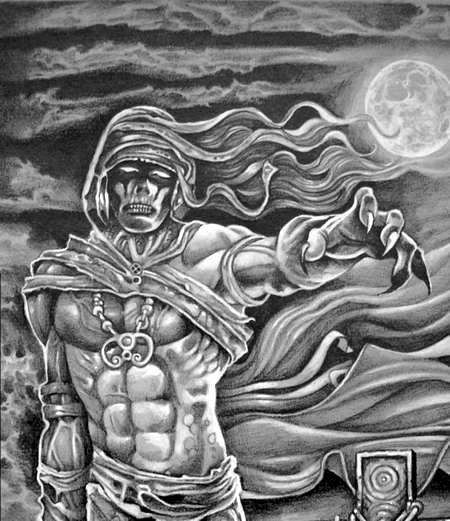
Draugr - Unexplained Mysteries of one who walks after death

A draugr or draug (original Old Norse plural draugar, as used here, not draugrs), or draugen (Nor., Swe. and Dan., meaning "the draug"), also known as aptrgangr (lit. "after-goer," or "one who walks after death") is an undead creature from Norse mythology. The original Norse meaning of the word is ghost, and in older literature one will find clear distinctions between sea-draug and land-draug. Draugar were believed to live in the graves of dead Vikings, being the body of the dead. Views differ on whether the personality and soul of the dead person lingers in the draugr. As the graves of important men often contained a good amount of wealth, the draugr jealously guards his treasures, even after death.

Traits

Draugar possess superhuman strength, can increase their size at will and carry the unmistakable stench of decay. The draugr's body, however does not decay and this odor was most likely due to the draugr being a host for diseases. The draugr's ability to increase its size also increased its weight as it did so, and the body of the draugr was described as being extremely heavy. It is possibly that the draugr could also be heavy without increasing its size, as this could help explain its immense strength, but the strength of the draugr could also be independent of its size or weight. The weight of the draugr may also only increase as size does. Thorolf of Eyrbyggja Saga was "uncorrupted, and with an ugly look about him... swollen to the size of an ox," and his body could not be raised without levers, it was so heavy. They are also noted for the ability to rise from the grave as wisps of smoke, possibly meaning they also have the ability to turn into smoke at will, although it is much more likely that this is an interperatation of their ability to "swim" through solid rock[5], which would be useful as a means of exiting their graves. Whether or not they can become intangible to other materials is not certain. In folklore the draugar slay their victims through various methods including crushing them with their enlarged forms, devouring their flesh, devouring them whole in their enlarged froms, inderectly killing them by driving them mad, and drinking their blood. Animals feeding near the grave of a draugr are often driven mad by the creature's influence.[ They may also die from being driven mad. Thorolf of the Eyrbyggja saga, for example, caused birds that flew over his howe to drop dead. Draugr are also noted as being able to drive living people insane. This may have been a method of the draugr to create more of his kind, similar to a vampire. The eyes of the draugr may be connected to this as their eyes are noted as being terrifying to look at, causing intense fear in even the bravest heroes. The power of the draugr's eyes, however, are never fully explained.

The draugr's victims were not limited to trespassers in its howe. The roaming ghosts decimated livestock by running the animals to death while either riding them or pursuing them in some hideous, half-flayed form. Shepherd, whose duties to their flocks left them out of doors at night time, were also particular targets for the hunger and hatred of the undead:

"... the oxen which had been used to haul Thorolf's body were ridden to death by demons, and every single beast that came near his grave went raving mad and howled itself to death. The shepherd at Hvamm often came racing home with Thorolf after him. One day that autumn neither sheep nor shepherd came back to the farm."

Draugr are noted for having numerous magical abilities, referred to as "trollskap" resembling those of living witches and wizards, such as shape-changing, controlling the weather, and seeing into the future. Among the creatures that a draugr may turn into are a seal, a great flayed bull, a grey horse with no ears or tail and a broken back, and a cat that would sit upon a sleeper's chest and grow steadily heavier until the victim suffocated The draugr Thrain shape-shifted into a "cat-like creature" (kattakyn) in Hromundar saga Greipssonar:

"Then Thrain turned himself into a troll, and the barrow was filled with a horrible stench; and he stuck his claws into the back of Hromund's neck, tearing the flesh from his bones..." 


More on this unexplained mystery at http://theunexplainedmysteries.com/Draugr.html

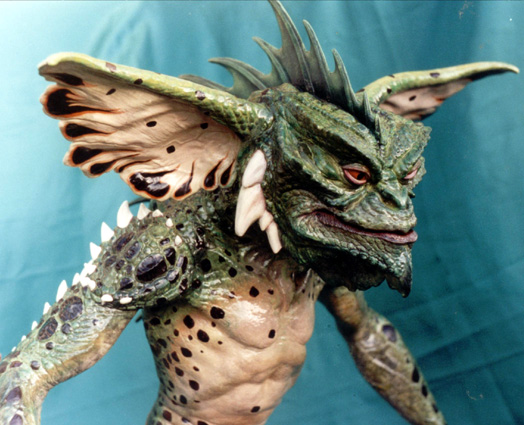
Unexplained Mysteries - Myhtical creature GREMLIN


Gremlin is an English folkloric creature, commonly depicted as mischievous and mechanically oriented, with a specific interest in aircraft. Although their origin is found in myths among airmen, claiming that the gremlins were responsible for sabotaging aircraft, John W. Hazen states that "some people" derive the name from the Old English word gremian, "to vex". Since World War II, different fantastical creatures have been referred to as gremlins, bearing varying degrees of resemblance to the originals.


The term "gremlin" was derived from the Old English word greme, which means to vex and annoy, commonly depicted as mischievous and mechanically oriented, with a specific interest in aircraft. The word "gremlin" originated in Royal Air Force (RAF) aviators' slang in Malta, the Middle East and India, with the earliest recorded printed use being in a poem published in the journal Aeroplane, in Malta on April 10, 1929. The concept of gremlins responsible for sabotaging aircraft was popularised during World War II among airmen of the UK's RAF, in particular the men of the high-altitude Photographic Reconnaissance Units (PRU) of RAF Benson, RAF Wick and RAF St Eval. The creatures were responsible for otherwise inexplicable accidents which sometimes occurred during their flights. Gremlins were also thought at one point to have enemy sympathies, but investigations revealed that enemy planes had similar and equally inexplicable mechanical problems. And that is certainly what the gremlins did to the pilots and their aircraft in World War II (1939–45) when the pesky entities were routinely blamed for engine troubles, electronic failures, and any other thing that might go wrong with an airplane.


An early reference to the Gremlin is in an article by Hubert Griffith in the servicemen's fortnightly Royal Air Force Journal dated April 18, 1942 although that article states the stories had been in existence for several years, and there are later recollections of it having been told by Battle of Britain Spitfire pilots as early as 1940. Later sources have sometimes claimed that the concept goes back to World War I, but there is no print evidence of this. Dave Stern, an aerospace, aviation, and history writer, says that the legend began in 1923 when a British navy pilot crashed into the sea. Once he was rescued, he blamed the accident on some little people who had jumped out of a beer bottle and had tormented him all night. It was these wee troublemakers who had followed him into the airplane, entered into the engine, messed with the flight controls, and caused him to crash. Not long after this reported gremlin attack, some pilots and mechanics stationed at an overseas RAF aerodrome complained of being bothered by the annoying entities, and by 1925, British pilots were cussing the little monsters and blaming gremlins for almost anything that might possibly go wrong with their aircraft. 

Monday, September 20, 2010

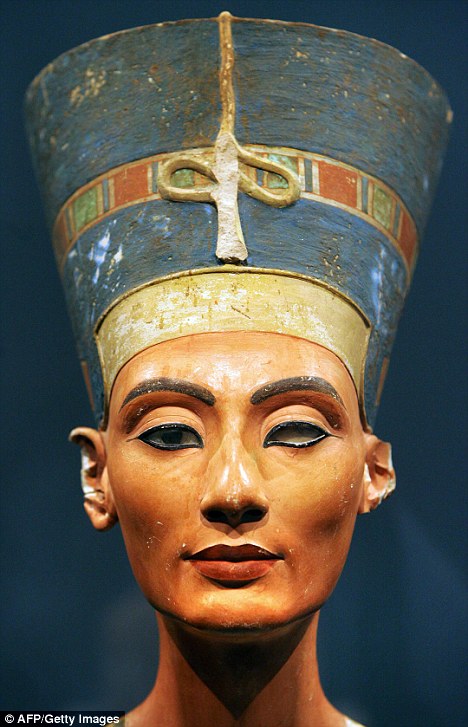
Queen Nefertiti bust may have had a facelift

An ancient Egyptian queen who was been hailed for thousands of years as the perfect example of beauty may not have been such a looker after all, researchers have claimed.

The 3,300-year-old carved bust of Queen Nerfititi with her aquiline nose and high cheek bones has won her admiring fans around the world.

But a delicately carved face in the limestone core of the famous bust suggests the royal sculptor at the time may have smoothed creases around the mouth and fixed a bumpy nose to depict the 'Beauty of the Nile' in a better light.

TV Historian Bettany Hughes was part of a team that made the discovery which is supported by earlier research from German scientists who studied the 20 inch bust of Nefretiti whose name means 'the beautiful one has come'.

Ms Hughes and her team carried out a CT scan of the bust and discovered a second limestone model with a bent nose and wrinkles around the eyes which may have been used as a template for the bust.

'That statue is still very beautiful nut not as beautiful. It showed her nose was bent, and that she had wrinkles around her eyes. It's a real portrait of a real woman,' Ms Hughes told The Independent Woodstock Literary Festival on Saturday.

'We're now going to a tomb in the Valley of the Kings where we think Nefertiti's sister is to see if the dynasty has the same features.

'All of life is in classical antiquity and articulated in the most beautiful, evocative and sensual way. We are denuding society if we don't allow young people to revel in that beautiful world.' The bust of Nefertiti, who died around 1330 BC aged between 29 and 38, is one of the most widely recognised Ancient Egyptian items after the mask of the king Tutenkhamen who may have been her son.

It was found in Egypt in 1912 at Tell el-Amarna, the short-lived capital of Nefertiti's husband, the Pharaoh Akhenaten. It is now housed in Berlin's Altes Museum. 


Read more on this unexplained mystery 

Friday, September 17, 2010

Banshee - Warning of Death - Unsolved Mysteries

The bean-sidhe (woman of the fairy may be an ancestral spirit appointed to forewarn members of certain ancient Irish families of their time of death. According to tradition, the banshee can only cry for five major Irish families: the O'Neills, the O'Briens, the O'Connors, the O'Gradys and the Kavanaghs. Intermarriage has since extended this select list.

Whatever her origins, the banshee chiefly appears in one of three guises: a young woman, a stately matron or a raddled old hag. These represent the triple aspects of the Celtic goddess of war and death, namely Badhbh, Macha and Mor-Rioghain.)The Banshee She usually wears either a grey, hooded cloak or the winding sheet or grave robe of the unshriven dead. She may also appear as a washer-woman, and is seen apparently washing the blood stained clothes of those who are about to die. In this guise she is known as the bean-nighe (washing woman).

Although not always seen, her mourning call is heard, usually at night when someone is about to die. In 1437, King James I of Scotland was approached by an Irish seeress or banshee who foretold his murder at the instigation of the Earl of Atholl. This is an example of the banshee in human form. There are records of several human banshees or prophetesses attending the great houses of Ireland and the courts of local Irish kings. In some parts of Leinster, she is referred to as the bean chaointe (keening woman) whose wail can be so piercing that it shatters glass. In Kerry, the keen is experienced as a "low, pleasant singing"; in Tyrone as "the sound of two boards being struck together"; and on Rathlin Island as "a thin, screeching sound somewhere between the wail of a woman and the moan of an owl".

The banshee may also appear in a variety of other forms, such as that of a hooded crow, stoat, hare and weasel - animals associated in Ireland with witchcraft.

Banshee also called a Ban Sith, or "woman of the fairies," in Scots Gaelic; a Bean Sidhe in Irish Gaelic; and a gwrach y Rhibyn ("the witch of Rhibyn") in Welsh, the banshee is a female spirit or ghost whose cry, wail, scream, or keening is said to tell of an imminent death. According to Celtic folklore, the spirit’s unearthly sounds, which can be heard only at night, are meant as a warning to the doomed person and/or his or her loved ones. 
 

Monday, September 13, 2010

Unsolved Mysteries of Spear of Destiny

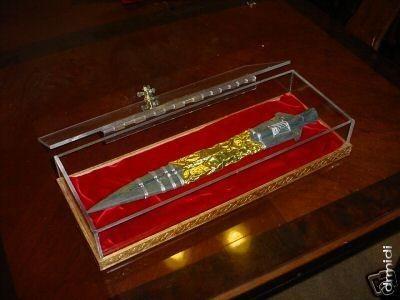
The Holy Lance (also known as the Spear of Destiny, Holy Spear, Lance of Longinus, Spear of Longinus or Spear of Christ) is the name given to the lance that pierced Jesus's side as he hung on the cross in John's account of the Crucifixion.

The Spear of Destiny, is in Christian tradition the spear that the Roman soldier Longinus thrust into the side of Jesus (c. 6 B.C.E.–c. 30 C.E.) as he hung on the cross. (“Then came the soldiers and brake the legs of the first and of the other which was crucified with him. But when they came to Jesus and saw that he was dead already, they brake not his legs: But one of the soldiers with a spear pierced his side and forthwith came out blood and water” [John 19: 32–34 KJV]).

Christian knights discovered the Holy Lance at Antioch during the First Crusade in 1098. The sight of the sacred artifact in the Church of St. Peter so inspired the beleaguered Christian soldiers that they rallied and routed the Saracens from the city. From that time forth, according to legend, whoever claims the spear and solves its secret holds the destiny of the world in his hands for good or evil. Although there are a number of relics in various European churches that claim to be the genuine Holy Lance, the spear that is on display in the Weltliches Schatzkammer Museum (the Hapsburg Treasure House Museum) in Vienna has been considered the most authentic and it has found a home there for 250 years. It is also known as Constantine’s Lance, and it was employed as a symbol of the imperial power of Holy Roman emperors at the time of their coronation in much a similar manner as the orb and scepter are used in the coronation of the monarchs of Great Britain.

According to Trevor Ravenscroft in The Spear of Destiny (1997), a 19-year-old Adolf Hitler (1889–1945) was first led to the lance in 1908 and from the moment of his first encounter with it in the museum, it became “the central pivot” in his life and the “very source of his ambitions to conquer the world.” In addition to Constantine (d. 337), Hitler found that as many as 45 emperors had owned the lance before the great Charlemagne (742–814) had possessed it. Frederick the Great of Germany (1194–1250), who founded the Teutonic Knights on which Hitler allegedly based his SS, had also been an owner of the Spear of Destiny at one time. Ravenscroft claimed in his book that Hitler would often visit the museum, stare at the Holy Lance, and enter into a trance state in which he would view his future glory as the master of the Third Reich.

Thirty years later, on March 14, 1938, Hitler arrived in Vienna to oversee the annexation of Austria. He also observed the transfer of the Hapsburg Crown Jewel collection, which included the Holy Lance, from Vienna to Nuremberg, the Nazis’ favorite city. With the Spear of Destiny now safely ensconced in Germany, Hitler declared that the war could begin in earnest. The lance would be well protected in the hall of St. Katherine’s Church, where it had once rested for nearly 400 years. However, later in the war when Allied bombers damaged a portion of St. Katherine’s, the many treasures looted by the Nazis and stored there were taken to another hiding place. In the chaos and confusion, the Holy Lance was inadvertently left behind.

The Spear of Destiny fell into the hands of U.S. soldiers on April 30, 1945. A few hours after the Holy Lance passed from Nazi possession on to its next claimant to world power, Adolf Hitler committed suicide in his Berlin bunker. Later, the United States officially returned the Holy Lance to Austria, alongwith the other treasures that the Nazis had stolen. Today, the Spear of Destiny stands again in the Hapsburg Treasure House Museum in Vienna. 


Read More on this Unsolved Mystery

Unexplained Mysteries of Kraken Monster


Kraken are mythical sea monsters of gargantuan size, said to have dwelt off the coasts of Norway and Iceland. The sheer size and fearsome appearance attributed to the beasts have made them common ocean-dwelling monsters in various fictional works . The legend may actually have originated from sightings of real giant squid that are variously estimated to grow to 13–15 m (40–50 ft) in length, including the tentacles. These creatures normally live at great depths, but have been sighted at the surface and have reportedly attacked ships.

Kraken is the definite article form of krake, a Scandinavian word designating an unhealthy animal, or something twisted. In modern German, Krake (plural and declined singular: Kraken) means octopus, but can also refer to the legendary Kraken.

The Kraken is the fabled sea monster said to have been sighted frequently off the coast of Norway; it was apparently quite capable of dragging the largest ships to the bottom and simply by submerging itself it could suck a vessel to its doom by means of the whirlpool it thereby created. Brewer says that the Kraken was first described by Erik Pontoppidan in his Natural History of Norway (1752; Pontoppidan, 1698–1764, was bishop of Bergen at the time). “Kraken” is probably from the Old Swedish kraken and the Danish krage, stump or stem of a tree, from a claimed resemblance to the infamous and decidedly uncouth monster. Pontopiddan described this creature as “a mile and a half wide.” Clearly, even allowing for regional variations in what constituted a proper Christian mile, this was a beast of no mean proportions.

Pontoppidan’s assertion that the creature’s “discharges turn the sea murky” point to the likelihood that the dreaded Kraken was nothing but a giant cuttlefish. The sea monsters of Scandinavia were of a peculiarly clerical bent: they seemed regularly to manifest themselves to seagoing clergy. Hans Egede, a Norwegian missionary (1686–1758) and later bishop of Greenland, described in 1741 a monster seen in those waters: The Monster was of so huge a Size, that coming out of the Water its Head reached as high, as the Mast-Head; its Body was as bulky as the Ship, and three or four times as long. It had a long pointed snout, and spouted like a Whale-Fish; great broad Paws, and the body seemed covered with shell-work, its skin very rugged and uneven. The under Part of its Body was shaped like an enormous huge serpent, and when it dived again under Water, it plunged backwards into the Sea and so raised its Tail aloft, which seemed a whole Ship’s Length distant from the bulkiest part of its body.

According to one of the stories, the Kraken spends its time sleeping on the seabed and feeding on huge seaworms now and then, and when the fires of hell warm the ocean beyond the point of comfort (as determined by Krakens), the beast will rise to the surface and die. Other accounts have it lounging around on the surface like an island. In 1555 Olaus Magnus (1490–1557), the Catholic archbishop of Sweden, said this monster had skin that looked so much like beach shingle that seamen were often beguiled into landing on it and cooking their food (a curious action, one would have thought, since all voyaging vessels were equipped with their own galleys for just such a purpose). 


Read more on this Unexplained Mysteries

Friday, September 3, 2010

Unsolved Mysteries of Underwater Pyramid In Japan

Submerged stone structures lying just below the waters off Yonaguni Jima are actually the ruins of a Japanese Atlantis—an ancient city sunk by an earthquake about 2,000 years ago. That's the belief of Masaaki Kimura, a marine geologist at the University of the Ryukyus in Japan who has been diving at the site to measure and map its formations for more than 15 years. 

One of the greatest discoveries in the history of archaeology was made last summer, off Japan There, spread over an amazing 311 miles on the ocean floor, are the well-preserved remains of an ancient city. Or at the very least, a number of closely related sites. A structure thought to be the world's oldest building, nearly twice the age of the great pyramids of Egypt, has been discovered. The rectangular stone ziggurat under the sea off the coast of Japan could be the first evidence of a previously unknown Stone Age civilisation, say archeologists. The monument is 600ft wide and 90ft high and has been dated to at least 8000BC. The oldest pyramid in Egypt, the Step Pyramid at Saqqara, was constructed more than 5,000 years later. The structure off Yonaguni, a small island southwest of Okinawa, was first discovered 75ft underwater by scuba divers 10 years ago and locals believed it was a natural phenomenon.

Professor Masaki Kimura, a geologist at Ryukyu University in Okinawa, was the first scientist to investigate the site and has concluded that the mysterious five-layer structure was man-made. "The object has not been manufactured by nature. If that had been the case, one would expect debris from erosion to have collected around the site, but there are no rock fragments there," he said. In the waters around Okinawa and beyond to the small island of Yonaguni, divers located eight separate locations beginning in March 1995. The discovery of what appears to be a road surrounding the building was further evidence that the structure was made by humans, he added.  


That first sighting was equivocal - a provocative, squared structure, so encrusted with coral that its manmade identity was uncertain. Then, as recently as the summer of 1996, a sports diver accidentally discovered a huge, angular platform about 40 feet below the surface, off the southwestern shore of Okinawa. The feature’s artificial provenance was beyond question. Widening their search, teams of more divers found another, different monument nearby. Then another, and another. They beheld long streets, grand boulevards, majestic staircases, magnificent archways, enormous blocks of perfectly cut and fitted stone - all harmoniously welded together in a linear architecture unlike anything they had ever seen before. 

Read more on this unsolved mystery  of world

Unexplained Mysteries of ThunderBird

ThuderBird Mysteries

Thunderbird is a term used in cryptozoology to describe large, bird-like creatures, generally identified with the Thunderbird of Native American tradition. Similar cryptids reported in the Old World are often called Rocs. Thunderbirds are regarded by a small number of researchers as having lizard features like the extinct pterosaurs such as Pteranodon. Although reports of Thunderbird sightings go back centuries, due to the lack of scientific evidence (such as a fossil record), the creature is generally regarded as a myth.

The Thunderbird figures prominently in the traditions of many Native American tribes. For some, it is the flapping of the Thunderbird’s wings that one hears during rainstorms rumbling in the skies and it is the Thunderbird’s eyes and beak that flash the lightning. To the Lakota of the prairie, the Thunderbird is an embodiment of the Great Mystery, the Supreme Being, which created all things on Earth. For the tribes of the Iroquois Confederacy of the northeast, Hino, the Thunderbird, guardian of the skies and the spirit of thunder, could assume the form of a human when it suited its purpose. The cosmology of many of the western tribes establish a Thunderbird in each of the four corners of the world as guardians and protectors, fighting always to keep away evil spirits. Many scholars over the centuries have attributed the Native American myths of the Thunderbird to their reverence for the eagle, the largest of indigenous birds in North America. Interestingly, however, many people have claimed to have seen for themselves a great bird, far larger than the eagle, flying overhead. In fact, even in the nineteenth century, some witnesses were claiming to have seen flying monsters that resembled pterodactyls, the winged reptiles that should have been extinct 60 million years ago. On April 9, 1948, a farm family outside of Caledonia, Illinois, saw a monster bird that they all said was bigger than an airplane. In different parts of the state on the same day, a Freeport truck driver said that he, too, had seen the creature.

The Thunderbird is a legendary creature in certain North American indigenous peoples' history and culture. It's considered a "supernatural" bird of power and strength. It is especially important, and richly depicted, in the art, songs and oral histories of many Pacific Northwest Coast cultures, and is found in various forms among the peoples of the American Southwest and Great Plains. Thunderbirds were major components of the Southeastern Ceremonial Complex of American prehistory

A former army colonel admitted that he had seen a bird of tremendous size while he stood talking with the head of Western Military Academy and a farmer near Alton. On April 10, several witnesses saw the gigantic bird. One man said that he had at first believed it to be a type of plane that he had never before seen. On April 24, back at Alton, a man described it as an enormous, incredible thing, flying at about 500 feet and casting a shadow the same size as that of a Piper Cub at the same height. Two policemen said that the monster bird was as big as a small airplane. Giant Thunderbird-type creatures have continued to be sighted in various parts of the United States, from the northeast to the northwest and many points in between. 

Read more at  http://theunexplainedmysteries.com/Thunderbird.html

Tuesday, August 31, 2010

Unsolved Mysteries of World - Bimini Road

Atlantis Bimini Road

Bimini is an island in the Bahamas, 55 miles east of Miami, Florida, approximately 7 miles long and 1/3 mile across at its widest point. Its modern inhabitants are descendants of West African slaves imported by Spain and Britain beginning in the mid-16th century. They replaced the resident Caribs, who arrived only a few generations before and after whom the Caribbean Sea was named. Bellicose cannibals from Middle America’s mainland, the Caribs feasted on the island’s earliest known inhabitants, the Lucayans, a linguistic branch of Arawak Indians. Before their extermination (consumption?), the Lucayans were described by Spanish explorers as able craftsmen (surviving Lucayan celts and hammer-stones attest to their refined skills), with noticeably lighter complexions and auburn hair, even occasional blue eyes. These untypical traits may have been genetic traces of contacts with pre-Columbian visitors from Europe, or even racial evidence for an Atlantis pedigree, in view of the following information. The origin and meaning of “Bimini” are unknown. However, the name appears in the Ancient Egyptian language as Baminini, which means, “Homage (ini) to the Soul (ba) of Min.” Min was the Egyptians’ divine protector of travelers on far-off journeys, a particularly appropriate god to be worshiped at distant Bimini, if indeed the island had been visited by voyagers from the Nile Valley.

Material evidence for an Egyptian or, at any rate, an Egyptian-like presence in the western Atlantic appeared during the late 1930s, when James Lockwood, Jr., an American archaeologist in Haiti, saw a stone statue of the ancient Egyptian god of the dead, Anubis, that had been discovered on an off-shore island. The Lucayans knew Bimini as “Guanahani,” another curious connection with the Ancient World, because the name translates as “the Island (hani) of Men (guana)” in the language of the Guanches. These were native inhabitants of the Canary Islands, off the northwest coast of North Africa, until their utter demise at the hands of the Spanish in the 15th and 16th centuries.

Although no monumental buildings were found on Bimini, in Arawak, Guanahani meant “the Place of the Encircling Walls”; in Arawak, hani was also synonymous for “crown” or “wreath.” This oldest known name for the island may have referred to a large stone formation lying in 19 feet of water less than 2 miles off Bimini’s northernmost point. It is composed of so far unnumbered but certainly no less than 5,000, mostly square-cut blocks running in a straight line for about 1,900 feet, before swinging back on itself to create a J-formation. To early observers, it resembled a paved road running across the bottom of the sea. But the general consensus of investigators since then tentatively identifies the structure as a cyclopean wall, not unlike Andean examples found in Peru, specifically, at Cuzco and Sacsahuaman.

bermudas atlantis bimini road

Unfortunately, it continues to be known by its first and misleading appellation. In 1933, Edgar Cayce, during one of his trance states, said that records from Atlantis still existed “where a portion of the temples may yet be discovered, under the slime of ages of sea water—near what is known as Bimini.” The little island was not Atlantis itself, he explained, but its outpost, known many thousands of years ago as Alta, extending (politically) to east-coastal Florida, and part of a wider Atlantean administration known as Poseidia, comprising the Lesser Antilles. In 1940, the “Sleeping Prophet” predicted, “Poseidia will be among the first portion of Atlantis to rise again. Expect it in ’68 and ’69; not so far away!” The so-called “Bimini Road” was, in fact, “discovered” in 1968 by maverick archaeologist Mason Valentine, while looking for Atlantean remains around the island in hopes of confirming Cayce’s prophesy. .
Read more at Unsolved Mysteries of World  

Monday, August 30, 2010

The Lost Treasure of King Juba

King Juba Lost TreasureJuba II was the monarch of a North African kingdom known as Mauretania, comprising most of modern Morocco and western Algeria. After Emperor Caligula murdered his son in A.D. 39, the Romans invaded Mauretania to seize his golden fortune. But they never found it. Nearly 2,000 years later, a buried treasure surrounded by Roman-era artifacts came to light in the American Midwest. Could this apparently ancient trove have been the lost exchequer of King Juba, concealed nearly fifteen centuries before Columbus landed on America continent?

In the extreme northeast corner of Richland County, in southern Illinois, bends an elbow of the River Embarras, branching from its bigger sister, the Wabash. An infrequently visited site, certainly unknown outside its immediate vicinity, was hardly more than a hole in the ground. But the opening, about ten feet wide and eight feet from ceiling to roof, was large enough for infrequent local visitors to stoop through a kind of natural corridor running about 15 feet into the side of a hill perhaps three-quarters of a mile from the south bank of the Embarras.

On April 2, 1982, a 47-year-old “caver” entered its dark recesses outfitted with flashlight, pick-hammer and knapsack. Nineteen years later, Russell Burrows publicly presented a detailed description of the events of April 2 before an international archaeology conference in the Vienna Art Center, Austria. “The cave itself is 535 feet deep to its terminal breakdown,” he said. The down-angle is six degrees. The artifacts which he recovered were located in the silt on the most part. However, some were recovered from niches and shelves along the walls. Also to be seen are lamps cut out of knobs of rock on the walls. There are several of these lamps, since they seem to be positioned every fifteen or twenty feet. The area above these lamps is blackened by smoke from the lamps, which most likely burned animal fat or oil of some kind.


Read more on this hidden treasure at http://theunexplainedmysteries.com/Lost-Treasure-of-King-Juba.html

Thursday, August 12, 2010

Friday the 13th - Scary Urban Legends

By the numbers

Here are 13 more facts about the infamous day, courtesy of Fernsler and some of our own research:

1. The British Navy built a ship named Friday the 13th. On its maiden voyage, the vessel left dock on a Friday the 13th, and was never heard from again.

2. The ill-fated Apollo 13 launched at 13:13 CST on Apr. 11, 1970. The sum of the date's digits (4-11-70) is 13 (as in 4+1+1+7+0 = 13). And the explosion that crippled the spacecraft occurred on April 13 (not a Friday). The crew did make it back to Earth safely, however.

3. Many hospitals have no room 13, while some tall buildings skip the 13th floor.

4. Fear of Friday the 13th - one of the most popular myths in science - is called paraskavedekatriaphobia as well as friggatriskaidekaphobia. Triskaidekaphobia is fear of the number 13.

5. Quarterback Dan Marino wore No. 13 throughout his career with the Miami Dolphins. Despite being a superb quarterback (some call him one of the best ever), he got to the Super Bowl just once, in 1985, and was trounced 38-16 by the San Francisco 49ers and Joe Montana (who wore No. 16 and won all four Super Bowls he played in).

6. Butch Cassidy, notorious American train and bank robber, was born on Friday, April 13, 1866.

7. Fidel Castro was born on Friday, Aug. 13, 1926.

8. President Franklin D. Roosevelt would not travel on the 13th day of any month and would never host 13 guests at a meal. Napoleon and Herbert Hoover were also triskaidekaphobic, with an abnormal fear of the number 13.

9. Superstitious diners in Paris can hire a quatorzieme, or professional 14th guest. Another scary legend of friday-the-13th

10. Mark Twain once was the 13th guest at a dinner party. A friend warned him not to go. "It was bad luck," Twain later told the friend. "They only had food for 12."

11. Woodrow Wilson considered 13 his lucky number, though his experience didn't support such faith. He arrived in Normandy, France on Friday, Dec. 13, 1918, for peace talks, only to return with a treaty he couldn't get Congress to sign. (The ship's crew wanted to dock the next day due to superstitions, Fernsler said.) He toured the United States to rally support for the treaty, and while traveling, suffered a near-fatal stroke. The scary legend of Friday the 13th continues.

12. The number 13 suffers from its position after 12, according to numerologists who consider the latter to be a complete number - 12 months in a year, 12 signs of the zodiac, 12 gods of Olympus, 12 labors of Hercules, 12 tribes of Israel, 12 apostles of Jesus, 12 days of Christmas and 12 eggs in a dozen.

13. The seals on the back of a dollar bill include 13 steps on the pyramid, 13 stars above the eagle's head, 13 war arrows in the eagle's claw and 13 leaves on the olive branch. So far there's been no evidence tying these long-ago design decisions to the present economic situation.

Origins of Friday the 13th

Where's all this superstition come from? Nobody knows for sure. But it may date back to Biblical times (the 13th guest at the Last Supper betrayed Jesus). By the Middle Ages, both Friday and 13 were considered bearers of bad fortune.

Meanwhile the belief that numbers are connected to life and physical things - called numerology - has a long history.

"You can trace it all the way from the followers of Pythagoras, whose maxim to describe the universe was 'all is number,'" says Mario Livio, an astrophysicist and author of "The Equation That Couldn't Be Solved" (Simon & Schuster, 2005). Thinkers who studied under the famous Greek mathematician combined numbers in different ways to explain everything around them, Livio said.

In modern times, numerology has become a type of para-science, much like the meaningless predictions of astrology, scientists say.

"People are subconsciously drawn towards specific numbers because they know that they need the experiences, attributes or lessons, associated with them, that are contained within their potential," says professional numerologist Sonia Ducie. "Numerology can 'make sense' of an individual's life (health, career, relationships, situations and issues) by recognizing which number cycle they are in, and by giving them clarity."

Mathematicians dismiss numerology as having no scientific merit, however.

"I don't endorse this at all," Livio said, when asked to comment on the popularity of commercial numerology for a story prior to the date 06/06/06. Seemingly coincidental connections between numbers will always appear if you look hard enough, he said.

Friday the 13th, the most widespread superstition

The sixth day of the week and the number 13 both have foreboding reputations said to date from ancient times, and their inevitable conjunction from one to three times a year (there happen to be three such occurrences in 2009, two of them right in a row) portends more misfortune than some credulous minds can bear. According to experts it's the most widespread superstition in the United States today. Some people won't go to work on Friday the 13th; some won't eat in restaurants; many wouldn't think of setting a wedding on the date.

How many Americans at the turn of the new millennium actually suffer from this condition? According to Dr. Donald Dossey, a psychotherapist specializing in the treatment of phobias (and coiner of the term paraskevidekatriaphobia, also spelled paraskavedekatriaphobia), the figure may be as high as 21 million. If he's right, eight percent of Americans are still in the grips of a very old superstition.

Exactly how old is difficult to say, because determining the origins of superstitions is an inexact science, at best. In fact, it's mostly guesswork.

LEGEND HAS IT:

If 13 people sit down to dinner together, one will die within the year. The Turks so disliked the number 13 that it was practically expunged from their vocabulary (Brewer, 1894). Many cities do not have a 13th Street or a 13th Avenue. Many buildings don't have a 13th floor. If you have 13 letters in your name, you will have the devil's luck (Jack the Ripper, Charles Manson, Jeffrey Dahmer, Theodore Bundy and Albert De Salvo all have 13 letters in their names). There are 13 witches in a coven.

Although no one can say for sure when and why human beings first associated the number 13 with misfortune, the superstition is assumed to be quite old, and there exist any number of theories — most of which deserve to be treated with a healthy skepticism, please note — purporting to trace its origins to antiquity and beyond. 


Read complete story at http://theunexplainedmysteries.com/friday-the-13th.html

Friday, July 16, 2010

Sicily Crypts: Place Where The Dead Don't Sleep

 
A Haunting Experience in Palermo Catacomb

It has been said that Sicilians have an obsession with death. It is still very common to see elderly Sicilian widows wearing black for the remainder of their lives and a tradition of professional mourners once existed for centuries. It is hard to say where this cult of the dead comes from, either from the deep rooted Catholic faith or perhaps a holdover from ancient Greek and Roman times. Regardless of the origins, notions about death are still alive in Sicily, and no place better exemplifies this than Palermo's Capuchin Crypt. This macabre display is one of a mummy.

The Capuchin Order is an offshoot of the more famous Franciscans that branched out in the mid sixteenth century. Their names comes from the distinctive hood that the monks wear that has since lent its name to the popular coffee drink Cappuccino, whose foamed milk top it resembles. Even though this Order of the Friars Minor originated in the Marche region of Italy, their unique take on the mortal body after death make them a perfect fit for Sicily. In fact the first monk to be embalmed was placed in the crypt shortly after the Order arrived in Palermo.

Entrance to the Crypt is located at Piazza Cappuccini, which is a short walk from the Palazzo Reale. It is an unassuming building that conforms to the Order's vow of poverty and may be overlooked if you miss the signs. On arriving you may be greeted by the elderly monk who watches over the crypt as he gestures toward the cool and dark stairway that leads to the crypt. As you walk down the steps one is reminded of Dante's inscription above the gates of hell: "Abandon all hope, ye who enter here." 
 
 
Once inside the crypt feels more like the set for "Night of the Living Dead" or Michael Jackson's "Thriller" than a religious community. No horror movie or amusement park haunted house can compete with hundred of bodies dressed in their Sunday's best and suspended by hooks on the wall. The bodies, in various levels of decay stare down (some with their own eyes) looking like they are ready to grab you, wanting you to join them.

A creepy, eerie feeling surrounds you as you walk along the halls. Suddenly the ghostly voice of a monk echoes through the chamber stating "no photo." It makes you wonder why anyone would want to take pictures in the first place. If ghosts could be caught on film, it would certainly be here. 
 

Wednesday, June 23, 2010

Bigfoot In Burke County? Residents Discover Mysterious Footprintt

A group of researchers affiliated with legendary Big Foot Hunter Tom Biscardi left North Carolina Sunday after spending Saturday night camped out in the woods near Highway 18, south of Morganton, to investigate a recent footprint sighting.

The researchers set up cameras but said they didn’t find anything. They told Eyewitness News that they will evaluate what they do have and determine if they will return to look again. Group members said they believe the footprint, which was discovered by a farmer, is real because it shows dermal ridges like a hand print and a mid tarsal break, which is evidence of a foot that bends in the middle, unlike that of a human.

Robert Price was in Hickory with two other Alabama researchers to compare a track found recently in Burke County to one found in Texas.

“The possibility is definitely there," he said. "It's not to be overlooked."

The large, muddy and mysterious footprint has captured imaginations in the area.

A farmer said he recently stumbled across a larger-than-life footprint near the intersection of Highway 18 and George Hildebran School Road in the southern part of Burke County. Pork Lowman said he was walking in the woods when he came across the print, which measures 15 by 8 inches.

“It's out here in no-man's land, and that's what really got me,” Lowman said. 


Read more at http://theunexplainedmysteries.com/bigfoot-foot-prints.html

LinkWithin

Related Posts with Thumbnails