Showing posts with label unexplained mysteries. Show all posts

Sunday, March 9, 2014

Whipping Tom: The Weird, Serial Spanker Of London


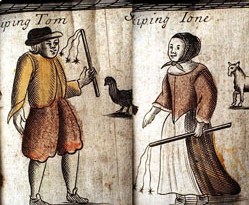
Whipping Tom was a mysterious man who wandered the streets of London in 1680. He shocked 17th-century society by lunging at women, lifting their dresses, and spanking their bums while shouting “Spanko!” before escaping capture. At one point, things got so bad that armed men would patrol the streets dressed as women in the hopes of drawing him out.Almost 200 years before Jack the Ripper stalked the streets of London, there was a much more hilarious monster terrifying society. He was given the name of Whipping Tom because this monster’s modus operandi was the spanking of young women’s bums. He would allegedly attack without warning, spanking ladies on the bottom while shouting “Spanko!” and then elude all attempts to capture him. He was so quick and slippery that some people even claimed he used supernatural powers in his escape. It was this sort of behavior that earned him the title “The enemy of milk wenches’ bums everywhere.”

Mostly Tom would use his hands to carry out a spanking but sometimes he would use a birch rod, attacking quickly, tipping them over his knee so that they couldn’t get away as he gleefully laid a smackdown on their derrieres and then be gone in an instant while his victim sat there confused as to what had just happened.

"Whipping Tom" was the nickname given to two sexual attackers in London and the nearby village of Hackney. Both would attack women walking alone and beat them on the buttocks. While there is some evidence that an earlier attacker in around 1672 was also nicknamed "Whipping Tom" and carried out similar attacks on women, the earliest recorded attacker of this nature was active in central London in 1681. He would approach unaccompanied women in alleys and courtyards and spank them on the buttocks, before fleeing. The inability of the authorities to apprehend the offender caused complaints about the ineffectiveness of London's constabulary, and prompted vigilante patrols in the affected areas. A local haberdasher and his accomplice were captured and tried for the attacks.

Whipping Tom: The Weird, Serial Spanker Of London

Rokurokubi - Long Neck Japanese Legendary Ghosts


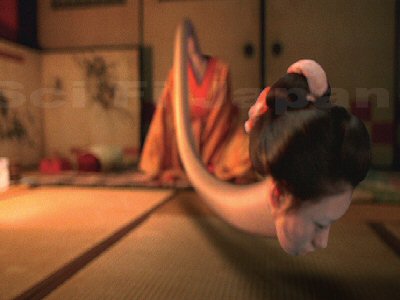
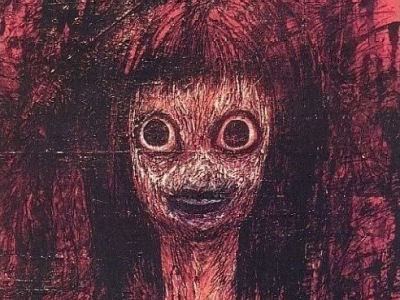
Rokurokubi which are related to Nure-onna are yokai found in Japanese folklore. They look like normal human beings by day, but at night they gain the ability to stretch their necks to great lengths. They can also change their faces to those of terrifying Oni to better scare mortals.

In their daytime human forms, rokurokubi often live undetected and may even take mortal spouses. Many rokurokubi become so accustomed to such a life that they take great pains to keep their demonic forms secret. They are tricksters by nature, however, and the urge to frighten and spy on human beings is hard to resist. Some rokurokubi thus resort to revealing themselves only to drunkards, fools, the sleeping, or the blind in order to satisfy these urges. Other rokurokubi have no such compunctions and go about frightening mortals with abandon. A few, it is said, are not even aware of their true nature and consider themselves normal humans. This last group stretch their necks out while asleep in an involuntary action; upon waking up in the morning, they find they have weird dreams regarding seeing their surroundings in unnatural angles.

According to some tales, rokurokubi were once normal human beings but were transformed by karma for breaking various precepts of Buddhism. Often, these rokurokubi are truly sinister in nature, eating people or drinking their blood rather than merely frightening them. These demonic rokurokubi often have a favored prey, such as others who have broken Buddhist doctrine or human men.

Tanuki often imitated rokurokubi when playing practical jokes on people. In a folktale collected for his book, Kwaidan by Lafcadio Hearn, the nukekubi is misidentified as rokurokubi, an error that also appears in the Fighting Fantasy book, Sword of the Samurai, and in Stephen Dedman's novel The Art of Arrow-Cutting. The nukekubi is a similar but slightly different being from Japanese folklore belonging to the same overall class; instead of necks that stretch, the nukekubi have heads that completely detach. The book Even More Short & Shivery by Robert D. San Souci has a tale called Rokuro-kubi, but, again, the descriptions in the book are nukekubi, not rokurokubi.

Thursday, February 27, 2014

La Pascualita – The Mexican Corpse Bride

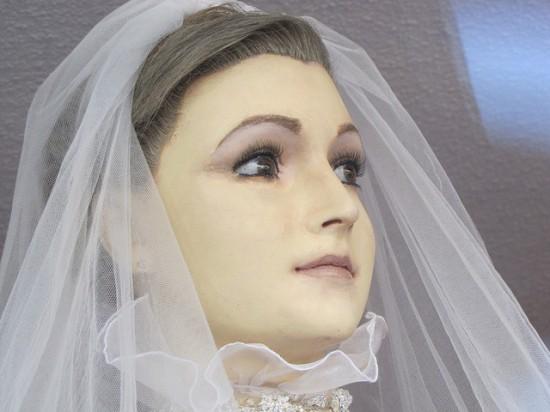
La Pascualita or Little Pascuala is a bridal mannequin that has “lived” in a store window in Chihuahua, Mexico for the past 75 years. That is quite a long time for a bridal gown shop to retain a mannequin, but then the dummy has a rather strange history behind it. According to an urban legend, La Pascualita isn’t a dummy at all, but the perfectly preserved corpse of the previous owner’s daughter.

Peering through the glass at a mannequin's veined hands, sparkling eyes and eerie smile, the small crowd gathered outside a store in northern Mexico tries to settle a macabre riddle beguiling many.Is the tall, slender bridal figure in the window a richly detailed shop's dummy or, as a local legend says, the decades-old embalmed corpse of the former store owner's daughter?.

The haunting figure known as 'La Pascualita,' or 'Little Pascuala' first appeared 75 years ago in the window of the bridal gown store in the city of Chihuahua.Since then, the striking realism of the dummy has spawned supernatural tales and reports of a miracle, and even inspired a foot-stomping accordion ballad played on local radio.

The figure has drawn a stream of people from across the desert state of Chihuahua over the past eight decades, and is now attracting curious visitors from South America, the United States and Europe, the owners of the La Popular store say.As cars and trucks rumble by the shop on a busy city street, the entranced visitors smudge their noses up against the store window and try to decide for themselves if it's a corpse.

"She looks good for all the years that she's been here," Yolanda Robles, who trekked to the shop out of curiosity from Phoenix, Arizona, said as she studied the rosary-clutching figurine."There are just so many details, like her hair and the nails on her hand, that it just has to be true," she added.


La Pascualita – The Mexican Corpse Bride

Trauco and La Fiura - Sex Demons That You Never Knew Existed

Chiloé, an island off the south of Chile, is said to be home to the Trauco, a sexually potent Dwarf with the power to paralyze women with a look, before having sex with them. The Trauco is described as being ugly and goblin-like, often wearing a hat and suit. His feet are stumps and he communicates through a series of grunts. Some reports suggest the Trauco doesn’t even need to have intercourse with his victims, that he can, in fact, impregnate them with his gaze.

Often, when a single woman on Chiloé falls pregnant people assume the Trauco is the father. In these cases the women are considered blameless as the Trauco is said to be irresistible to women.


El Trauco’s wife, La Fiura, is said to be a grotesquely ugly dwarf with the ability to cast a “sickness spell” against anyone who rejects her sexual advances. Her breath is so foul it can physically scar a human and turn animals lame. Despite her appearance, she is generally irresistible to men and, after having intercourse with them, she drives them insane.


The Trauco is a mythical entity who inhabits the woods of Chiloé, an island in the south of Chile. It has a powerful magnetism that attracts young and middle-aged women. According to myth, the Trauco's wife is the wicked and ugly Fiura. The trauco carries a small stone-headed hatchet that he uses to strike trees in the forest to symbolize his sexual potency.


Whoever the Trauco chooses will go to him, even if she is sleeping, and fall enraptured at his feet. No woman can resist his magical attraction; all have sexual intercourse with him. Men of Chiloé fear the Trauco, as his gaze can be deadly.


When a single woman is pregnant and no one steps forward as the father, people assume that the Trauco is the father. Because the Trauco is irresistible, the woman is considered blameless. The Trauco is sometimes invoked to explain sudden or unwanted pregnancies, especially in unmarried women.


http://theunexplainedmysteries.com/Trauco-and-La-Fiura-Demons.html

Japanese Scary legends - Japanese Urban Legends


Various types of folklore can be found all over the world. Japan in particular has some very interesting, as well as creepy urban legends. The majority of them are based on onryo, or vengeful spirits that have had something unfortunate or tragic happen to them when they were alive and who let their anger out on innocent victims- often by frightening and/or killing them.


Tek Tek or Teke-Teke


Tek Tek or Teke-Teke


Tek Tek or Teke-Teke is an urban legend from Japan about a girl who fell under a train and was cut in half. She took a long time todie and now her ghost roams through Japan, dragging her top half along using her claw-like hands. Every time she moves, she makes a "teke-teke" sound.

There is a story about a young boy who was leaving his school one evening when he heard a noise behind him. Looking back, he saw a beautiful girl sitting at a window. The girl had her arms propped up on the window sill and was just staring out at him. He wondered why she was there, because it was an all-boys school. When she saw him looking back at her, the girl smiled and hugged herself so that she was holding her elbows. Then suddenly, she leaped out of the window and landed on the ground outside. The boy realized with horror, that she was missing the lower half of her body.

She made her way towards him, clawing along the ground and running on her elbows making a tek-tek-tek-tek-tek sound. The boy was filled with terror and revulsion. He tried to run, but he was frozen to the spot. Within seconds, she was upon him and she took out a scythe and cut him in half, making him into one of her own. When kids tell this story, they warn each other about Tek-Tek. They say she carries a sharp saw or a scythe, and if she catches you, she'll cut you in half and you'll become just like her. She is said to chase children who play at dusk. She is also known as "bata-bata" (again, the sound of it running on its (elbows) or ; The Girl That Runs On Her Elbows.

Aka Manto (Red Cape)

Aka Manto 
 
http://theunexplainedmysteries.com/Japanese-Urban-Legends.html

The Real Life Legend of Slender Man

There are legends and myths that have been around for centuries and have seared themselves into our minds and culture. Then there are those that have been brought to life by way of modern technologies reminding us of nightmares that should have been buried and forgotten. One such legend is known through internet popularity as Slender man.

The creature known as Slender man is said to have the appearance of a tall, lanky man in a black suit. Not so scary, right? Just wait.

He towers at six to seven feet with unusually thin limbs. His face, if you can call it that, is featureless and white, though some say that it can morph into whatever you fear the most. His arms, however, can stretch out to grab his victims and bend in unnatural ways with long, talon-like fingers used to scratch at the windows of children. Yes that’s right. While he haunts everyone who has the misfortune to see him, he prefers to devour those that are 16 and younger. He is also said to have multiple arms sometimes seen as long tentacles used to ensnare whomever catches his eye, or should I say, the void where his face should be.

Slender man is a silent stalker that likes to hide in plain sight and is usually spotted in wooded areas where he could blend in amongst the trees and dark corners of the forest. When he finds his victim of choice, he follows them home and upon being seen through the window, can use a form of hypnosis that compels you to walk right into his spindly arms. Usually glimpsed at a distance, once he’s close enough to get a good look at, that’s when he slinks into your home appearing in dark hallways or blank t.v. screens. American legend says that he was once a man who was tortured viciously, first being beaten with a log, then impaled with a 2 foot stick and hung from a tree with his arms and legs pulled from their sockets.

When captured, you will wake to find Slender man standing above you. He will ask one question and if you’re lucky and get it right, he breaks both your arms and legs. But if you are wrong, then he slowly sticks his fingers down your throat pulling out the heart. In circles on the internet Slender man is claimed to be the creation of a website called Somethingawful.com. Many say that this alone debunks the mysterious legend and closes the case on the creature’s fictitious existence. Well, not quite.

It appears that the Slender man myth goes back a lot farther than is claimed. He is based on something called Der Grossman, meaning “tall man”, which is the Germanic version. Legend says that children would site him in the Black Forest days before their disappearance. All that was left behind would be the mutilated remains of livestock and in a few cases, village inhabitants would be found several miles from their homes impaled on the higher branches of the trees. 


http://theunexplainedmysteries.com/SlenderMan-Legends.html

Tuesday, September 17, 2013

Okiku - Ghost Story of Japanese Haunted Devil Doll

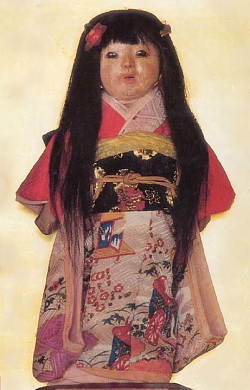
The haunted japanese doll Okiku, possessed by the spirit of a 10 year old girl who took refuge inside it. Some time after the funeral of the girl, the hair of the doll began to grow. Although the doll’s hair is cut regularly, the hair grows again and again. A mysterious doll possessed by the spirit of a child has captured the curiosity of people across Japan for decades. The legendary Okiku doll, named after the girl who long ago used to play with it, is a 40-centimeter (16-in) tall kimono-clad figure with beady black eyes -- and hair that grows.

The Okiku doll has resided at the Mannenji temple in the town of Iwamizawa (Hokkaido prefecture) since 1938. According to the temple, the traditional doll initially had short cropped hair, but over time it has grown to about 25 centimeters (10 in) long, down to the doll's knees. Although the hair is periodically trimmed, it reportedly keeps growing back.

It is said that the doll was originally purchased in 1918 by a 17-year-old boy named Eikichi Suzuki while visiting Sapporo for a marine exhibition. He bought the doll on Tanuki-koji -- Sapporo's famous shopping street -- as a souvenir for his 2-year-old sister, Okiku. The young girl loved the doll and played with it every day, but the following year, she died suddenly of a cold. The family placed the doll in the household altar and prayed to it every day in memory of Okiku.

Some time later, they noticed the hair had started to grow. This was seen as a sign that the girl's restless spirit had taken refuge in the doll.

This doll was originally purchased in 1918 by a Eikichi Suzuki in Sapporo, where he saw a beautiful Japanese doll with a Kimono. Eikichi bought this doll for her sister, who is two years old named Okiku. She loved this doll and play it every day. But unfortunately, Okiku died shortly afterwards of a fever. Then at his funeral, family want to put a doll into his coffin, but somehow they forgot. The girl’s family then put the doll on the household altar and pray for every day in order to commemorate Okiku. Some time later, they saw the hair began grows. According to this story is the spirit of the girl who took refuge inside the doll. 


Okiku - Ghost Story of Japanese Haunted Devil Doll

Shugborough Inscription - Shepherd’s Monument Inscription

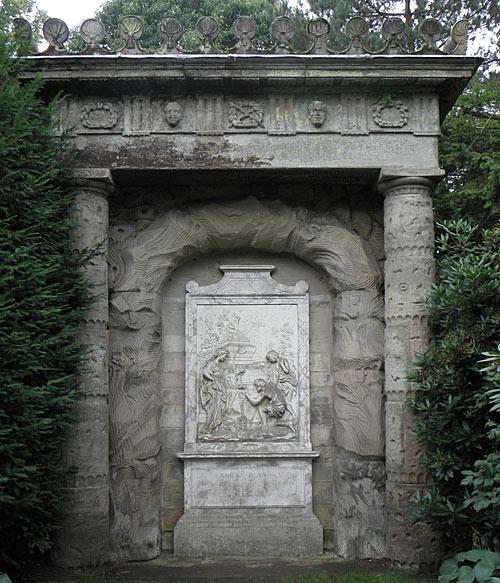
In Staffordshire, England, there is a sculpture that has invited the wits and intellect of many intellectuals in an attempt to decode an inscription reading DOUOSVAVVM. Although the Shepherd’s Monument was constructed back in the 18th century, the letters found therein were never solved, even 250 years after it was completed. The Shugborough inscription is a sequence of letters - O U O S V A V V, between the letters D M - carved on the 18th-century Shepherd's Monument in the grounds of Shugborough Hall in Staffordshire, England, below a mirror image of Nicolas Poussin's painting, the Shepherds of Arcadia. It has never been satisfactorily explained, and has been called one of the world's top uncracked ciphertexts. The inscription became widely known after being mentioned in the 1982 book The Holy Blood and the Holy Grail by Michael Baigent, Richard Leigh, and Henry Lincoln.


Shugborough_inscription


The monument was built sometime between 1748 and 1763, commissioned by Thomas Anson, paid for by his brother, Admiral George Anson, and fashioned by the Flemish sculptor Peter Scheemakers. The relief copy of the Poussin painting is contained within a rustic arch, and shows a woman and three shepherds, two of whom are pointing to a tomb. On the tomb is carved the Latin text Et in arcadia ego ("I am also in Arcadia" or "I am, even in Arcadia"). The carving displays a number of small alterations from the original painting, and an extra sarcophagus has been placed on top of the main tomb. Above the Poussin scene are two stone heads, one showing a smiling bald-headed man, the other bearing a likeness to the goat-horned Greek god Pan. 


 Shugborough Inscription - Shepherd’s Monument Inscription

Thursday, August 22, 2013

Mummy Juanita - Inca Girl Frozen For 500 Years

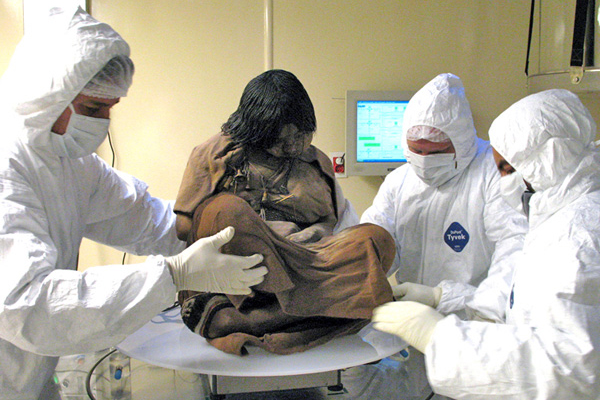
Initially this might look to you like any normal girl being treated by a doctor,the girl in the photo is not any normal living girl but the mummy of a 15 year old child who has been dead for about 500 years.

She was found in 1999 near Llullaillaco's 6739 meter summit. An Argentine-Peruvian expedition found the perfectly preserved body and she was nicknamed "La doncella" which means “The maiden”. According to the Inca she was chosen to go and live with the gods. But in reality she was a sacrifice to the Inca Gods and had been brutally killed in the name of religion.

Scientists say that her organs are intact and its as if she had died just a few weeks ago. From testing the samples of her hair they could determine the type of diet she was on before her death. This lead to the discovery that the Incan fattened their children before killing them. Months or even years before the sacrifice pilgrimage these children were given diets which were those of the elite, consisting of maize and animal proteins.

Judging from the condition of the body, it is believed that she was drugged and left to die in the mountains. It would not have taken much time for her to die due to the high exposure. The Incan high priests took their victims to high mountaintops for sacrifice. As the journey was extremely long and arduous, especially so for the younger victims, coca leaves were fed to them to aid them in their breathing so as to allow them to reach the burial site alive. Upon reaching the burial site, the children were given an intoxicating drink to minimize pain, fear, and resistance, then killed them either by strangulation, a blow to their head or by leaving them to lose consciousness in the extreme cold and die of exposure. 


Mummy Juanita - Inca Girl Frozen For 500 Years

Wednesday, July 3, 2013

The Curse of Macbeth

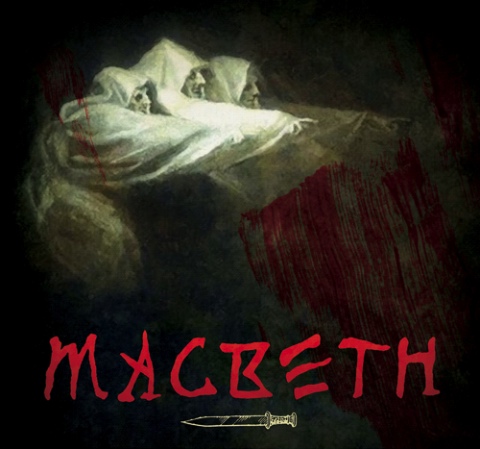
The Scottish Play and the The Bard's Play are euphemisms for William Shakespeare's Macbeth. The first is a reference to the play's Scottish setting, the second a reference to Shakespeare's popular nickname. According to a theatrical superstition, called the Scottish curse, speaking the name Macbeth inside a theatre will cause disaster. A variation of the superstition forbids direct quotation of the play (except during rehearsals) while inside a theater.

Because of this superstition, the lead character is most often referred to as the Scottish King or Scottish Lord. Sometimes Mackers is used to avoid saying the name, mostly in North America.

As success or failure in the theater can be influenced by so many intangible and unpredictable factors, it's not surprising that actors and other theater types maintain a variety of long-standing superstitions, which often are taken very seriously. (The most famous is the insistence on saying "break a leg" rather than "good luck.")

Two such superstitions float around Macbeth. The first is that it's bad luck to even say “Macbeth” except during rehearsal or performance. When referring to the work one instead uses circumlocutions, such as “the Scottish play” or “Mackers” or “the Scottish business” or “the Glamis comedy” or just “that play." Some say this rule applies only when inside a theater; it’s OK, therefore, to use the dread name in other settings – like classrooms, for instance.

The remedy, if someone does happen to utter the unutterable, is to leave the room, close the door, turn around three times, say a dirty word (or spit, some say), then knock on the door and ask to be let back in. If you can’t do all that, you simply quote from Hamlet, act 1, scene 4: “Angels and ministers of grace defend us!”

The second superstition is that the play itself brings ill luck to cast and crew, and many productions of Macbeth have, in fact, encountered unfortunate circumstances. The supposed origin story for this is that Shakespeare used “authentic” witches’ chants in the play; as punishment, real witches cast a curse on the play, condemning it for all time. 


The Curse of Macbeth

The Real Life Legend of Slender Man

There are legends and myths that have been around for centuries and have seared themselves into our minds and culture. Then there are those that have been brought to life by way of modern technologies reminding us of nightmares that should have been buried and forgotten. One such legend is known through internet popularity as Slender man.

The creature known as Slender man is said to have the appearance of a tall, lanky man in a black suit. Not so scary, right? Just wait.

He towers at six to seven feet with unusually thin limbs. His face, if you can call it that, is featureless and white, though some say that it can morph into whatever you fear the most. His arms, however, can stretch out to grab his victims and bend in unnatural ways with long, talon-like fingers used to scratch at the windows of children. Yes that’s right. While he haunts everyone who has the misfortune to see him, he prefers to devour those that are 16 and younger. He is also said to have multiple arms sometimes seen as long tentacles used to ensnare whomever catches his eye, or should I say, the void where his face should be.

Slender man is a silent stalker that likes to hide in plain sight and is usually spotted in wooded areas where he could blend in amongst the trees and dark corners of the forest. When he finds his victim of choice, he follows them home and upon being seen through the window, can use a form of hypnosis that compels you to walk right into his spindly arms. Usually glimpsed at a distance, once he’s close enough to get a good look at, that’s when he slinks into your home appearing in dark hallways or blank t.v. screens. American legend says that he was once a man who was tortured viciously, first being beaten with a log, then impaled with a 2 foot stick and hung from a tree with his arms and legs pulled from their sockets.

When captured, you will wake to find Slender man standing above you. He will ask one question and if you’re lucky and get it right, he breaks both your arms and legs. But if you are wrong, then he slowly sticks his fingers down your throat pulling out the heart. In circles on the internet Slender man is claimed to be the creation of a website called Somethingawful.com. Many say that this alone debunks the mysterious legend and closes the case on the creature’s fictitious existence. Well, not quite.

It appears that the Slender man myth goes back a lot farther than is claimed. He is based on something called Der Grossman, meaning “tall man”, which is the Germanic version. Legend says that children would site him in the Black Forest days before their disappearance. All that was left behind would be the mutilated remains of livestock and in a few cases, village inhabitants would be found several miles from their homes impaled on the higher branches of the trees. 


The Real Life Legend of Slender Man

Hell Fire Club Secret Society - Sex, Satanism and Secret Societies

The Hellfire Club was a name for several exclusive clubs for high society rakes established in Britain and Ireland in the 18th century, and was more formally or cautiously known as the Order of the Friars of St. Francis of Wycombe. These clubs were rumoured to be the meeting places of "persons of quality" who wished to take part in immoral acts, and the members were often very involved in politics. Neither the activities nor membership of the club are easy to ascertain. The club motto was Fais ce que tu voudras (Do what thou wilt), a philosophy of life associated with François Rabelais' fictional abbey at Thélème and later used by Aleister Crowley.

Throughout history, secret societies have captured the public's attention. They have been the basis for many conspiracy theories mainly based on their tight secrecy. The question still remains today if they really were secret societies set to overtake the world or if they were just bored people who wanted to give the world something to talk about. One of those secret societies was the Hell Fire Club in England.

There has been much speculation about the layout and the design of the Hellfire Caves. Map of the Hellfire Caves with female reproductive system showing the perfect match of the Ovary, Womb, Pubis, Shaft and Testicles. Just a coincidence?

The purpose of this club was to enliven the "dull traditional Sunday" with drinks and rude songs. According to a contemporary satire "Religion is their scorn, foul vice their Pride, The Clergy is their Subject to deride". It is generally assumed that during these rakes' meeting parodies of religious rites were carried out, though these were probably more akin to Blackadder's and Melchett's drinking nights than to the generally imagined Satanic ritual.

The Hell Fire Club was established in the early 1700s by Sir Francis Dashwood. It began as a mockery of religion but became something much more. Dashwood was always at odds with religion and was not quiet about his feelings in that regard. He took many opportunities to mock religion, especially Catholicism. This included the establishment of The Friars of St. Francis of Weycomb (some called it Medmenham which was the name of the abbey the group made its home in) as the Hell Fire Club was originally known as. According to Daniel Pratt Mannix, "The original Hell-Fire Club had been abolished by special order of the Lord High Chancellor, because even in that broadminded time the members had carried things a little too far when they celebrated Mass on the body of a naked girl stretched out on one of the barroom tables." Dashwood recreated the group under the new name but the public kept calling the group The Hell Fire Club. 


Hell Fire Club Secret Society - Sex, Satanism and Secret Societies 

Wednesday, May 22, 2013

The Mysterious Norwegian Woman - The Isdal Woman Spy Thriller

The Isdal woman (Norwegian: Isdalskvinnen) is the subject of an unsolved case involving an unidentified woman found dead at Isdalen Valley in Bergen, Norway on 29 November 1970. Considered one of Norway's most profound mysteries, the case has been the subject of intense speculation over the years regarding the identity of the victim, the events leading up to her death and the cause of death. Public interest in the case remains significant.

The woman was found in a part of Isdalen popularly known as "Death Valley", which lies in the direction towards Mount Ulriken. Next to the scene police found a burned-out passport. The autopsy showed that the woman had suffered blunt force trauma to the neck and had taken several sleeping pills before she died. The official police report concluded suicide, but this conclusion is highly controversial.

Discovery

On 29 November 1970 at approximately 13:15, while hiking in the hills of Isdalen valley outside of Bergen, a university professor and his two young daughters came across the partially charred remains of a naked woman hidden among some rocks at a remote hiking trail. Present at the scene were large amounts of sleeping pills, and bottles of petrol. A full scale murder investigation was immediately initiated and the case has since evolved to become the most comprehensive criminal case by the Bergen police.

Investigation

Police traced the woman to two suitcases that were found in an NSB train station in Bergen. Police also found that the labels had been removed from every piece of clothing she wore, and that her fingerprints had been sanded away.

In addition, police discovered a prescription for a lotion, but both the doctor's name and date had been removed. Within the lining on one suitcase police discovered 500 German marks. Partial fingerprints were found on a few pieces of broken glass. They were insufficient for an identification, but police suspected that they belonged to the dead woman. The police had made phantom drawings on the basis of witness descriptions and analysis made from the body; these drawings were published in the media and disseminated via INTERPOL in a number of countries. 


The Mysterious Norwegian Woman - The Isdal Woman Spy Thriller 

Monday, May 6, 2013

Vera Renczi – The Black Widow Serial Killer Who Killed All Of Her Lovers

Born into a wealthy family with Hungarian origins from Bucharest, Romania, the family relocated to the town of Berkerekul (former Yugoslavia) when Renczi was ten. By the age of fifteen, she had become increasingly unmanageable by her parents and had frequently run away from home with numerous boyfriends, many of whom were significantly older than herself. Early childhood friends described Renczi as having an almost pathological desire for constant male companionship and possessing a highly jealous and suspicious nature. Although Vera Renczi was a stunningly beautiful woman (according to the standards of the time, I guess), she was also one of the most prolific female serial killers in history, driven by a pathological need for devotion from men.

Renczi's first marriage was to a wealthy Bucharest businessman many years her senior and she bore him a son named Lorenzo. Left at home daily while her older husband worked, she began to suspect that her husband was being unfaithful. One evening, in a jealous rage, Renczi tinctured the man's dinner wine with arsenic and began to tell family, friends, and neighbors that he had abandoned her and their son. After approximately a year of "mourning", she then declared that she had heard word of her supposedly estranged husband's death in a car accident

Shortly after hearing the news of her first husband's "automobile accident" Renczi again remarried, this time to a man nearer her own age. However, the relationship was a tumultuous one and Renczi was again plagued by the suspicion that her new husband was involved in extramarital affairs. After only months of marriage the man vanished and Renczi then told friends and family that the man had abandoned her. After a year had passed, she then claimed to have received a letter from her husband proclaiming his intentions of leaving her forever. This would be her last marriage. 


Vera Renczi – The Black Widow Serial Killer Who Killed All Of Her Lovers 

Tuesday, April 23, 2013

The Great Train Robbery - Unsolved Mystery

The Great Train Robbery is the name given to a £2.6 million train robbery (the equivalent of £41 million today) committed on 8 August 1963 at Bridego Railway Bridge, Ledburn near Mentmore in Buckinghamshire, England. The bulk of the stolen money was not recovered. Three robbers were never found, two convicted robbers escaped. One convicted was most likely never involved, and died in prison. Though there were no firearms involved, the standard judgment was 30 years.

Planning the robbery

The robbery was planned by several parties with no overall mastermind. Although the robbery operation itself was planned and executed by the late Bruce Reynolds, the target and the information came from a still unknown individual dubbed the "Ulsterman". The key field organisers were Gordon Goody, Buster Edwards and Charlie Wilson, with Brian Field being the key link between the robbers and the informant.

At 6:50 PM on Wednesday 7 August 1963 the travelling post office (TPO) "Up Special" train set off from Glasgow Central Station, Scotland en route to Euston Station in London. The train was hauled by an English Electric Type 4 (later Class 40) diesel-electric locomotive numbered at the time as D326 (later renumbered 40 126). The train consisted of 12 carriages and carried 72 Post Office staff who sorted mail during the journey.

Mail was loaded onto the train at Glasgow and also during station stops en route, as well as from line-side collection points where local post office staff would hang mail sacks on elevated track-side hooks which were caught by nets deployed by the on-board staff. Sorted mail on the train could also be dropped off at the same time. This process of exchange allowed mail to be distributed locally without delaying the train with unnecessary station stops. One of the carriages involved in the robbery is preserved at the Severn Valley Railway.

The second carriage behind the engine was known as the HVP (High Value Packages) coach, which carried large quantities of money, as well as registered mail for sorting. Usually the value of the shipment was in the region of £300,000, but because there had been a Bank Holiday weekend in Scotland, the total on the day of the robbery was £2.6 million (equivalent to about £43 million in 2012 RPI terms). 


The Great Train Robbery - Unsolved Mystery

Thursday, April 11, 2013

The Legend of the African Fertility Statues

Please Don't Touch - Unless You Want a Baby!

More than 2,000 women have reported that they became pregnant shortly after touching the wooden fertility statues. Many of them had been told by doctors they would never be able to conceive. Some are very serious about touching the statues, believing in their powers to help them conceive. Others want to avoid touching the fertlity statues - for the very same reason! The five-foot tall wooden statues were acquired from the Ivory Coast of West Africa in 1993 and were placed in the lobby of Ripley Entertainment's corporate headquarters in Orlando. Within months, 13 women, including staffers and office visitors were pregnant.

A Little History

The five foot tall wooden statues were acquired from the Baule people of the Ivory Coast of West Africa and within a year of going on display at Ripley Entertainment’s head office in Orlando, Florida, 13 office staff and visitors became pregnant. 


The idea of fertility statues appear in a variety of cultures. Fertility statues serve both as a tribute to whatever fertility gods that the locals believe in, as well as often a mystical totem which helps the women of a given tribe to conceive and bear healthy children. These fertility statues may resemble people, or they can look like some particular animal that is associated with fertility in that culture. Archaeological digs have turned up a variety of these sorts of statues, from the Norse goddess Freya riding a boar to the statue of a fat woman found in the ruins of the Tarxien temples on the island of Malta.  

The Legend of the African Fertility Statues

Monday, March 11, 2013

Phantom Hitchhikers : The Vanishing hitchhiker Ghost Stories

The vanishing hitchhiker (the ghostly hitchhiker, the disappearing hitchhiker, the phantom hitchhiker or the hitchhiker) story is an urban legend in which people traveling by vehicle meet with or are accompanied by a hitchhiker who subsequently vanishes without explanation, often from a moving vehicle. Vanishing hitchhikers have been reported for centuries and the story is found across the world, with many variants. The popularity and endurance of the legend has helped it spread into contemporary popular culture.

ONE OF THE most persistent and entertaining types of ghost stories is that of the phantom or vanishing hitchhiker. It's also one of the most chilling because, if true,it brings ghosts in very close contact with mortals. More disconcerting still, the stories depict the specters as looking, acting, and sounding like living people - even physically interacting with the unsuspecting drivers who pick them up.

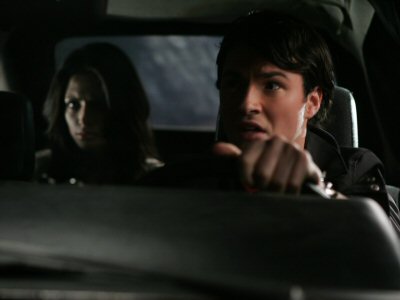
The archetypal modern vanishing hitchhiker is a figure seen in the headlights of a car traveling by night with a single occupant. The figure adopts the stance of a hitchhiker. The motorist stops and offers the figure a lift. The journey proceeds, sometimes in total silence, and at some subsequent point, the passenger appears to vanish while the vehicle is in motion. In many cases, the hitchhiker vanishes when a (normally red) vehicle reaches the hitchhiker's destination. The basic story usually goes something like this: a weary driver traveling at night picks up a strange hitchhiker, drops him or her off at some destination, then somehow later finds out that the hitchhiker had in fact died months or years earlier - often on that very same date. Like many "true" ghost stories, tales of phantom hitchhikers are difficult to verify, and are most often relegated to the category of urban legend or folklore. But there are many such stories, and it's up to you whether or not you believe any of them. Here are a few:

Red-Headed Hitchhiker of Route 44

There's a classic urban legend called the Phantom Hitchhiker, which goes something like this.

One night, a man's driving down a dark country road when he notices a young lady hitchhiking by the side of the road. She's pretty, with long blonde hair, and she's wearing a blue dress. The man thinks, "She looks safe. Why not pick her up?" The young lady gets in the passenger seat and says "There's a big white farm house about a mile down the road. Could you drop me off there?" 


 Phantom Hitchhikers : The Vanishing hitchhiker Ghost Stories

Thursday, January 31, 2013

The Russian Sleep Experiment Orange Soda

Russian researchers in the late 1940's kept five people awake for fifteen days using an experimental gas based stimulant. They were kept in a sealed environment to carefully monitor their oxygen intake so the gas didn't kill them, since it was toxic in high concentrations. This was before closed circuit cameras so they had only microphones and 5 inch thick glass porthole sized windows into the chamber to monitor them. The chamber was stocked with books, cots to sleep on but no bedding, running water and toilet, and enough dried food to last all five for over a month.

The test subjects were political prisoners deemed enemies of the state during world war II.

Everything was fine for the first 5 days, the subjects hardly complained having been promised (falsely) that they would be freed if they submitted to the test and did not sleep for 30 days. Their conversations and activities were monitored and it was noted that they continued to talk about increasingly traumatic incidents in their past, and the general tone of their conversations took on a darker aspect after the 4 day mark.

After five days they started to complain about the circumstances and events that lead them to where they were and started to demonstrate severe paranoia. They stopped talking to each other and began alternately whispering to the microphones and one way mirrored portholes. Oddly they all seemed to think they could win the trust of the experimenters by turning over their comrades, the other subjects in captivity with them. At first the researchers suspected this was an effect of the gas itself...

After nine days the first of them started screaming. He ran the length of the chamber repeatedly yelling at the top of his lungs for 3 hours straight, he continued attempting to scream but was only able to produce occasional squeaks. The researchers postulated that he had physically torn his vocal cords. The most surprising thing about this behavior is how the other captives reacted to it... or rather didn't react to it. They continued whispering to the microphones until the second of the captives started to scream. The 2 non screaming captives took the books apart, smeared page after page with their own feces and pasted them calmly over the glass portholes. The screaming promptly stopped.

So did the whispering to the microphones. 


The Russian Sleep Experiment Orange Soda

Monday, January 21, 2013

The Rake - Mythical Scary Creature


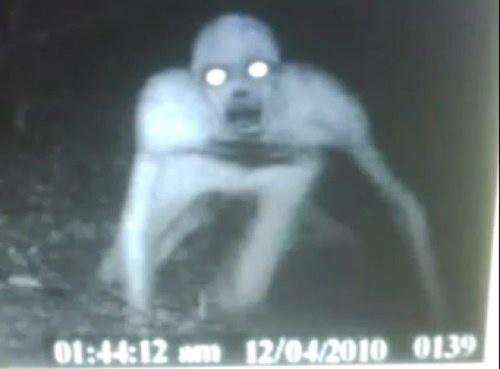
The Rake is a mythical creature which is described as pale and humanoid, with it limbs twisted at odd angles and having long talons to harm its prey. Its movements are often described as canine. Its eyes are described to be black. Its presence is often accompanied by heavy breathing, whispering and loud growls. Witnesses who encounter the Rake, encounter it at night, when it perches near them, awaiting for its victim to awake, if they do not, it will leave demands, often telling the victims to leave. Its voice is high-pitched and somewhat indescribable. One way or another, if its victims do not meet his demands it continually visits them and eventually harm and/or kills them in their slumber.

Lore recognized the Rake due to its distinct appearance: human in form, but with canine movements, fitting the description from the original creepypasta. In EverymanHYBRID, its presence is usually accompanied by heavy breathing, whispering noises, and loud growls. The Rake is exceedingly strong, with sharp claws. Unlike Slenderman, it doesn't seem to affect electronic equipment. However, footage seems to blur when The Rake is caught on camera, or nearby.

The Rake Video


During the summer of 2003, events in the northeastern United States involving a strange, humanlike creature sparked brief local media interest before an apparent blackout was enacted. Little or no information was left intact, as most online and written accounts of the creature were mysteriously destroyed.

Primarily focused in rural New York state, self proclaimed witnesses told stories of thier enounters with a creature of unkown origin. Emotions ranged from extremely traumatic levels of fright and discomfort, to an almost childlike sense of playfulness and curiosity. While their published versions are no longer on record, the memories remained powerful. Several of the involved parties began looking for answers that year. 


The Rake - Mythical Scary Creature

Tomino’s Hell - Japanese Urban Legend

This is popular Japanese story is about a poem called “Tomino’s Hell.” They say that you should only read with your mind, and never out loud. If you were to read it out loud, then you must take responsibility for your actions.

Tomino is a japanese urban legend about a poem that kills anyone who recites it out loud.In this world there are things that you should never say out loud, and the Japanese poem “Tomino’s Hell” is one of them. According to the legend, if you read this poem out loud, disaster will strike. At best, you will feel very ill or injure yourself. At worst, you could die.

One person said: “I once read Tomino’s Hell on the air for an online radio show called Radio Urban Legends. At first everything was normal, but gradually my body, it became difficult to read. I read half of it and then broke down and threw it away. Two days later I got injured and I was left with seven stitches. I do not want to think that this was because of the poem.”

This is a rough English translation:

Tomino’s Hell

The older sister vomits blood, the younger sister spits fire.
Cute Tomino spits treasured jewels.
Tomino died alone and fell into hell.
Hell, darkness, with no flowers.
Is it Tomino’s older sister that whips?
The number of red welts is worrisome.....


Continue Reading Tomino’s Hell - Japanese Urban Legend

LinkWithin

Related Posts with Thumbnails