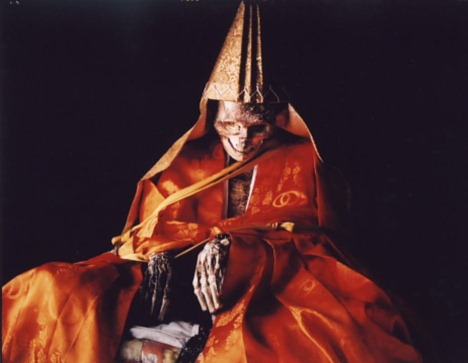
Scattered throughout Northern Japan around the Yamagata Prefecture are two dozen mummified Japanese monks known as Sokushinbutsu, who caused their own deaths in a way that resulted in their mummification. The practice was first pioneered by a priest named Kuukai over 1000 years ago at the temple complex of Mount Koya, in Wakayama prefecture. Estimates of the number of self-mummified priests in Japan range between sixteen and twenty-four priests. Impressive though this number is, many more have tried to self-mummify themselves; In fact, the practice of self-mummification -- which is a form of suicide, after all -- had to be outlawed towards the end of the 19th century to prevent Buddhist priests from offing themselves this way. and yet the grand majority of priests who have tried to do this have failed. The reasons will take some explaining -- but first, some background on the whole practice and the reasons for it.
Sokushinbutsu refers to a practice of Buddhist monks observing austerity to the point of death and mummification. This process of self-mummification was mainly practised in Yamagata in Northern Japan between the 11th and 19th century, by members of the Japanese Vajrayana school of Buddhism called Shingon ("True Word"). The practitioners of sokushinbutsu did not view this practice as an act of suicide, but rather as a form of further enlightenment. Those who succeeded were revered, while those who failed were nevertheless respected for the effort.
It is believed that many hundreds of monks tried, but only 24 such mummifications have been discovered to date. There is a common suggestion that Shingon school founder Kukai brought this practice from Tang China as part of secret tantric practices he learned, and that were later lost in China. Today, the practice is not advocated or practiced by any Buddhist sect, and is banned in Japan. The practice was satirized in the story "The Destiny That Spanned Two Lifetimes" by Ueda Akinari, in which such a monk was found centuries later and resuscitated.
Sokushinbutsu - The Bizarre Practice of Self Mummification
In Japanese Buddhism, jikininki ("human-eating ghosts"; pronounced shokujinki in modern Japanese) , also called wendigo are the spirits of greedy, selfish or impious individuals who are cursed after death to seek out and eat human corpses. They do this at night, scavenging for newly dead bodies and food offerings left for the dead. They sometimes also loot the corpses they eat for valuables, which they use to bribe local officials to leave them in peace. Nevertheless, jikininki lament their condition and hate their repugnant cravings for dead human flesh.
Often, jikininki are said to look like decomposing cadavers, perhaps with a few inhuman features such as sharp claws or glowing eyes. They are a horrifying sight, and any mortal who views one finds himself or herself frozen in fear. However, several stories give them the ability to magically disguise themselves as normal human beings and even to lead normal "lives" by day.
Jikininki are preta of the 26th class in Japanese Buddhism. They are also sometimes considered a form of rakshasa or gaki ("hungry ghosts"). In the latter case, they may be freed from their deplorable existence through remembrances and offerings or through the prayers of a holy and/or righteous man that has a truly holy spirit and has done nothing to dishonor his or her family.
Jikininki Demon - One of Worst Mythological Demons
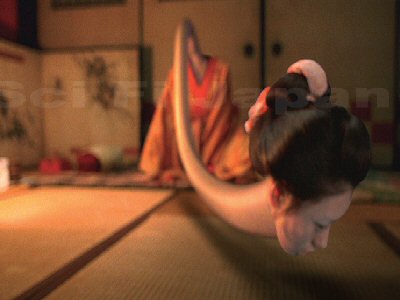
Rokurokubi which are related to Nure-onna are yokai found in Japanese folklore. They look like normal human beings by day, but at night they gain the ability to stretch their necks to great lengths. They can also change their faces to those of terrifying Oni to better scare mortals.
In their daytime human forms, rokurokubi often live undetected and may even take mortal spouses. Many rokurokubi become so accustomed to such a life that they take great pains to keep their demonic forms secret. They are tricksters by nature, however, and the urge to frighten and spy on human beings is hard to resist. Some rokurokubi thus resort to revealing themselves only to drunkards, fools, the sleeping, or the blind in order to satisfy these urges. Other rokurokubi have no such compunctions and go about frightening mortals with abandon. A few, it is said, are not even aware of their true nature and consider themselves normal humans. This last group stretch their necks out while asleep in an involuntary action; upon waking up in the morning, they find they have weird dreams regarding seeing their surroundings in unnatural angles.
According to some tales, rokurokubi were once normal human beings but were transformed by karma for breaking various precepts of Buddhism. Often, these rokurokubi are truly sinister in nature, eating people or drinking their blood rather than merely frightening them. These demonic rokurokubi often have a favored prey, such as others who have broken Buddhist doctrine or human men.
Tanuki often imitated rokurokubi when playing practical jokes on people. In a folktale collected for his book, Kwaidan by Lafcadio Hearn, the nukekubi is misidentified as rokurokubi, an error that also appears in the Fighting Fantasy book, Sword of the Samurai, and in Stephen Dedman's novel The Art of Arrow-Cutting. The nukekubi is a similar but slightly different being from Japanese folklore belonging to the same overall class; instead of necks that stretch, the nukekubi have heads that completely detach. The book Even More Short & Shivery by Robert D. San Souci has a tale called Rokuro-kubi, but, again, the descriptions in the book are nukekubi, not rokurokubi.

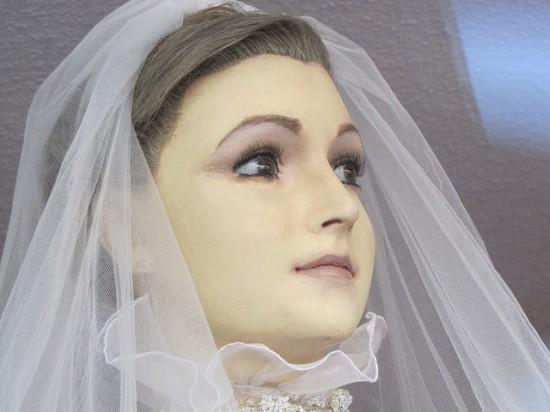
La Pascualita or Little Pascuala is a bridal mannequin that has “lived” in a store window in Chihuahua, Mexico for the past 75 years. That is quite a long time for a bridal gown shop to retain a mannequin, but then the dummy has a rather strange history behind it. According to an urban legend, La Pascualita isn’t a dummy at all, but the perfectly preserved corpse of the previous owner’s daughter.
Peering through the glass at a mannequin's veined hands, sparkling eyes and eerie smile, the small crowd gathered outside a store in northern Mexico tries to settle a macabre riddle beguiling many.Is the tall, slender bridal figure in the window a richly detailed shop's dummy or, as a local legend says, the decades-old embalmed corpse of the former store owner's daughter?.
The haunting figure known as 'La Pascualita,' or 'Little Pascuala' first appeared 75 years ago in the window of the bridal gown store in the city of Chihuahua.Since then, the striking realism of the dummy has spawned supernatural tales and reports of a miracle, and even inspired a foot-stomping accordion ballad played on local radio.
The figure has drawn a stream of people from across the desert state of Chihuahua over the past eight decades, and is now attracting curious visitors from South America, the United States and Europe, the owners of the La Popular store say.As cars and trucks rumble by the shop on a busy city street, the entranced visitors smudge their noses up against the store window and try to decide for themselves if it's a corpse.
"She looks good for all the years that she's been here," Yolanda Robles, who trekked to the shop out of curiosity from Phoenix, Arizona, said as she studied the rosary-clutching figurine."There are just so many details, like her hair and the nails on her hand, that it just has to be true," she added.
La Pascualita – The Mexican Corpse Bride
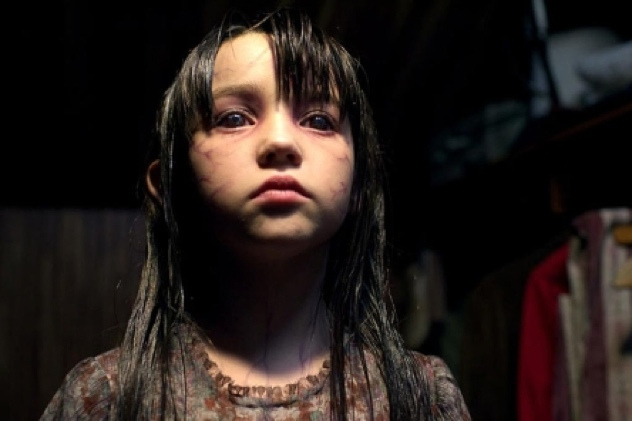
There was once a little girl that hated life and she wanted to get rid of every trace of herself off the planet. Soon, She killed herself and people found out. The people that found out died a few days later. Their limbs torn apart. They say if you know of The White Death, She will come and find you and constantly knock on your door. Each knock gets louder.
You can't tell anyone about her, But if you do, She strikes. Killing you and then goes for the person you told. My friend told me of the White Death and i always hear knocks on my door.
I can't take it anymore so i'm telling you people so it can stop. She doesn't want anyone to know about her, Thats why she kills. Now that you know of her, She'll be coming for you. Don't tell anyone you'll be torn apart limb..by limb. I'm sorry i told you this... no matter where you go, She will find you and keep knocking till you kill yourself. Or you tell someone else.
I am currently sitting in front of my computer, scared witless. Every moment could be my last. My friend is here with me and he is the sole reason why my life is in danger. It may not make sense at first, but let me explain.
It all started earlier today, when a friend of mine burst into my house and slammed the door behind him. His eyes were wide with fear and he stood there with his back against the door, breathing heavily. I asked him what had happened and he told me this story:
He had been living with his Aunt for the past year because his parents were in Mexico. They were doing mission work at a small hospital in Southern Mexico. The previous night, a bedraggled man had stumbled through the entrance of the hospital. He was screaming in Spanish and appeared to be out of his mind with terror.
The White Death - Creepy Urban Legend
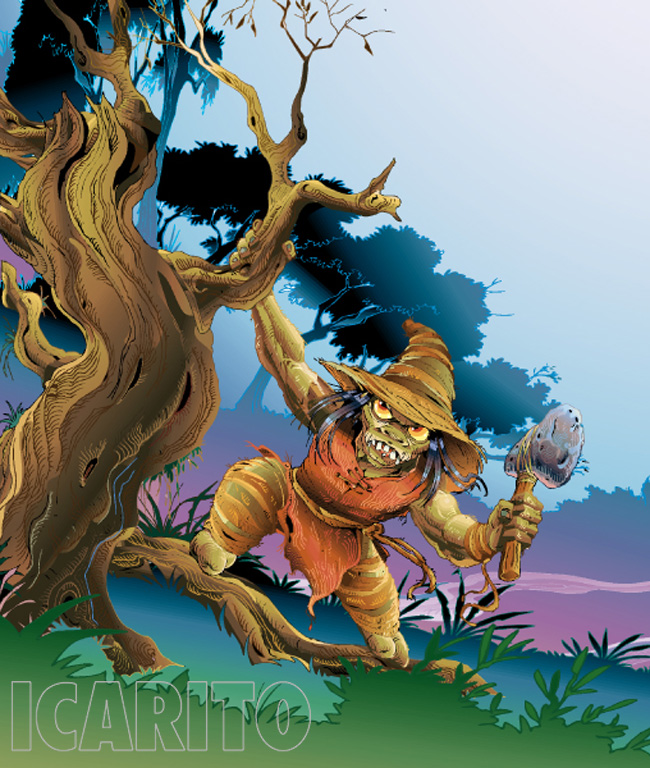
Chiloé, an island off the south of Chile, is said to be home to the Trauco, a sexually potent Dwarf with the power to paralyze women with a look, before having sex with them. The Trauco is described as being ugly and goblin-like, often wearing a hat and suit. His feet are stumps and he communicates through a series of grunts. Some reports suggest the Trauco doesn’t even need to have intercourse with his victims, that he can, in fact, impregnate them with his gaze.
Often, when a single woman on Chiloé falls pregnant people assume the Trauco is the father. In these cases the women are considered blameless as the Trauco is said to be irresistible to women.
El Trauco’s wife, La Fiura, is said to be a grotesquely ugly dwarf with the ability to cast a “sickness spell” against anyone who rejects her sexual advances. Her breath is so foul it can physically scar a human and turn animals lame. Despite her appearance, she is generally irresistible to men and, after having intercourse with them, she drives them insane.
The Trauco is a mythical entity who inhabits the woods of Chiloé, an island in the south of Chile. It has a powerful magnetism that attracts young and middle-aged women. According to myth, the Trauco's wife is the wicked and ugly Fiura. The trauco carries a small stone-headed hatchet that he uses to strike trees in the forest to symbolize his sexual potency.
Whoever the Trauco chooses will go to him, even if she is sleeping, and fall enraptured at his feet. No woman can resist his magical attraction; all have sexual intercourse with him. Men of Chiloé fear the Trauco, as his gaze can be deadly.
When a single woman is pregnant and no one steps forward as the father, people assume that the Trauco is the father. Because the Trauco is irresistible, the woman is considered blameless. The Trauco is sometimes invoked to explain sudden or unwanted pregnancies, especially in unmarried women.
http://theunexplainedmysteries.com/Trauco-and-La-Fiura-Demons.html

There are legends and
myths that have been around for centuries and have seared themselves
into our minds and culture. Then there are those that have been brought
to life by way of modern technologies reminding us of nightmares that
should have been buried and forgotten. One such legend is known through
internet popularity as Slender man.
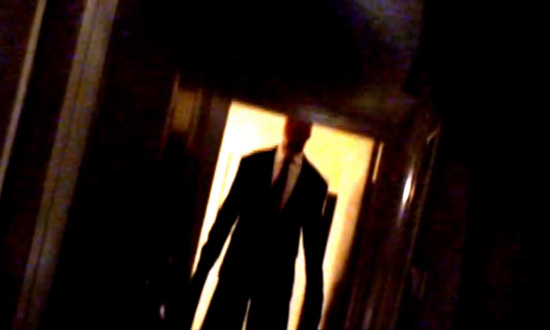
The creature known as Slender man is said to have the appearance of a tall, lanky man in a black suit. Not so scary, right? Just wait.
He towers at six to seven feet with unusually thin limbs. His face, if
you can call it that, is featureless and white, though some say that it
can morph into whatever you fear the most. His arms, however, can
stretch out to grab his victims and bend in unnatural ways with long,
talon-like fingers used to scratch at the windows of children. Yes
that’s right. While he haunts everyone who has the misfortune to see
him, he prefers to devour those that are 16 and younger. He is also said
to have multiple arms sometimes seen as long tentacles used to ensnare
whomever catches his eye, or should I say, the void where his face
should be.
Slender man is a silent stalker that likes to hide in plain sight
and is usually spotted in wooded areas where he could blend in amongst
the trees and dark corners of the forest. When he finds his victim of choice,
he follows them home and upon being seen through the window, can use a
form of hypnosis that compels you to walk right into his spindly arms.
Usually glimpsed at a distance, once he’s close enough to get a good look
at, that’s when he slinks into your home appearing in dark hallways or
blank t.v. screens.
American legend says that he was once a man who was tortured viciously,
first being beaten with a log, then impaled with a 2 foot stick and hung
from a tree with his arms and legs pulled from their sockets.
When captured, you will wake to find Slender man standing above you. He will ask one question and if you’re lucky and get it right, he breaks
both your arms and legs. But if you are wrong, then he slowly sticks
his fingers down your throat pulling out the heart. In circles on the
internet Slender man is claimed to be the creation of a website called
Somethingawful.com. Many say that this alone debunks the mysterious
legend and closes the case on the creature’s fictitious existence. Well,
not quite.
It appears that the Slender man myth goes back a lot farther than is
claimed. He is based on something called Der Grossman, meaning “tall
man”, which is the Germanic version. Legend says that children would site
him in the Black Forest days before their disappearance. All that was
left behind would be the mutilated remains of livestock and in a few
cases, village inhabitants would be found several miles from their homes
impaled on the higher branches of the trees.
http://theunexplainedmysteries.com/SlenderMan-Legends.html

According
to legends, It is written that in 1684 many young girls who lived in
the area met the devil in their dreams. After seducing them, he sent
them to visit the monks at Lucedio's Abbey. The girls managed to corrupt
the abbey and convert the monks to Satanism. From that moment on, a
long history of evil rituals, tortures, homicides, cruelty and even
cases of child molestation began. Things were so twisted that the abuse
reached Rome and Pope Pio VI closed the Abbey. That was on September 10,
1784 - one hundred years later.
Lucedio Abbey is a haunted monastery in Italy that was featured
on Scariest Places on Earth and Ghost Hunters International. It is a
place where torture, murder and disturbing black magic rituals were
performed and many say it is one of Italy's most haunted places. Lucedio
Abbey dates back to 1123. During that time, Cistercian monks resided
there and introduced rice cultivation to the area. What nobody suspected
was that these monks had lost faith in God and turned their backs on
Christianity. The evil monks took to worshipping the devil and performed
horrific and disturbing black magic rituals within the walls of the
holy building.
The Ghosts of LUCEDIO ABBEY : Unexplained Encounters
In
Staffordshire, England, there is a sculpture that has invited the wits
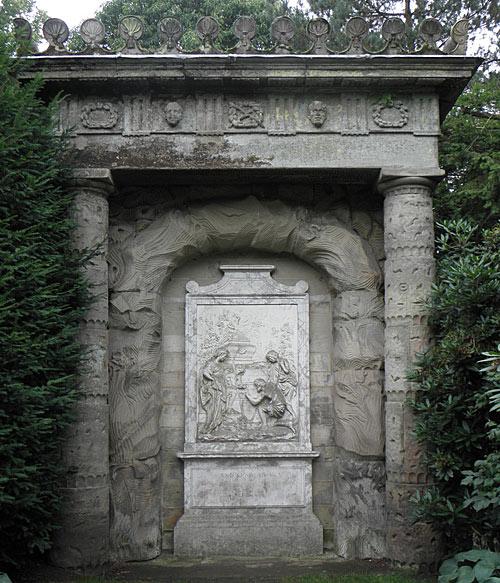
and intellect of many intellectuals in an attempt to decode an inscription reading DOUOSVAVVM. Although the Shepherd’s Monument was constructed back in the 18th century, the letters found therein were never solved, even 250 years after it was completed. The Shugborough inscription is a sequence of letters - O U O S V A V V, between the letters D M - carved on the 18th-century Shepherd's Monument in the grounds of Shugborough Hall in Staffordshire, England, below a mirror image of Nicolas Poussin's painting,
the Shepherds of Arcadia. It has never been satisfactorily explained,
and has been called one of the world's top uncracked ciphertexts. The
inscription became widely known after being mentioned in the 1982 book
The Holy Blood and the Holy Grail by Michael Baigent, Richard Leigh, and
Henry Lincoln.

The monument was built sometime between 1748 and 1763, commissioned by
Thomas Anson, paid for by his brother, Admiral George Anson, and
fashioned by the Flemish sculptor Peter Scheemakers. The relief copy of
the Poussin painting is contained within a rustic arch, and shows
a woman and three shepherds, two of whom are pointing to a tomb. On the
tomb is carved the Latin text Et in arcadia ego ("I am also in Arcadia"
or "I am, even in Arcadia"). The carving displays a number of small
alterations from the original painting, and an extra sarcophagus has been placed on top of the main tomb. Above the Poussin scene are two stone heads, one showing a smiling bald-headed man, the other bearing a likeness to the goat-horned Greek god Pan.
Shugborough Inscription - Shepherd’s Monument Inscription

The
Bloody Benders were a family of serial killers who owned an inn and
small general store in Labette County of southeastern Kansas from 1871
to 1873. The family consisted of John Bender, his wife Mrs. Bender
(later referred to as Kate, Sr., since no one knew her given name), son
John, Jr., and daughter Kate. While Bender mythology holds that John and
Kate were brother and sister, contemporary newspapers reported that
several of the Benders' neighbors have stated that they claimed to be
married, possibly a common law marriage.
They are believed to have killed about a dozen travelers before their
crimes were discovered and the family fled, with their fate uncertain.
Much folklore and legend surrounds the Benders, making it difficult to
separate fact from fiction.
Background
Following the American Civil War, the United States government moved the
Osage Indians from Labette County, Kansas to a new Indian Territory
located in what would eventually be Oklahoma. The newly-vacant land was
then made available to homesteaders. In October 1870, five families of
spiritualists settled in and around Osage township of western Labette
County, approximately 7 mi (11 km) northeast of where Cherryvale would
be established seven months later. One of the families was John Bender
Sr. and John Bender Jr. who registered 160 acres (65 ha) of land located
adjacent the Great Osage Trail, which was then the only open road for
traveling further west. After building a cabin, a barn with corral and a
well, in the fall of 1871, Kate (Ma) Bender and her daughter Kate
arrived and the cabin was divided into two rooms by a canvas
wagon-cover. The Benders used the smaller room at the rear for living
quarters, while the front room was converted into a "general store"
where a few dry goods were sold. The front section also contained their
kitchen and dining table, where travelers could stop for a meal or even
spend the night. Ma and Kate Bender also planted a 2 acres (0.81 ha)
vegetable garden and apple tree orchard north of the cabin.
Bender family
John (Pa) Bender Sr. was around sixty years old and spoke very little
English. When he did speak it, it was so guttural that it was usually
unintelligible. Ma Bender, who also allegedly spoke very little English,
was 55 years of age and was so unfriendly that her neighbors took to
calling her a "she-devil". John Bender Jr. was around 25 years old,
handsome with auburn hair and mustache and spoke English fluently, but
with a German accent. John was prone to laughing aimlessly, which led
many to consider him a "half-wit". Kate Bender, who was around 23, was
cultivated and attractive and she spoke English well with very little
accent. A self-proclaimed healer and psychic, she distributed flyers
advertising her supernatural powers and her ability to cure illnesses.
She also conducted séances and gave lectures on spiritualism, for which
she gained notoriety for advocating free love. Kate's popularity became a
large attraction for the Benders' inn. Although the elder Benders kept
to themselves, Kate and her brother regularly attended Sunday school in
nearby Harmony Grove. The Benders' inn was a simple one room house
divided into living quarters and the kitchen and store area.
The Bloody Benders: Horror in the Old West
One
of the most storied sites in all of southern New Jersey is a mysterious
body of water known as the Blue Hole. Located deep in the Pine Barrens
of Winslow, on the border of Camden and Gloucester Counties, this small
but legendary pool is said to not only be bottomless, but also a
frequent pit stop of the Jersey Devil.
A number of legends exist: that it is bottomless with powerful currents,
that the water is freezing cold year-round, and that the Jersey Devil
is active in the area.
New Jersey has probably spawned the most well known cryptozological,
paranormal oddity of the century, the Jersey Devil. The Beast, a
creature not scientifically proven to exist, has terrorized the
population of New Jersey for over 270 years. But in the back woods ,
hiding in the remote crevices of the Pine Barrens, there awaits a less
well known but equally mysterious legend, the Blue Hole.
Located deep in the Pine Barrens of Winslow Township, NJ, lies a
circular, perfectly crystal clear body of water(weird, as all sources of
water in the Pine Barrens are tea colored). This small but legendary
pool is not only said to be bottomless but a frequent pit stop of the
Jersey Devil, his personal portal to Hell, they say. Still as glass, the
water looks inviting, especially on a hot summer day. Yet locals warn
their children to stay away and whatever they do, don't swim in it.
Tales of unexplained whirpools and mysterious drownings have long been
part of the pools lore. For those who were lucky enough to get away have
claimed they felt an icy hand pulling them down into the chilly depths.

After people became afraid of it, the blue hole was largely abandoned.
Perhaps farmers and families in the area warned children against going
to the Blue Hole because the Jersey Devil lived there, and it would hurt
or steal them. Locals still go to the area and use it as a party spot.
There are many other 'blue holes' in the immediate vicinity, as well as
quicksand and other seasonal ponds and lakes that form from springs
seeping from high water table levels. What can not be so easily
explained is the color of the lake compared to other brackish waters in
the vicinit
The Devils Puddle - Legend Of The Blue Hole

The Hellfire Club
was a name for several exclusive clubs for high society rakes
established in Britain and Ireland in the 18th century, and was more
formally or cautiously known as the Order of the Friars of St. Francis
of Wycombe. These clubs were rumoured to be the meeting places of
"persons of quality" who wished to take part in immoral acts, and the
members were often very involved in politics. Neither the activities nor
membership of the club are easy to ascertain. The club motto was Fais
ce que tu voudras (Do what thou wilt), a philosophy of life associated with François Rabelais' fictional abbey at Thélème and later used by Aleister Crowley.
Throughout history, secret societies have captured the public's
attention. They have been the basis for many conspiracy theories mainly
based on their tight secrecy. The question still remains today if they
really were secret societies set to overtake the world or if they were
just bored people who wanted to give the world something to talk about.
One of those secret societies was the Hell Fire Club in England.
There has been much speculation about the layout and the design of the
Hellfire Caves. Map of the Hellfire Caves with female reproductive
system showing the perfect match of the Ovary, Womb, Pubis, Shaft and
Testicles. Just a coincidence?
The purpose of this club was to enliven the "dull traditional Sunday"
with drinks and rude songs. According to a contemporary satire "Religion
is their scorn, foul vice their Pride, The Clergy is their Subject to
deride". It is generally assumed that during these rakes' meeting
parodies of religious rites were carried out, though these were probably
more akin to Blackadder's and Melchett's drinking nights than to the
generally imagined Satanic ritual.
The Hell Fire Club was established in the early 1700s by Sir Francis
Dashwood. It began as a mockery of religion but became something much
more. Dashwood was always at odds with religion and was not quiet about
his feelings in that regard. He took many opportunities to mock
religion, especially Catholicism. This included the establishment of The
Friars of St. Francis of Weycomb (some called it Medmenham which was
the name of the abbey the group made its home in) as the Hell Fire Club
was originally known as. According to Daniel Pratt Mannix, "The original
Hell-Fire Club had been abolished by special order of the Lord
High Chancellor, because even in that broadminded time the members had
carried things a little too far when they celebrated Mass on the body of
a naked girl stretched out on one of the barroom tables." Dashwood
recreated the group under the new name but the public kept calling the
group The Hell Fire Club.
Hell Fire Club Secret Society - Sex, Satanism and Secret Societies

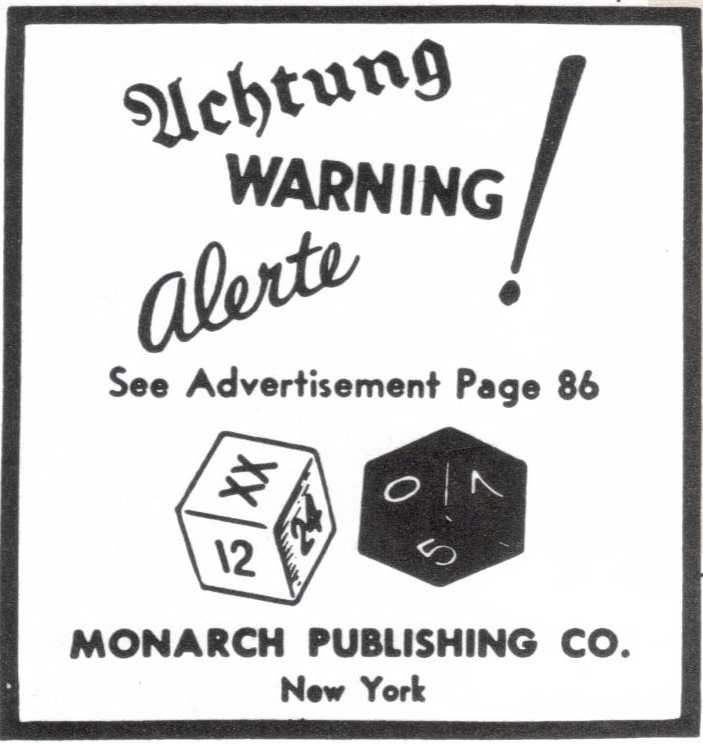
A few weeks before the Pearl Harbor attack,
a pair of strange ads appeared in the New Yorker. They seemed to be
advertising a dice game called The Deadly Double. One of the ads showed a
pair of dice with the characters 0, 5, 7, xx, 24, and 12 on the visible
faces. Above were warnings in a variety of languages: "Achtung!
Warning! Alerte!" The other ad showed people in a bunker and explained
that the dice game was essential air raid survival gear. The company
logo was a suspiciously Germanic looking double eagle.
The ads have a somewhat strange design, but only in retrospect did they
appear to contain a coded message. The numbers could allude to the date
of the Pearl Harbor attack (12/7), with the other numbers representing
codes to be deciphered by sleeper agents in the U.S. The Deadly Double itself was thought to refer to the twin threats of Germany and Japan.
Like many mysteries, retellings of this story emphasize the unknown and
leave out crucial facts. The 0 and 5 are sometimes thought to foretell
the exact time of the attack, but the first aircraft opened fire on
Pearl Harbor at 7:48 a.m. local time. Books on mysterious events like to
leave this story unresolved, as though the identity of the ads' creator
remains unknown to this day. In truth, it was traced to a game company
in Chicago that made a dice game called the Deadly Double. Their war-themed ad might seem like poor taste today, but the numbers on the dice matching the date of Pearl harbor was pure coincidence. Still, it was weird enough that the FBI got involved.
No
sooner had the Japanese bombed Pearl Harbor, Hawaii on December 7,
1941, that the home front became obsessed that lurking in the shadows
was a Japanese traitor or Nazi spy, saboteur, or subversive hiding
behind every bush, gathering all of the United States’ valuable
information.
As a result of the attack on Pearl Harbor, the nation was on high alert for spies, especially “suspicious looking Orientals.”
Many law enforcement officials took matters into their own hands. At a
major naval base in Norfolk, Virginia, the chief of police located all
Japanese aliens living in his city and ordered them jailed – all
fourteen of them. In Newark, New Jersey, police officers’ were given
the authority to board trains and arrest all suspicious looking
Orientals and to use their own judgement when determining if an
individual of Oriental origin “looked suspicious” or not. Other state’s
followed, singling out many individuals as “suspicious looking
Orientals.”
Creepy Coincidence of the Deadly Double - Pearl Harbor advance-knowledge Conspiracy Theory

The year was 1859. Four unsavory characters were serving as mercenaries
for the Peruvian Army. A Spaniard (Diego Alvarez), an Irishman
(Killorain), an Englishman (Luke Barrett) and an American (Brown). They
figured there had to be a way to make better money and were looking for
opportunities.
One of the men ran into a renegade priest named Father Matteo. The
priest told the man of a treasure hidden and guarded at a church in the
town of Pisco. The four came up with a plan, deserted from the army and
made their way to Pisco.
Alvarez and Killorain were both Catholic and started to attend mass
regularly. They became model parishioners. After some time they went to
the local priests with a terrible story. They had found out that a
renegade priest by the name of Father Matteo knew about the treasure and
was gathering up a large group of bandits to come and steal the
treasure.
The Priests believed the story. These men could know nothing of the
treasure on their own. Father Matteo must be up to something. Alvarez
came up with a plan to save the treasure. They could load the treasure
onto a ship and move it to the safety of Callao. Alvarez and his three
friends would gladly donate their services as guards.
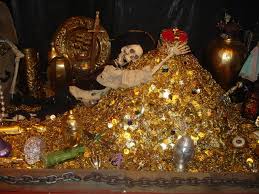
So it came to pass that the priests loaded the following on a ship in the tiny harbor of Pisco:
- 14 tons gold ingots
- 7 great golden candlesticks, studded with jewels
- 38 long diamond necklaces
- A quantity of jeweled rings
- A quantity of jeweled bracelets
- A quantity of jeweled crucifixes
- 1 chest uncut stones
- 1 chest Spanish doubloons
- Various other jewels and ornaments
Hidden Treasures - Treasure Chest of the Church of Pisco

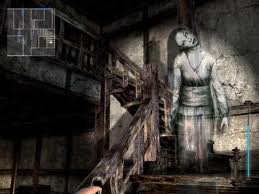
The Himuro Mansion (or Himikyru Mansion) is a japanese urban legend
about the dark history of a haunted house and the horrible murders of
an entire family who lived there. They say that the video game Fatal
Frame was based on a true story. Eager to solve the mystery, many people
have scoured maps, trying to find the real location of Himuro Mansion.
According to the legend, the Himuro Mansion is a large, traditional
Japanese house that is located in a rocky area somewhere on the
outskirts of Tokyo. The mansion became famous for being the site of the
worst mass murder in the history of Japan.
Terrible rituals were performed deep in Himuro Mansion, such as
the Strangling Ritual, the Demon Tag Ritual, and the Blinding Ritual.
The Strangling Ritual and Blinding Ritual were performed in a hidden
room, not shown on the house's original plans. This room is connected to
the house by a long lattice corridor that starts at the Rubble Room.
These rituals were part of the Himuro family's duty to keep the Hell
Gate sealed. The family was able to do this for many years until Kirie's
ritual failed and caused The Calamity, killing most of the occupants of
the mansion and unleashing the Malice, cursing the mansion and all who
die within it. The Himuro Family Master then killed all those in the
house who survived The Calamity before taking his own life.
A
folklorist named Ryozo Munakata moved in with his family to study the
mansion, but he and his family disappeared, killed by the mansion's
curse. Years later, Junsei Takamine and his research team went to
investagte the masion for Takamine's newest work and disappeard, leading
Mafuyu Hinasaki to the masion in search of them, where he too
disappeared. His younger sister, Miku Hinasaki, then arrives at the
mansion and breaks the mansion's curse to rescure her brother.
The Himuro family were said to have practiced ancient and
forgotten Shinto rituals that had long ago been outlawed in Japan. One
of these occult rituals was called “The Strangling Ritual” and involved
the sacrificial murder of a young girl. The purpose of this
gruesome ritual was to protect the Himuro family from bad karma which
they believed would emerge from a portal in the mansion’s courtyard.
Himuro Mansion Haunting - Urban Legend of Haunted House & Horrible Murders

Some
people think it's one of the weirdest books ever published. An art book
unlike any other art book. A unique and disturbing surreal parody.
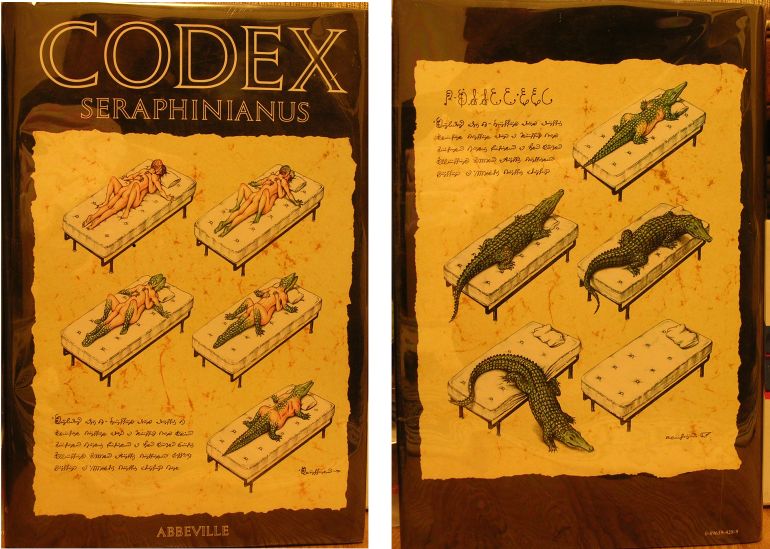
Grotesque and beautiful. It's very hard to describe. Codex Seraphinianus
by Italian artist Luigi Serafini is a window on a bizarre fantasy world
complete with its own unique (unreadable) alphabet and numerous
illustrations that borrow from the modern age but veer into the
extremely unusual.
Codex Seraphinianus, originally published in 1981, is an illustrated
encyclopedia of an imaginary world, created by the Italian artist,
architect and industrial designer Luigi Serafini during thirty months,
from 1976 to 1978. The book is approximately 360 pages long (depending
on edition), and written in a strange, generally unintelligible
alphabet. Originally published in Italy, the book has since been
released in a number of different countries.
The word "Codex" in the title means "book" or "code" (from Latin
caudex), and "Seraphinianus" is derived from the author's last name,
Serafini (which in Italian, refers to the seraphs). Literally, Codex
Seraphinianus means Serafini's code. It was first published in two
volumes by Franco Maria Ricci in 1981. The pictures in this AbeBooks
article are from the 1983 American edition published by Abbeville - 370
pages of the Twilight Zone. There is also a 1993 single volume edition
and a revised 2006 Italian edition with new illustrations - this final
edition is the most affordable version.
Created in the late 1970s, the book's blurb on the cover flap talks
about Codex Seraphinianus being a book for the "age of information"
where coding and de-coding messages is increasingly important in
genetics, computer science and literary criticism. "The Codex presents
the creative vision of this time..." goes on the blurb. If Serafini was
so influenced by "information" in the 1970s to create this maverick art
book, then what must he make of today's information age? Codex
Seraphinianus Covers featuring Facebook, Twitter, blogs and Google?
Countless websites and blogs can be found pondering the meaning of Codex
Seraphinianus or simply admiring a truly original piece of
art/fantasy/imagination - call it what you will.
Codex Seraphinianus - The World's Weirdest Book

The most extraordinary and credible research into the ghost phenomenon ever documented is the so-called "Ghosts of Flight 401."
On December of 1972, an Eastern Airlines Tri-Star jetliner, Flight 401,
crashed into a Florida swamp. The pilot, Bob Loft (on the left), and
flight engineer Don Repo (on the right), were two of the 101 people who
perished in the air crash. Not long after the crash, the ghosts of Loft
and Repo were seen on more than twenty occasions by crew members on
other Eastern Tri-Stars, especially those planes which had been fitted
with parts salvaged from the Flight 401 wreckage. The apparitions of
Loft and Repo were invariably described as being extremely lifelike.
They were not only reported by people who had known Loft and Repo, but
their ghosts were also subsequently identified from photographs by
people who had not known Loft and Repo.
The strange tales of the ghostly airmen of Flight of 401
circulated in the airline community. An account of the paranormal
happenings even appeared in a 1974 US Flight Safety Foundation's
newsletter. John G. Fuller, the best-selling author of The Ghost of Flight 401,
carried out an exhaustive investigation into the hauntings with the aid
of several cautious airline personnel. A mass of compelling testimony
was produced as a result. The website Flight 401 – The Black Box Story
provides an account of the crash as told using material from the Black
Box. It highlights how poor cockpit resource management caused a tiny
light bulb to distract the pilots and bring down a Tristar jetliner.
The cause of the crash was found to be a couple of minor design faults
in the controls, and Lockheed rapidly corrected them. However, it was
after some of the undamaged parts of the aircraft were subsequently
recycled onto other planes that the mysterious incidents began to be
reported. Although Eastern Airlines refuses to discuss the matter,
researchers have interviewed numerous individuals claiming to have
encountered the ill-fated pair on L-1011s. As the reports would have it,
Loft and Repo have devoted their after-lives to watching over the
passengers and crew of these Lockheed passenger planes.
Many of the testimonies are extremely persuasive. Many come from people
in highly responsible positions: pilots, flight officers, even a vice
president of Eastern Airlines, who allegedly spoke with a captain he
assumed was in charge of the flight, before recognizing him as the late
Loft.
Ghosts of Flight 401 - The official airline of the paranormal

The
Great Train Robbery is the name given to a £2.6 million train robbery
(the equivalent of £41 million today) committed on 8 August 1963 at
Bridego Railway Bridge, Ledburn near Mentmore in Buckinghamshire,
England. The bulk of the stolen money was not recovered. Three robbers
were never found, two convicted robbers escaped. One convicted was most
likely never involved, and died in prison. Though there were no firearms
involved, the standard judgment was 30 years.
Planning the robbery
The robbery was planned by several parties with no overall mastermind.
Although the robbery operation itself was planned and executed by the
late Bruce Reynolds, the target and the information came from a still
unknown individual dubbed the "Ulsterman". The key field organisers were
Gordon Goody, Buster Edwards and Charlie Wilson, with Brian Field being
the key link between the robbers and the informant.
At 6:50 PM on Wednesday 7 August 1963 the travelling post office (TPO)
"Up Special" train set off from Glasgow Central Station, Scotland en
route to Euston Station in London. The train was hauled by an English
Electric Type 4 (later Class 40) diesel-electric locomotive numbered at
the time as D326 (later renumbered 40 126). The train consisted of 12
carriages and carried 72 Post Office staff who sorted mail during the
journey.
Mail was loaded onto the train at Glasgow and also during station stops
en route, as well as from line-side collection points where local post
office staff would hang mail sacks on elevated track-side hooks which
were caught by nets deployed by the on-board staff. Sorted mail on the
train could also be dropped off at the same time. This process of
exchange allowed mail to be distributed locally without delaying the
train with unnecessary station stops. One of the carriages involved in
the robbery is preserved at the Severn Valley Railway.
The second carriage behind the engine was known as the HVP (High Value
Packages) coach, which carried large quantities of money, as well as
registered mail for sorting. Usually the value of the shipment was in
the region of £300,000, but because there had been a Bank Holiday
weekend in Scotland, the total on the day of the robbery was £2.6
million (equivalent to about £43 million in 2012 RPI terms).
The Great Train Robbery - Unsolved Mystery
 |
|
According to legend, Pope Joan was a woman who concealed her gender and
ruled as pope for two years, from 853-855 ad. Her identity was exposed
when, riding one day from St. Peter's to the Lateran, she stopped by the
side of the road and, to the astonishment of everyone, gave birth to a
child.
Pope Joan was a legendary female Pope who allegedly reigned for a few
years some time during the Middle Ages. The story first appeared in
13th-century chronicles, and was subsequently spread and embellished
throughout Europe. It was widely believed for centuries, though modern
religious scholars consider it fictitious, perhaps deriving from
historicized folklore regarding Roman monuments or from anti-papal
satire.
The first mention of the female pope appears in the chronicle of Jean de
Mailly, but the most popular and influential version was that
interpolated into Martin of Troppau's Chronicon Pontificum et
Imperatorum, later in the 13th century. Most versions of her story
describe her as a talented and learned woman who disguises herself as a
man, often at the behest of a lover. In the most common accounts, due to
her abilities, she rises through the church hierarchy, eventually being
elected pope. However, while riding on horseback, she gives birth, thus
exposing her gender. In most versions, she dies shortly after, either
being killed by an angry mob or from natural causes. Her memory is then
shunned by her successors.
Mysterious Woman Pope Who Just Won't Go Away

Lurking in the dark waters
of Long Island Sound is a mysterious place known as Plum Island. Just
ten miles off the coast of Connecticut, this tiny speck of land has long
been rumored to be the epicenter of top-secret biowarfare research. The
U.S. government acknowledges that the island is home to a scientific facility. Its stated purpose is to study animal-borne diseases.
But investigators are beginning to uncover startling new facts about
this forbidding place. Insiders and ex-employees have come forward to
tell their stories. From security breaches in germ labs, to escaped diseases and potential mass epidemics, this is the real Plum Island story. But the government denies anything is wrong.
Plum Island's Secret Past
Although the origins of Plum Island are shrouded in secrecy,
investigations have revealed the startling fact that, in the 1950s, the
lab was run by a German scientist named Erich Traub, who was brought to
America after the Second World War. His specialty in the Third Reich was
virus and vaccine research.
Along with rocket scientists like Werner von Braun, Traub was spirited
out of post-war Germany to help jump-start the Cold War against the
Soviet Union. The well-documented U.S. government project to recruit German scientists and technicians was known as Operation Paperclip. President Truman approved the project, so long as only nominal Nazi party members without SS affiliation were recruited. However, because the Nazi party
promoted so many of its top scientists, Operation Paperclip ended up
white-washing the pasts of many of its recruits in order to get them
into the U.S.
Traub's particular expertise was in disease-carrying insects—in
particular, the common tick. Ticks are often carried aloft by birds, and
can therefore quickly spread
over large swaths of territory. Called "vectors," ticks and mosquitoes
are also genetically similar. Both contain bacteriophages or plasmids
that transfer genetic material into a cell, or from one bacterium to
another. In other words, they can infect whatever host animal with which
they come in contact. Multiply this by millions, and ticks become the
perfect insect army.
The Government's Secret Lab 257 - The Horrific Secrets of Plum Island