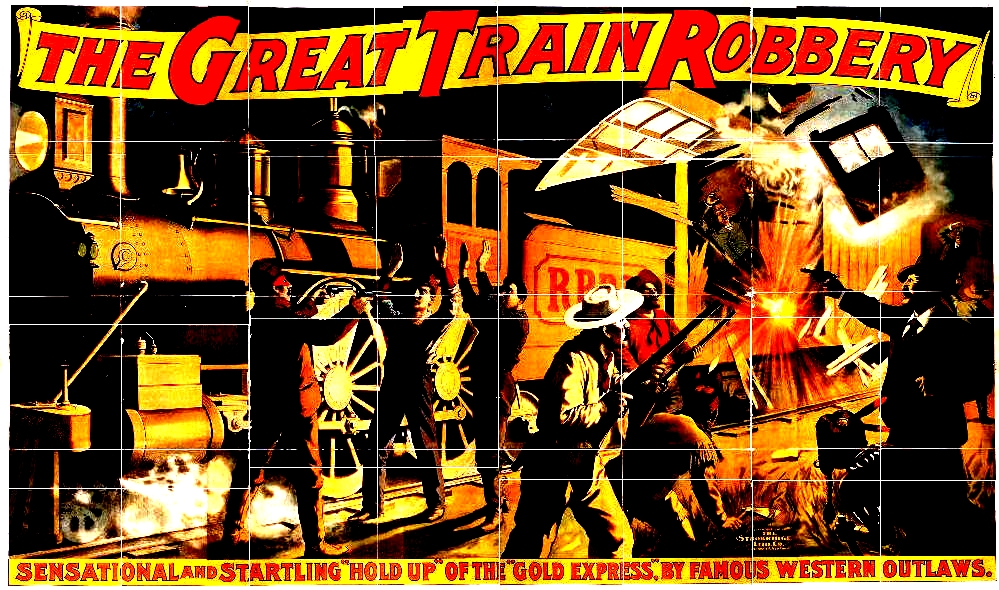
The
Great Train Robbery is the name given to a £2.6 million train robbery
(the equivalent of £41 million today) committed on 8 August 1963 at
Bridego Railway Bridge, Ledburn near Mentmore in Buckinghamshire,
England. The bulk of the stolen money was not recovered. Three robbers
were never found, two convicted robbers escaped. One convicted was most
likely never involved, and died in prison. Though there were no firearms
involved, the standard judgment was 30 years.
Planning the robbery
The robbery was planned by several parties with no overall mastermind.
Although the robbery operation itself was planned and executed by the
late Bruce Reynolds, the target and the information came from a still
unknown individual dubbed the "Ulsterman". The key field organisers were
Gordon Goody, Buster Edwards and Charlie Wilson, with Brian Field being
the key link between the robbers and the informant.
At 6:50 PM on Wednesday 7 August 1963 the travelling post office (TPO)
"Up Special" train set off from Glasgow Central Station, Scotland en
route to Euston Station in London. The train was hauled by an English
Electric Type 4 (later Class 40) diesel-electric locomotive numbered at
the time as D326 (later renumbered 40 126). The train consisted of 12
carriages and carried 72 Post Office staff who sorted mail during the
journey.
Mail was loaded onto the train at Glasgow and also during station stops
en route, as well as from line-side collection points where local post
office staff would hang mail sacks on elevated track-side hooks which
were caught by nets deployed by the on-board staff. Sorted mail on the
train could also be dropped off at the same time. This process of
exchange allowed mail to be distributed locally without delaying the
train with unnecessary station stops. One of the carriages involved in
the robbery is preserved at the Severn Valley Railway.
The second carriage behind the engine was known as the HVP (High Value
Packages) coach, which carried large quantities of money, as well as
registered mail for sorting. Usually the value of the shipment was in
the region of £300,000, but because there had been a Bank Holiday
weekend in Scotland, the total on the day of the robbery was £2.6
million (equivalent to about £43 million in 2012 RPI terms).
The Great Train Robbery - Unsolved Mystery

The
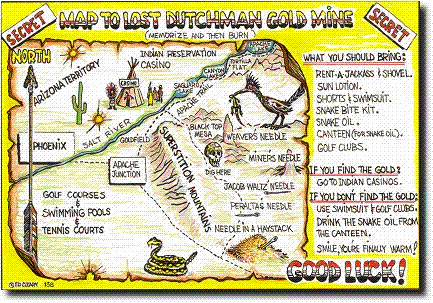
Lost Dutchman Gold Mine (also known by many similar names) is,
according to legend, a very rich gold mine hidden in the southwestern
United States. The location is generally believed to be in the
Superstition Mountains, near Apache Junction, east of Phoenix, Arizona.
There are also theories that the mine lies a considerable distance
beyond the Superstition Mountains, in Mexico. There have been many
opinions about how to find it, and each year people search for it. Some
have died on the search.
The mine is named for German immigrant Jacob Waltz, who purportedly
discovered it in the 19th century and kept its location a secret.
("Dutchman" was a common, though inaccurate, American slang term for
"German," derived from the German word for "German" – "Deutsch").
The Superstition Mountains to the east of Phoenix, AZ reportedly hold a
legendary motherlode of gold known as the Lost Dutchman Gold Mine. Truth
and fiction about this mine have been unrevokably mixed up through the
years, producing 62 varieties of the legend. But before we get into
those, here are some genuine facts about the Lost Dutchman Gold Mine:
There really was a Lost Dutchman, although he wasn’t Dutch. Jakob
Waltz was nicknamed Dutch (i.e. from the Netherlands) because he was
Deutsch (i.e. from Germany; a common error, see also ‘Pennsylvania
Dutch’). A man of that name was born in Württemberg in 1810 and
emigrated to the US. From the 1860s onward, he homesteaded in Arizona,
pursuing mining and prospecting as a hobby – a quite unsuccessful one.
Waltz fell ill and died in 1891, but not before revealing the location
of an alleged gold mine to Julia Thomas, the neighbour who cared for
him. As early as Sept 1, 1892, a local newspaper relates how Thomas and
others were trying to locate the mine. When they failed, it is reported
they sold copies of a map for $7 each. After about a decade, the story
sank into obscurity, regaining notoriety when it had acquired more
spectacular aspects, in a fashion not dissimular to a game of Chinese
whispers.
The Lost Dutchman Gold Mine
 Juba II was the monarch of a North African kingdom known as Mauretania, comprising most of modern Morocco and western Algeria. After Emperor Caligula murdered his son in A.D. 39, the Romans invaded Mauretania to seize his golden fortune. But they never found it. Nearly 2,000 years later, a buried treasure surrounded by Roman-era artifacts came to light in the American Midwest. Could this apparently ancient trove have been the lost exchequer of King Juba, concealed nearly fifteen centuries before Columbus landed on America continent?
In the extreme northeast corner of Richland County, in southern Illinois, bends an elbow of the River Embarras, branching from its bigger sister, the Wabash. An infrequently visited site, certainly unknown outside its immediate vicinity, was hardly more than a hole in the ground. But the opening, about ten feet wide and eight feet from ceiling to roof, was large enough for infrequent local visitors to stoop through a kind of natural corridor running about 15 feet into the side of a hill perhaps three-quarters of a mile from the south bank of the Embarras.
On April 2, 1982, a 47-year-old “caver” entered its dark recesses outfitted with flashlight, pick-hammer and knapsack. Nineteen years later, Russell Burrows publicly presented a detailed description of the events of April 2 before an international archaeology conference in the Vienna Art Center, Austria. “The cave itself is 535 feet deep to its terminal breakdown,” he said. The down-angle is six degrees. The artifacts which he recovered were located in the silt on the most part. However, some were recovered from niches and shelves along the walls. Also to be seen are lamps cut out of knobs of rock on the walls. There are several of these lamps, since they seem to be positioned every fifteen or twenty feet. The area above these lamps is blackened by smoke from the lamps, which most likely burned animal fat or oil of some kind.
Read more on this hidden treasure at http://theunexplainedmysteries.com/Lost-Treasure-of-King-Juba.html