In
a dense mountain forest high up in the Austrian Alps, 60 miles from
Salzburg, the mysterious Lake Toplitz lies isolated. It is surrounded by
cliffs and forests in the picturesque Salzkammergut lake district
within the Totes Gebirge, or dead mountains. Luftwaffe
Commander-in-Chief Hermann Goering had a villa not far from the lake. He
would sit in the local bar with Adolf Hitler himself, communing
contentedly with the villagers.
This region was intended to be the Alpenfestung, the Reich's Alpine
Fortress and last redoubt, but by April 1945, Hitler was dead, the
Allies were closing in, and the Reich found itself out of time. Allied
artillery echoed in the mountains. Many of the last leaders of the Nazi
regime fled here - some to make a last stand, others to try to preserve
some shred of the Reich in hope of a future rebirth. Among the artifacts
hidden here is rumored to be a horde of Nazi gold.
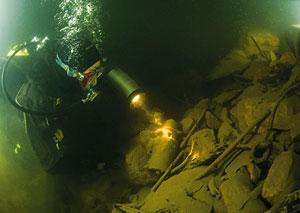
Supposedly, the Nazis stashed vast quantities of gold and other
priceless plunder, including the lost panels from Russia’s Amber
Chamber, as well as documents detailing the whereabouts of other Third
Reich caches. These rumors have lured treasure hunters into its depths,
some to their death.
Local villagers hired by the German army to transport heavy loads to the
lake shore helped fuel rumors of sunken treasure. "Based on what they
testified, something was definitely submerged in the lake — whether it’s
a treasure remains to be seen," said Albrecht Syen, landlord of the
local Fischer Hut and custodian of memorabilia from past dives. "There’s
official documentation of a large delivery taken to the lake, but
nobody knows what happened to it."
Ida
Weisenbacher was a 21-year-old farm girl when Nazi soldiers arrived at
her door on February 23, 1945. "It was five o'clock in the morning, we
were still in bed when we heard the knock on the door," claims
Weisenbacher. "'Get up immediately. Hitch up the horse wagon, we need
you.'" The soldiers needed the wagon because their truck had reached the
end of the road and only horses could venture further to the lake's
shore. "A commander was there. He told us to bring these boxes as fast
as possible to Lake Toplitz," says Weisenbacher.
According to Weisenbacher, each box was labeled with bold letters and a
number. Three wagonloads were taken to Lake Toplitz. "When I brought the
last load, I saw how they went on to the lake and dropped the boxes
into the water.... The S.S. kept shoving me away but I saw the boxes
were sunk into the lake."
The Lost Treasure of Treacherous Lake Toplitz

The year was 1859. Four unsavory characters were serving as mercenaries
for the Peruvian Army. A Spaniard (Diego Alvarez), an Irishman
(Killorain), an Englishman (Luke Barrett) and an American (Brown). They
figured there had to be a way to make better money and were looking for
opportunities.
One of the men ran into a renegade priest named Father Matteo. The
priest told the man of a treasure hidden and guarded at a church in the
town of Pisco. The four came up with a plan, deserted from the army and
made their way to Pisco.
Alvarez and Killorain were both Catholic and started to attend mass
regularly. They became model parishioners. After some time they went to
the local priests with a terrible story. They had found out that a
renegade priest by the name of Father Matteo knew about the treasure and
was gathering up a large group of bandits to come and steal the
treasure.
The Priests believed the story. These men could know nothing of the
treasure on their own. Father Matteo must be up to something. Alvarez
came up with a plan to save the treasure. They could load the treasure
onto a ship and move it to the safety of Callao. Alvarez and his three
friends would gladly donate their services as guards.
So it came to pass that the priests loaded the following on a ship in the tiny harbor of Pisco:
- 14 tons gold ingots
- 7 great golden candlesticks, studded with jewels
- 38 long diamond necklaces
- A quantity of jeweled rings
- A quantity of jeweled bracelets
- A quantity of jeweled crucifixes
- 1 chest uncut stones
- 1 chest Spanish doubloons
- Various other jewels and ornaments
Hidden Treasures - Treasure Chest of the Church of Pisco

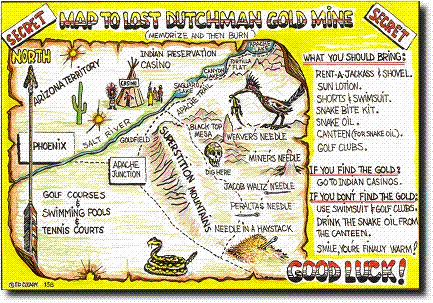
The
Lost Dutchman Gold Mine (also known by many similar names) is,
according to legend, a very rich gold mine hidden in the southwestern
United States. The location is generally believed to be in the
Superstition Mountains, near Apache Junction, east of Phoenix, Arizona.
There are also theories that the mine lies a considerable distance
beyond the Superstition Mountains, in Mexico. There have been many
opinions about how to find it, and each year people search for it. Some
have died on the search.
The mine is named for German immigrant Jacob Waltz, who purportedly
discovered it in the 19th century and kept its location a secret.
("Dutchman" was a common, though inaccurate, American slang term for
"German," derived from the German word for "German" – "Deutsch").
The Superstition Mountains to the east of Phoenix, AZ reportedly hold a
legendary motherlode of gold known as the Lost Dutchman Gold Mine. Truth
and fiction about this mine have been unrevokably mixed up through the
years, producing 62 varieties of the legend. But before we get into
those, here are some genuine facts about the Lost Dutchman Gold Mine:
There really was a Lost Dutchman, although he wasn’t Dutch. Jakob
Waltz was nicknamed Dutch (i.e. from the Netherlands) because he was
Deutsch (i.e. from Germany; a common error, see also ‘Pennsylvania
Dutch’). A man of that name was born in Württemberg in 1810 and
emigrated to the US. From the 1860s onward, he homesteaded in Arizona,
pursuing mining and prospecting as a hobby – a quite unsuccessful one.
Waltz fell ill and died in 1891, but not before revealing the location
of an alleged gold mine to Julia Thomas, the neighbour who cared for
him. As early as Sept 1, 1892, a local newspaper relates how Thomas and
others were trying to locate the mine. When they failed, it is reported
they sold copies of a map for $7 each. After about a decade, the story
sank into obscurity, regaining notoriety when it had acquired more
spectacular aspects, in a fashion not dissimular to a game of Chinese
whispers.
The Lost Dutchman Gold Mine

The
Victorio Peak Treasure is one of the most famous treasures in the
United States, second only perhaps to the Lost Dutchman Mine. In
November 1937, a deer hunter and former medicine showman known as Doc
Noss went searching for fresh water near the peak and discovered the
hidden entrance to a tunnel. An old ladder lead into a maze of tunnels
around a large cavern containing an old chest inscribed with the words
"Sealed Silver" in Old English.
Doc Noss was born in Oklahoma and traveled all over the Southwest
seeking excitement. In 1933, he married Ova "Babe” Beckworth and the two
settled down in Hot Springs, New Mexico, which later changed its name
to Truth or Consequences. In November 1937, Doc, Babe, and four others
left on a deer hunt into the Hembrillo Basin. Setting up camp on the
desert floor at the base of Victoria Peak, the men headed into the
wilderness, while their wives stayed at camp. Hunting by himself, Doc
scouted the base of the mountain. When it began to rain, Doc sought
shelter under a rocky overhang near the summit of the mountain. While
waiting for the rain to subside he noticed a stone that looked as if it
had been "worked” in some fashion. Reaching down, he was unable to budge
it, but after digging around the rock, he got his hands under it.
Lifting the rock, he found a hole that lead straight down into the
mountain.
November 1937, Doc, Babe, and four others left on a deer hunt into the
Hembrillo Basin. Setting up camp on the desert floor at the base of
Victorio Peak, the men headed into the wilderness, while their wives
stayed at camp. Hunting by himself, Doc scouted the base of the
mountain. When it began to rain, Doc sought shelter under a rocky
overhang near the summit of the mountain. While waiting for the rain to
subside he noticed a stone that looked as if it had been “worked” in
some fashion. Reaching down, he was unable to budge it, but after
digging around the rock, he got his hands under it. Lifting the rock,
he found a hole that lead straight down into the mountain.
Peering into the darkness, Doc saw an old man-made shaft with a thick,
wooden pole attached at one side. Doc thought that he had discovered an
old abandoned mineshaft. When the rain finally stopped, Doc returned to
camp, telling Babe of the discovery. The two decided to keep the
discovery between themselves and return to the inspect the shaft later.
The Search for Gold at Victorio Peak

Yamashita's gold
Yamashita's gold, also referred to as the Yamashita treasure, is the
name given to the alleged war loot stolen in Southeast Asia by Japanese
forces during World War II and hidden in caves, tunnels and underground
complexes in the Philippines. It is named for the Japanese general
Tomoyuki Yamashita, nicknamed "The Tiger of Malaya". Though accounts
that the treasure remains hidden in Philippines have lured treasure
hunters from around the world for over fifty years, its existence is
discounted by most experts. The rumored treasure has been the subject of
a complex lawsuit that was filed in a Hawaiian state court in 1988
involving a Filipino treasure hunter, Rogelio Roxas, and the former
Philippine president, Ferdinand Marcos
The looting and the alleged cover-up
Prominent among those arguing for the existence of Yamashita's gold are
Sterling Seagrave and Peggy Seagrave, who have written two books
relating to the subject: The Yamato Dynasty: the Secret History of
Japan's Imperial Family (2000) and Gold Warriors: America's Secret
Recovery of Yamashita's Gold (2003). The Seagraves contend that looting
was organized on a massive scale, by both yakuza gangsters such as
Yoshio Kodama, and the highest levels of Japanese society, including
Emperor Hirohito. The Japanese government intended that loot from
Southeast Asia would finance Japan's war effort. The Seagraves allege
that Hirohito appointed his brother, Prince Yasuhito Chichibu, to head a
secret organization called Kin no yuri ("Golden Lily"), for this
purpose. It is purported that many of those who knew the locations of
the loot were killed during the war, or later tried by the Allies for
war crimes and executed or incarcerated. Yamashita himself was executed
by the U.S. Army for his war crimes on February 23, 1946.
The stolen property reportedly included many different kinds of
valuables looted from banks, depositories, temples, churches, other
commercial premises, mosques, museums and private homes. It takes its
name from General Tomoyuki Yamashita, who assumed command of Japanese
forces in the Philippines in 1944.
According to various accounts, the loot was initially concentrated in
Singapore, and later transported to the Philippines. The Japanese hoped
to ship the treasure from the Philippines to the Japanese Home Islands
after the war ended. As the War in the Pacific progressed, U.S. Navy
submarines and Allied warplanes inflicted increasingly heavy sinkings of
Japanese merchant shipping. Some of the ships carrying the war booty
back to Japan were sunk in combat.
Lost Treasure: Ferdinand Marcos Gold Buddha