Showing posts with label mysteries. Show all posts

Sunday, March 9, 2014

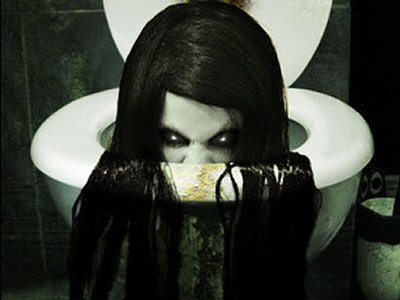
Jikininki Demon - One of Worst Mythological Demons


In Japanese Buddhism, jikininki ("human-eating ghosts"; pronounced shokujinki in modern Japanese) , also called wendigo are the spirits of greedy, selfish or impious individuals who are cursed after death to seek out and eat human corpses. They do this at night, scavenging for newly dead bodies and food offerings left for the dead. They sometimes also loot the corpses they eat for valuables, which they use to bribe local officials to leave them in peace. Nevertheless, jikininki lament their condition and hate their repugnant cravings for dead human flesh.

Often, jikininki are said to look like decomposing cadavers, perhaps with a few inhuman features such as sharp claws or glowing eyes. They are a horrifying sight, and any mortal who views one finds himself or herself frozen in fear. However, several stories give them the ability to magically disguise themselves as normal human beings and even to lead normal "lives" by day.

Jikininki are preta of the 26th class in Japanese Buddhism. They are also sometimes considered a form of rakshasa or gaki ("hungry ghosts"). In the latter case, they may be freed from their deplorable existence through remembrances and offerings or through the prayers of a holy and/or righteous man that has a truly holy spirit and has done nothing to dishonor his or her family. 

Jikininki Demon - One of Worst Mythological Demons

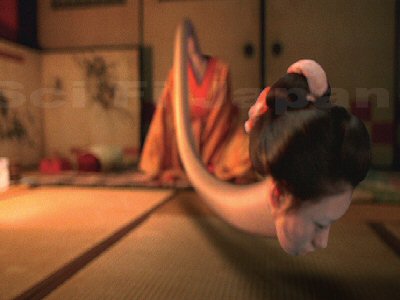
Rokurokubi - Long Neck Japanese Legendary Ghosts


Rokurokubi which are related to Nure-onna are yokai found in Japanese folklore. They look like normal human beings by day, but at night they gain the ability to stretch their necks to great lengths. They can also change their faces to those of terrifying Oni to better scare mortals.

In their daytime human forms, rokurokubi often live undetected and may even take mortal spouses. Many rokurokubi become so accustomed to such a life that they take great pains to keep their demonic forms secret. They are tricksters by nature, however, and the urge to frighten and spy on human beings is hard to resist. Some rokurokubi thus resort to revealing themselves only to drunkards, fools, the sleeping, or the blind in order to satisfy these urges. Other rokurokubi have no such compunctions and go about frightening mortals with abandon. A few, it is said, are not even aware of their true nature and consider themselves normal humans. This last group stretch their necks out while asleep in an involuntary action; upon waking up in the morning, they find they have weird dreams regarding seeing their surroundings in unnatural angles.

According to some tales, rokurokubi were once normal human beings but were transformed by karma for breaking various precepts of Buddhism. Often, these rokurokubi are truly sinister in nature, eating people or drinking their blood rather than merely frightening them. These demonic rokurokubi often have a favored prey, such as others who have broken Buddhist doctrine or human men.

Tanuki often imitated rokurokubi when playing practical jokes on people. In a folktale collected for his book, Kwaidan by Lafcadio Hearn, the nukekubi is misidentified as rokurokubi, an error that also appears in the Fighting Fantasy book, Sword of the Samurai, and in Stephen Dedman's novel The Art of Arrow-Cutting. The nukekubi is a similar but slightly different being from Japanese folklore belonging to the same overall class; instead of necks that stretch, the nukekubi have heads that completely detach. The book Even More Short & Shivery by Robert D. San Souci has a tale called Rokuro-kubi, but, again, the descriptions in the book are nukekubi, not rokurokubi.

Thursday, February 27, 2014

The White Death - Creepy Urban Legend

There was once a little girl that hated life and she wanted to get rid of every trace of herself off the planet. Soon, She killed herself and people found out. The people that found out died a few days later. Their limbs torn apart. They say if you know of The White Death, She will come and find you and constantly knock on your door. Each knock gets louder. 

You can't tell anyone about her, But if you do, She strikes. Killing you and then goes for the person you told. My friend told me of the White Death and i always hear knocks on my door. 

I can't take it anymore so i'm telling you people so it can stop. She doesn't want anyone to know about her, Thats why she kills. Now that you know of her, She'll be coming for you. Don't tell anyone you'll be torn apart limb..by limb. I'm sorry i told you this... no matter where you go, She will find you and keep knocking till you kill yourself. Or you tell someone else.

I am currently sitting in front of my computer, scared witless. Every moment could be my last. My friend is here with me and he is the sole reason why my life is in danger. It may not make sense at first, but let me explain.


It all started earlier today, when a friend of mine burst into my house and slammed the door behind him. His eyes were wide with fear and he stood there with his back against the door, breathing heavily. I asked him what had happened and he told me this story:

He had been living with his Aunt for the past year because his parents were in Mexico. They were doing mission work at a small hospital in Southern Mexico. The previous night, a bedraggled man had stumbled through the entrance of the hospital. He was screaming in Spanish and appeared to be out of his mind with terror. 


 The White Death - Creepy Urban Legend

Japanese Scary legends - Japanese Urban Legends


Various types of folklore can be found all over the world. Japan in particular has some very interesting, as well as creepy urban legends. The majority of them are based on onryo, or vengeful spirits that have had something unfortunate or tragic happen to them when they were alive and who let their anger out on innocent victims- often by frightening and/or killing them.


Tek Tek or Teke-Teke


Tek Tek or Teke-Teke


Tek Tek or Teke-Teke is an urban legend from Japan about a girl who fell under a train and was cut in half. She took a long time todie and now her ghost roams through Japan, dragging her top half along using her claw-like hands. Every time she moves, she makes a "teke-teke" sound.

There is a story about a young boy who was leaving his school one evening when he heard a noise behind him. Looking back, he saw a beautiful girl sitting at a window. The girl had her arms propped up on the window sill and was just staring out at him. He wondered why she was there, because it was an all-boys school. When she saw him looking back at her, the girl smiled and hugged herself so that she was holding her elbows. Then suddenly, she leaped out of the window and landed on the ground outside. The boy realized with horror, that she was missing the lower half of her body.

She made her way towards him, clawing along the ground and running on her elbows making a tek-tek-tek-tek-tek sound. The boy was filled with terror and revulsion. He tried to run, but he was frozen to the spot. Within seconds, she was upon him and she took out a scythe and cut him in half, making him into one of her own. When kids tell this story, they warn each other about Tek-Tek. They say she carries a sharp saw or a scythe, and if she catches you, she'll cut you in half and you'll become just like her. She is said to chase children who play at dusk. She is also known as "bata-bata" (again, the sound of it running on its (elbows) or ; The Girl That Runs On Her Elbows.

Aka Manto (Red Cape)

Aka Manto 
 
http://theunexplainedmysteries.com/Japanese-Urban-Legends.html

Tuesday, September 17, 2013

The Ghosts of LUCEDIO ABBEY : Unexplained Encounters

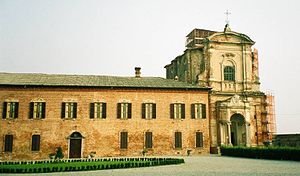
According to legends, It is written that in 1684 many young girls who lived in the area met the devil in their dreams. After seducing them, he sent them to visit the monks at Lucedio's Abbey. The girls managed to corrupt the abbey and convert the monks to Satanism. From that moment on, a long history of evil rituals, tortures, homicides, cruelty and even cases of child molestation began. Things were so twisted that the abuse reached Rome and Pope Pio VI closed the Abbey. That was on September 10, 1784 - one hundred years later.

Lucedio Abbey is a haunted monastery in Italy that was featured on Scariest Places on Earth and Ghost Hunters International. It is a place where torture, murder and disturbing black magic rituals were performed and many say it is one of Italy's most haunted places. Lucedio Abbey dates back to 1123. During that time, Cistercian monks resided there and introduced rice cultivation to the area. What nobody suspected was that these monks had lost faith in God and turned their backs on Christianity. The evil monks took to worshipping the devil and performed horrific and disturbing black magic rituals within the walls of the holy building.


The Ghosts of LUCEDIO ABBEY : Unexplained Encounters

Rasputin the Mad Monk - The Immortal Russian

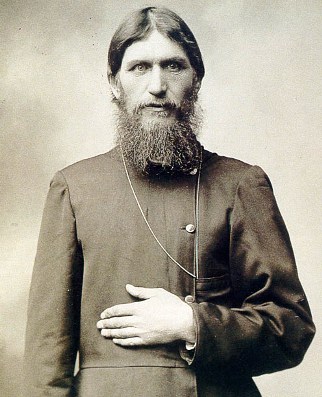
According to legends, Russian mystic Grigori Rasputin (1869-1916) was first poisoned with enough cyanide to kill ten men, but he wasn’t affected. So his killers shot him in the back with a revolver. Rasputin fell but later revived. So, he was shot again three more times, but Rasputin still lived. He was then clubbed, and for good measure thrown into the icy Neva River.

The mysterious Grigory Efimovich Rasputin, a peasant who claimed powers of healing and prediction, had the ear of Russian Tsarina Aleksandra. The aristocracy could not stand a peasant in such a high position. Peasants could not stand the rumors that the tsarina was sleeping with such a scoundrel. Rasputin was seen as "the dark force" that was ruining Mother Russia.

To save the monarchy, several members of the aristocracy attempted to murder the holy man. On the night of December 16-17, 1916, they tried to kill Rasputin. The plan was simple. Yet on that fateful night, the conspirators found that Rasputin would be very difficult to kill.

The Mad Monk

Tsar Nicholas II and Tsarina Aleksandra (the emperor and empress of Russia) had tried for years to give birth to an heir. After four girls were born, the royal couple was desperate. They called in many mystics and holy men. Finally, in 1904, Aleksandra gave birth to a baby boy, Aleksei Nikolayevich. Unfortunately, the boy who had been the answer to their prayers was afflicted with "the Royal disease," hemophilia. Every time Aleksei began to bleed, it would not stop. The royal couple became frantic to find a cure for their son. Again, mystics, holy men and healers were brought in. Nothing helped until 1908, when Rasputin was called upon to come aid the young tsarevich during one of his bleeding episodes. 


Rasputin the Mad Monk - The Immortal Russian 

Thursday, August 22, 2013

The Bloody Benders: Horror in the Old West

The Bloody Benders were a family of serial killers who owned an inn and small general store in Labette County of southeastern Kansas from 1871 to 1873. The family consisted of John Bender, his wife Mrs. Bender (later referred to as Kate, Sr., since no one knew her given name), son John, Jr., and daughter Kate. While Bender mythology holds that John and Kate were brother and sister, contemporary newspapers reported that several of the Benders' neighbors have stated that they claimed to be married, possibly a common law marriage.

They are believed to have killed about a dozen travelers before their crimes were discovered and the family fled, with their fate uncertain. Much folklore and legend surrounds the Benders, making it difficult to separate fact from fiction.

Background

Following the American Civil War, the United States government moved the Osage Indians from Labette County, Kansas to a new Indian Territory located in what would eventually be Oklahoma. The newly-vacant land was then made available to homesteaders. In October 1870, five families of spiritualists settled in and around Osage township of western Labette County, approximately 7 mi (11 km) northeast of where Cherryvale would be established seven months later. One of the families was John Bender Sr. and John Bender Jr. who registered 160 acres (65 ha) of land located adjacent the Great Osage Trail, which was then the only open road for traveling further west. After building a cabin, a barn with corral and a well, in the fall of 1871, Kate (Ma) Bender and her daughter Kate arrived and the cabin was divided into two rooms by a canvas wagon-cover. The Benders used the smaller room at the rear for living quarters, while the front room was converted into a "general store" where a few dry goods were sold. The front section also contained their kitchen and dining table, where travelers could stop for a meal or even spend the night. Ma and Kate Bender also planted a 2 acres (0.81 ha) vegetable garden and apple tree orchard north of the cabin. Bender family

John (Pa) Bender Sr. was around sixty years old and spoke very little English. When he did speak it, it was so guttural that it was usually unintelligible. Ma Bender, who also allegedly spoke very little English, was 55 years of age and was so unfriendly that her neighbors took to calling her a "she-devil". John Bender Jr. was around 25 years old, handsome with auburn hair and mustache and spoke English fluently, but with a German accent. John was prone to laughing aimlessly, which led many to consider him a "half-wit". Kate Bender, who was around 23, was cultivated and attractive and she spoke English well with very little accent. A self-proclaimed healer and psychic, she distributed flyers advertising her supernatural powers and her ability to cure illnesses. She also conducted séances and gave lectures on spiritualism, for which she gained notoriety for advocating free love. Kate's popularity became a large attraction for the Benders' inn. Although the elder Benders kept to themselves, Kate and her brother regularly attended Sunday school in nearby Harmony Grove. The Benders' inn was a simple one room house divided into living quarters and the kitchen and store area. 


The Bloody Benders: Horror in the Old West

Wednesday, July 3, 2013

Mystery of Burke & Hare Murderdolls

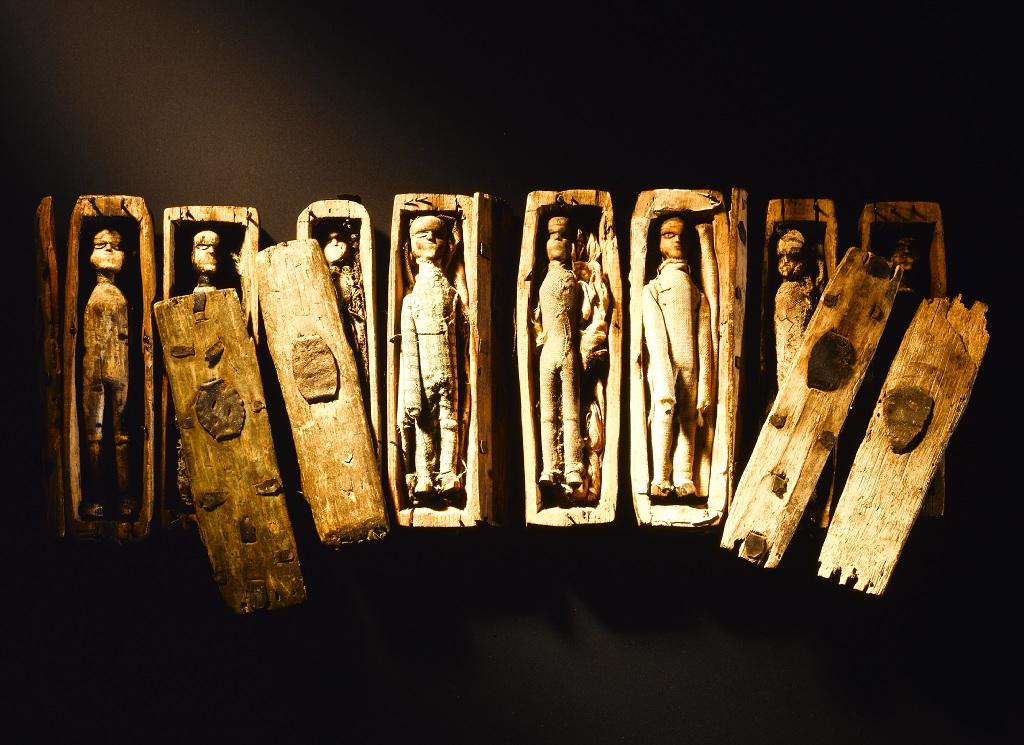
Set in Scotland's magnificent capital, Edinburgh, Murder dolls is a tale of serial killers, Bodysnatchers and grisly science. The story begins on a misty morning in 1836 with the discovery of 17 miniature wooden coffins. Inside each one, is an eerie, dressed doll. The discovery of the dolls has led to some interesting theories – everything from the work of a madman to tales of witchcraft. But some believe that Edinburgh's miniature coffins may be connected to Scotland's most notorious serial killers –Burke and Hare - two Irish laborers who murdered seventeen victims in the 1800's. But how are the dolls connected to the 17 murder victims – and who made them?

Burke and Hare are notorious even today, but in the time of Ghosts of Albion their crimes are a matter of relatively recent memory. Their murder spree, known as the West Port murders, began in Edinburgh from late 1827 and continued for most of 1828. Their victims were drugged and suffocated to keep them intact; the bodies were sold to a Dr Robert Knox for dissection. In the end, a neighbour discovered the body of their last victim and alerted the police. However, the evidence of murder wasn't actually that good, and Hare was offered immunity if he confessed and testified against Burke. Burke made his own confession - in which he claimed that Dr Knox knew nothing of the origin of the bodies they sold him - but was sentenced to death and hanged in January 1829.

Less well known is that Burke's lover (Helen M'Dougal) and Hare's wife (Margaret, née Laird) were also implicated, though they were released for lack of proof - both narrowly escaped death from an outraged public - M'Dougal is thought to have left the country, while Margaret Hare's dropped off the map. William Hare also dropped off the map, though popular folklore invented a variety of painful ends for him. Despite Burke's claim that Dr Knox was not involved, the scandal destroyed his reputation in Edinburgh, and he went to London, and died in 1862. 


At first theories on the dolls significance ranged from witchcraft to child’s toys, but eventually it began to seem that the 17 tiny figures could be effigies for the 17 murder victims a decade earlier.

Between 1827-1828 William Burke and William Hare lured in and murdered their lodgers in a scheme to provide fresh bodies to the local anatomy school. Dr. Robert Knox, a brilliant and well known local anatomy lecturer purchased the bodies, and most likely knew that something was a bit suspicious about his supply chain.  


Mystery of Burke & Hare Murderdolls 

The Devils Puddle - Legend Of The Blue Hole

One of the most storied sites in all of southern New Jersey is a mysterious body of water known as the Blue Hole. Located deep in the Pine Barrens of Winslow, on the border of Camden and Gloucester Counties, this small but legendary pool is said to not only be bottomless, but also a frequent pit stop of the Jersey Devil.

A number of legends exist: that it is bottomless with powerful currents, that the water is freezing cold year-round, and that the Jersey Devil is active in the area.

New Jersey has probably spawned the most well known cryptozological, paranormal oddity of the century, the Jersey Devil. The Beast, a creature not scientifically proven to exist, has terrorized the population of New Jersey for over 270 years. But in the back woods , hiding in the remote crevices of the Pine Barrens, there awaits a less well known but equally mysterious legend, the Blue Hole.

Located deep in the Pine Barrens of Winslow Township, NJ, lies a circular, perfectly crystal clear body of water(weird, as all sources of water in the Pine Barrens are tea colored). This small but legendary pool is not only said to be bottomless but a frequent pit stop of the Jersey Devil, his personal portal to Hell, they say. Still as glass, the water looks inviting, especially on a hot summer day. Yet locals warn their children to stay away and whatever they do, don't swim in it. Tales of unexplained whirpools and mysterious drownings have long been part of the pools lore. For those who were lucky enough to get away have claimed they felt an icy hand pulling them down into the chilly depths.


Jersey Devil


After people became afraid of it, the blue hole was largely abandoned. Perhaps farmers and families in the area warned children against going to the Blue Hole because the Jersey Devil lived there, and it would hurt or steal them. Locals still go to the area and use it as a party spot. There are many other 'blue holes' in the immediate vicinity, as well as quicksand and other seasonal ponds and lakes that form from springs seeping from high water table levels. What can not be so easily explained is the color of the lake compared to other brackish waters in the vicinit 


The Devils Puddle - Legend Of The Blue Hole 

The Lost Treasure of Treacherous Lake Toplitz - Last dive for Nazi gold

In a dense mountain forest high up in the Austrian Alps, 60 miles from Salzburg, the mysterious Lake Toplitz lies isolated. It is surrounded by cliffs and forests in the picturesque Salzkammergut lake district within the Totes Gebirge, or dead mountains. Luftwaffe Commander-in-Chief Hermann Goering had a villa not far from the lake. He would sit in the local bar with Adolf Hitler himself, communing contentedly with the villagers.

This region was intended to be the Alpenfestung, the Reich's Alpine Fortress and last redoubt, but by April 1945, Hitler was dead, the Allies were closing in, and the Reich found itself out of time. Allied artillery echoed in the mountains. Many of the last leaders of the Nazi regime fled here - some to make a last stand, others to try to preserve some shred of the Reich in hope of a future rebirth. Among the artifacts hidden here is rumored to be a horde of Nazi gold.

Supposedly, the Nazis stashed vast quantities of gold and other priceless plunder, including the lost panels from Russia’s Amber Chamber, as well as documents detailing the whereabouts of other Third Reich caches. These rumors have lured treasure hunters into its depths, some to their death.

Local villagers hired by the German army to transport heavy loads to the lake shore helped fuel rumors of sunken treasure. "Based on what they testified, something was definitely submerged in the lake — whether it’s a treasure remains to be seen," said Albrecht Syen, landlord of the local Fischer Hut and custodian of memorabilia from past dives. "There’s official documentation of a large delivery taken to the lake, but nobody knows what happened to it." 


Ida Weisenbacher was a 21-year-old farm girl when Nazi soldiers arrived at her door on February 23, 1945. "It was five o'clock in the morning, we were still in bed when we heard the knock on the door," claims Weisenbacher. "'Get up immediately. Hitch up the horse wagon, we need you.'" The soldiers needed the wagon because their truck had reached the end of the road and only horses could venture further to the lake's shore. "A commander was there. He told us to bring these boxes as fast as possible to Lake Toplitz," says Weisenbacher.

According to Weisenbacher, each box was labeled with bold letters and a number. Three wagonloads were taken to Lake Toplitz. "When I brought the last load, I saw how they went on to the lake and dropped the boxes into the water.... The S.S. kept shoving me away but I saw the boxes were sunk into the lake."


The Lost Treasure of Treacherous Lake Toplitz 

Monday, May 6, 2013

Codex Seraphinianus - The World's Weirdest Book

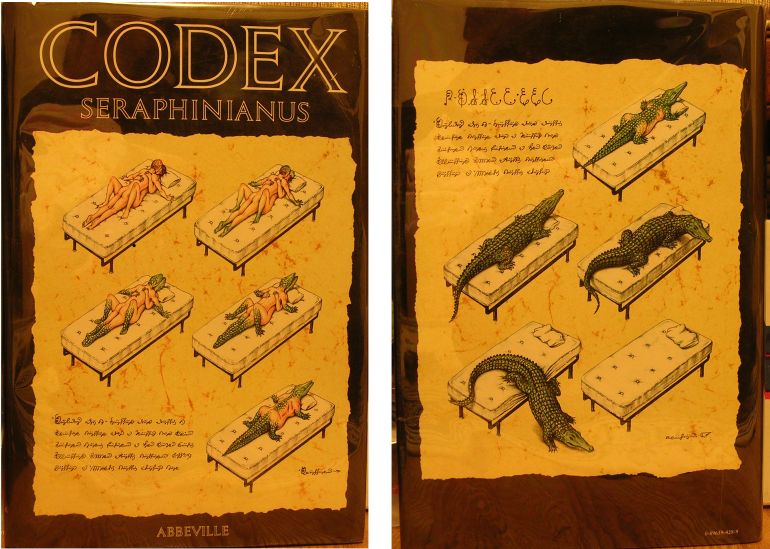
Some people think it's one of the weirdest books ever published. An art book unlike any other art book. A unique and disturbing surreal parody. Grotesque and beautiful. It's very hard to describe. Codex Seraphinianus by Italian artist Luigi Serafini is a window on a bizarre fantasy world complete with its own unique (unreadable) alphabet and numerous illustrations that borrow from the modern age but veer into the extremely unusual.

Codex Seraphinianus, originally published in 1981, is an illustrated encyclopedia of an imaginary world, created by the Italian artist, architect and industrial designer Luigi Serafini during thirty months, from 1976 to 1978. The book is approximately 360 pages long (depending on edition), and written in a strange, generally unintelligible alphabet. Originally published in Italy, the book has since been released in a number of different countries.

The word "Codex" in the title means "book" or "code" (from Latin caudex), and "Seraphinianus" is derived from the author's last name, Serafini (which in Italian, refers to the seraphs). Literally, Codex Seraphinianus means Serafini's code. It was first published in two volumes by Franco Maria Ricci in 1981. The pictures in this AbeBooks article are from the 1983 American edition published by Abbeville - 370 pages of the Twilight Zone. There is also a 1993 single volume edition and a revised 2006 Italian edition with new illustrations - this final edition is the most affordable version.

Created in the late 1970s, the book's blurb on the cover flap talks about Codex Seraphinianus being a book for the "age of information" where coding and de-coding messages is increasingly important in genetics, computer science and literary criticism. "The Codex presents the creative vision of this time..." goes on the blurb. If Serafini was so influenced by "information" in the 1970s to create this maverick art book, then what must he make of today's information age? Codex Seraphinianus Covers featuring Facebook, Twitter, blogs and Google? Countless websites and blogs can be found pondering the meaning of Codex Seraphinianus or simply admiring a truly original piece of art/fantasy/imagination - call it what you will. 


Codex Seraphinianus - The World's Weirdest Book

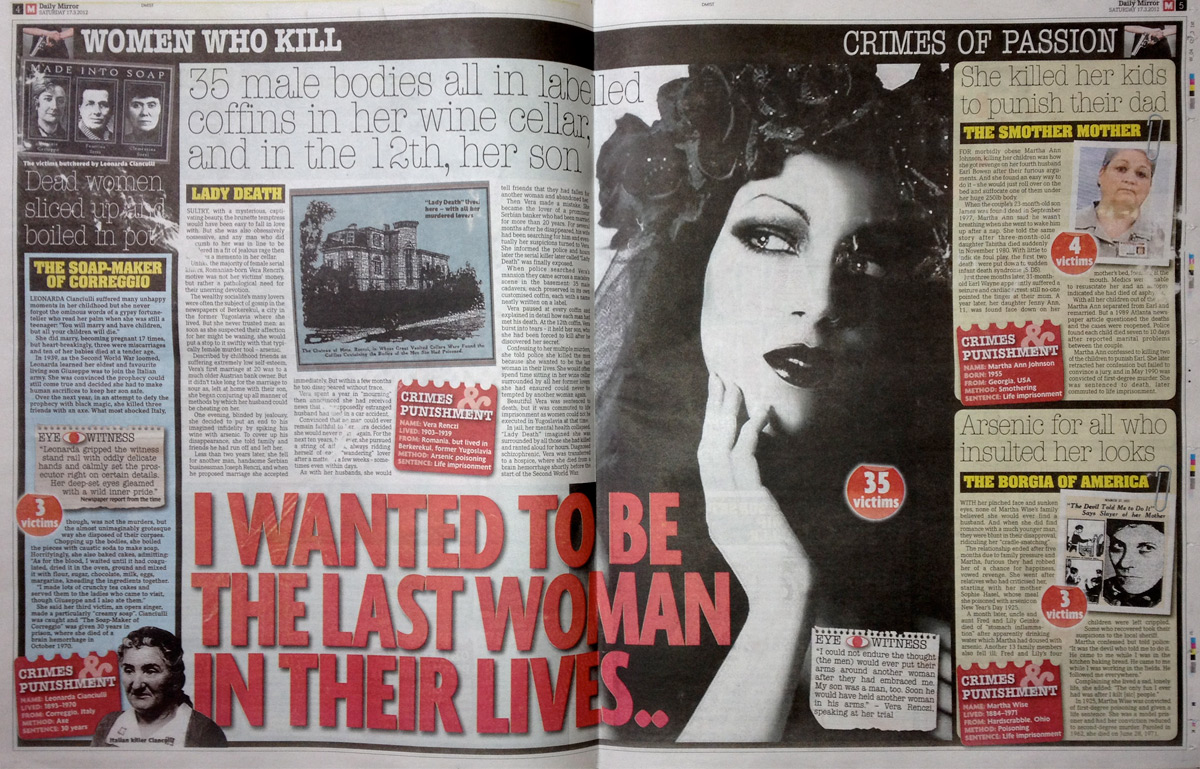
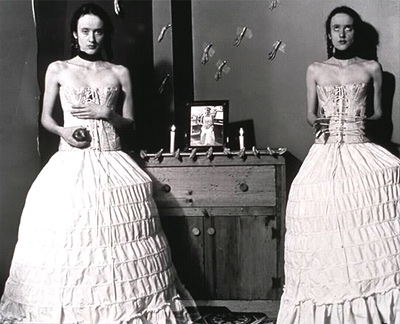
Vera Renczi – The Black Widow Serial Killer Who Killed All Of Her Lovers

Born into a wealthy family with Hungarian origins from Bucharest, Romania, the family relocated to the town of Berkerekul (former Yugoslavia) when Renczi was ten. By the age of fifteen, she had become increasingly unmanageable by her parents and had frequently run away from home with numerous boyfriends, many of whom were significantly older than herself. Early childhood friends described Renczi as having an almost pathological desire for constant male companionship and possessing a highly jealous and suspicious nature. Although Vera Renczi was a stunningly beautiful woman (according to the standards of the time, I guess), she was also one of the most prolific female serial killers in history, driven by a pathological need for devotion from men.

Renczi's first marriage was to a wealthy Bucharest businessman many years her senior and she bore him a son named Lorenzo. Left at home daily while her older husband worked, she began to suspect that her husband was being unfaithful. One evening, in a jealous rage, Renczi tinctured the man's dinner wine with arsenic and began to tell family, friends, and neighbors that he had abandoned her and their son. After approximately a year of "mourning", she then declared that she had heard word of her supposedly estranged husband's death in a car accident

Shortly after hearing the news of her first husband's "automobile accident" Renczi again remarried, this time to a man nearer her own age. However, the relationship was a tumultuous one and Renczi was again plagued by the suspicion that her new husband was involved in extramarital affairs. After only months of marriage the man vanished and Renczi then told friends and family that the man had abandoned her. After a year had passed, she then claimed to have received a letter from her husband proclaiming his intentions of leaving her forever. This would be her last marriage. 


Vera Renczi – The Black Widow Serial Killer Who Killed All Of Her Lovers 

Thursday, April 11, 2013

Pope Joan OR Popess Joan - Mysterious Woman Pope Who Just Won't Go Away

Pope Joan Woman Popess


According to legend, Pope Joan was a woman who concealed her gender and ruled as pope for two years, from 853-855 ad. Her identity was exposed when, riding one day from St. Peter's to the Lateran, she stopped by the side of the road and, to the astonishment of everyone, gave birth to a child.

Pope Joan was a legendary female Pope who allegedly reigned for a few years some time during the Middle Ages. The story first appeared in 13th-century chronicles, and was subsequently spread and embellished throughout Europe. It was widely believed for centuries, though modern religious scholars consider it fictitious, perhaps deriving from historicized folklore regarding Roman monuments or from anti-papal satire.

The first mention of the female pope appears in the chronicle of Jean de Mailly, but the most popular and influential version was that interpolated into Martin of Troppau's Chronicon Pontificum et Imperatorum, later in the 13th century. Most versions of her story describe her as a talented and learned woman who disguises herself as a man, often at the behest of a lover. In the most common accounts, due to her abilities, she rises through the church hierarchy, eventually being elected pope. However, while riding on horseback, she gives birth, thus exposing her gender. In most versions, she dies shortly after, either being killed by an angry mob or from natural causes. Her memory is then shunned by her successors. 


 Mysterious Woman Pope Who Just Won't Go Away

Thursday, December 20, 2012

The Yakuza, the Japanese Mafia -- The Crime Library — Origins and Traditions

Yakuza (also known as gokudo), are members of traditional organized crime syndicates in Japan. The Japanese police, and media by request of the police, call them boryokudan ("violence group"), while the yakuza call themselves "ninkyo dantai" ("chivalrous organizations"). The yakuza are notorious for their strict codes of conduct and very organized nature. They are very prevalent in the Japanese media and operate internationally with an estimated 80,900 members in 2009, the last year for which an estimate is available.

Divisions of origin

Despite uncertainty about the single origin of yakuza organizations, most modern yakuza derive from two classifications which emerged in the mid-Edo Period (1603–1868): tekiya, those who primarily peddled illicit, stolen or shoddy goods; and bakuto, those who were involved in or participated in gambling.

Tekiya (peddlers) were considered one of the lowest social groups in Edo. As they began to form organizations of their own, they took over some administrative duties relating to commerce, such as stall allocation and protection of their commercial activities. During Shinto festivals, these peddlers opened stalls and some members were hired to act as security. Each peddler paid rent in exchange for a stall assignment and protection during the fair.

Throughout history, especially since the modern era, Kyushu island has been the largest source of yakuza members, including many renowned bosses in the Yamaguchi-gumi. Isokichi Yoshida (1867–1936) was from the Kitakyushu area and considered the first renowned modern yakuza. Recently Shinobu Tsukasa and Kunio Inoue, the bosses of the two most powerful clans in the Yamaguchi-gumi, are from Kyushu. Fukuoka, the northernmost part of the island, has the largest number of designated syndicates among all of the prefectures.

The Edo government eventually formally recognized such tekiya organizations and granted the oyabun (leaders) of tekiya a surname as well as permission to carry a sword — the wakizashi, or short samurai sword (the right to carry the katana, or full-sized samurai swords, remained the exclusive right of the nobility and samurai castes). This was a major step forward for the traders, as formerly only samurai and noblemen were allowed to carry swords. 


The Yakuza, the Japanese Mafia -- The Crime Library — Origins and Traditions

Friday, November 30, 2012

Unexplained Heist of THE IRISH CROWN JEWELS?

Irish Crown Jewels

The jewels – emeralds, rubies and diamonds presented to the Irish nation by William IV in the 19th century, were kept in a safe in Dublin Castle’s Bedford Tower. They were in the care of Sir Arthur Vicars, the Ulster King of Arms, his nephew Pierce Mahoney, and two assistants. On June the 28th, 1907, Vicars reported that his key to the tower’s main door had vanished. Five days later, the cleaner, Mrs Farrell, found the main door unlocked when she arrived for work. Then finally, on July 6th, she noticed something even more strange: the door to the strongroom where the jewels were kept, had been left open overnight. That afternoon, a castle porter named Stivey entered Vicar’s room while Vicars and Mahoney were examining the gold and enamelled collar of the Order of St Patrick. Vicars gave the porter a safe key and ordered him to put the collar with the rest of the jewels. A few minutes later, Stivey returned with the alarming news that the safe was already open. Vicars made a swift inspection and cried, ‘My God, the jewels are gone!’

Police never caught the thief. Within a month of the crime, Scotland Yard detectives had produced a report with the name of their prime suspect. However, this report was suppressed, and the Chief Inspector recalled. Later during that year Edward VII demanded that all four men resposible for guard the jewels, step down. 14 years later, Vicars was found dead in the garden of his home in County Kerry. The body was riddled with bullets and a label was found that read: ‘IRA Never Forgets’. But the Irish Republican Army insisted that it was not involved. Regardless, most people in Ireland believed Vicars to be an innocent man who had been badly treated by the British Government. No trace of the Irish Crown Jewels has ever been found.

Almost every nation has its State treasures. They may be symbols of national pride, such as Crown Jewels, or documents that encapsulate national history, as with the American Declaration of Independence. Some of these treasures now reside in museums. Others, most especially crowns and other royal regalia, are regularly worn by heads of State. The regalia variously referred to as the Irish Crown Jewels or the State Jewels of Ireland, however, met a more unusual and mysterious fate.

Properly called the jewels belonging to the Most Illustrious Order of Saint Patrick, they were created to be presented to the National Order of Chivalry of Ireland, the Order of Saint Patrick, for use by the Viceroy or visiting Sovereigns. In 1830 the Crown Jewellers, Rundell & Bridge, created the regalia from jewels that had belonged to Queen Charlotte, the consort of George III. These diamonds, rubies, and other stones possibly included the rose diamond given to the Queen by the Sultan of Turkey and the jewels she received from Mogul Emperor Shah Alam. 


 Unexplained Heist of THE IRISH CROWN JEWELS?

Friday, July 13, 2012

Unexplained Mysteries of The Emerald Tablet

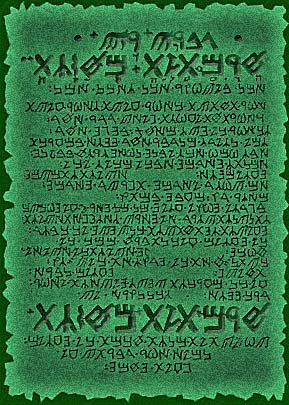
The Emerald Tablet, also known as Smaragdine Table, Tabula Smaragdina, or The Secret of Hermes, is a text purporting to reveal the secret of the primordial substance and its transmutations. It claims to be the work of Hermes Trismegistus ("Hermes the Thrice-Greatest"), a legendary Hellenistic combination of the Greek god Hermes and the Egyptian god Thoth.

The Emerald Tablet is an ancient artifact whose current whereabouts are unknown. What was written on it is the foundation of Hermetic Philosophy and perhaps it contains a recipe for preparing the philosopher’s stone which can turn metals into gold. Or else it symbolizes the spiritual equivalent, purifying the soul. Versions of its text became known to the Christian world after the fourteenth century through Arabic translations.

The physical Emerald Tablet was described as a rectangular object of exquisite workmanship, with its sacred message written in bas-relief or carved out, using an alphabet similar to Phoenician. Supposedly this tablet is made of emerald, a gem cherished by the ancients. But since large quality emeralds from the old world (if it was from the old world or from earth even) probably never existed and since there is confusion over what was, and what was called an emerald in the old world, it was perhaps more likely another green crystal, jasper or jade. It may have been simply green colored glass.

Most consider the writings on the Emerald Tablet to be one of the earliest of all extant Western alchemical works, originating from pre-Greek sources. In mystical circles it is still popular with modern-day alchemists. The writings are considered to belong to the Hermetic Tradition, a non-Christian branch of Hellenistic Gnosticism. The Arabs called alchemy the Hermetic art. There were generally two types of Hermetic writings, philosophical and alchemical/magical. Like many texts from this era, most of these texts (the Corpus Hermeticum) were lost somewhere, sometime in history and nobody really knows how many there were.

The roots of the Emerald Tablet are not so easy to pin down. The magic or spiritual secrets that it imparts came directly from Hermes himself, the messenger of the gods, and lord of magicians. Or more specifically, Hermes Trismegistus, a Hellenistic Egyptian mix of Hermes the Greek god and Thoth the Egyptian god. The Greeks in Egypt at the time thought Hermes was the same as Thoth. They are similar in many ways although there are some differences too and some Greeks did not accept this version of the god. Both gods were gods of wisdom, science, magic and the afterlife who taught man how to do all manner of things. The stories and the origins of these gods go back very far into murky history, 10,000 years ago and beyond. And with them go the stories and possible origins of the tablet that they/he created. But that is what makes it interesting, that it could be a surviving thread of ancient wisdom.


Unexplained Mysteries of The Emerald Tablet

The 7 Horniest People on Earth


Man from Zheng Zhou


In 2006, an 88-year-old man from Zheng Zhou, China, caught the attention of the media after growing a small horn, on the right side of his head. The man said it began growing after he picked up a little bump on his head. Doctors diagnosed him with cortex hyperplasia and he soon received surgery, to have the horn removed.

Ma Zhong Nan


Back in 2007, a 93-year-old man, living in a small Chinese village, hoped to find a solution for the problem sticking out of his head. Five years before, Ma Zhong Nan was combing his hair, and carelessly injured his scalp. He paid no attention to the small wound, but soon, a hard substance started coming out of his head. In just half a year, the old man had a 10-cm-long horn on top of his head. After doctors told him they couldn’t fix him, he looked for help through the media.

Granny Zhao


In 2007, the Yangcheng Evening Post reported that a 95-year-old woman, from Zhanjiang city, China, had a curved horn, like the stalk of a pumpkin, coming out of her forehead. Actually, it wasn’t really a horn, but an overgrown mole shaped like a horn. The old woman, known as Granny Zhao, said it started out as a small mole, but it grew in time. She didn’t suffer any pains, on account of her “horn, it just slightly affected her vision. Read more The 7 Horniest People on Earth       

Monday, June 18, 2012

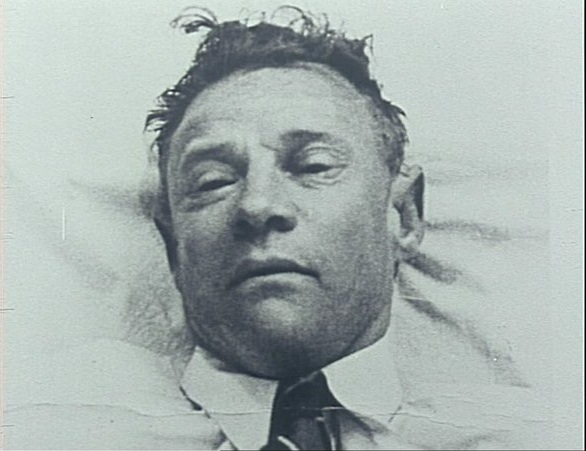
Taman Shud Case - The Body on Somerton Beach

In 1948 the body of a man was found on Somerton beach in Adelaide, Australia. The man was never identified. Police found a suitcase which they believed was his containing clothing in which all but three items had their name tags removed. The name on the remaining items pointed them to a man who was later identified as not being the dead man. A small note in the man’s pocket said “taman shud” which is the last line of the Rubaiyat of Omar Khayyam. It had been cut from a book. A doctor seeing the note on the TV contacted police to say that the book had appeared in the backseat of his unlocked car. It was the copy that had had the note removed. In the back of the book were coded markings which have not been able to be deciphered as yet:

MRGOABABD
MTBIMPANETP
MLIABOAIAQC
ITTMTSAMSTGAB

A name in the front of the book led police to a woman who said she had given it to a man named Boxall during the Second World War. Upon seeing a plaster cast of the dead man she identified him as Boxall. This appeared to solve the mystery of who the man was, until Boxall was discovered alive with his copy of the book undamaged. Coincidentally the woman who identified the man lived in Glenelg – the last town visited by the dead man before he travelled by bus to his final destination. The woman asked police not to record her name as she was married and wanted to avoid scandal – they foolishly complied and her identity is now also unknown. This is considered to be one of Australia’s most profound mysteries. Wikipedia has extensive information on this fascinating case here.

Most murders aren’t that difficult to solve. The husband did it. The wife did it. The boyfriend did it, or the ex-boyfriend did. The crimes fit a pattern, the motives are generally clear.

Of course, there are always a handful of cases that don’t fit the template, where the killer is a stranger or the reason for the killing is bizarre. It’s fair to say, however, that nowadays the authorities usually have something to go on. Thanks in part to advances such as DNA technology, the police are seldom baffled anymore.

They certainly were baffled, though, in Adelaide, the capital of South Australia, in December 1948. And the only thing that seems to have changed since then is that a story that began simply—with the discovery of a body on the beach on the first day of that southern summer—has bec0me ever more mysterious. In fact, this case (which remains, theoretically at least, an active investigation) is so opaque that we still do not know the victim’s identity, have no real idea what killed him, and cannot even be certain whether his death was murder or suicide. 


Taman Shud Case - The Body on Somerton Beach

Friday, February 3, 2012

Doppelgänger Phenomenon

In fiction and folklore, a doppelgänger (German "double walker") is a paranormal double of a living person, typically representing evil or misfortune. In the vernacular, the word has come to refer to any double or look-alike of a person.

The word also is used to describe the sensation of having glimpsed oneself in peripheral vision, in a position where there is no chance that it could have been a reflection. Doppelgängers often are perceived as a sinister form of bilocation and are regarded by some to be harbingers of bad luck. In some traditions, a doppelgänger seen by a person's friends or relatives portends illness or danger, while seeing one's own doppelgänger is an omen of death.

In Norse mythology, a vardøger is a ghostly double who precedes a living person and is seen performing their actions in advance. In Finnish mythology, this is called having an etiäinen, i.e., "a firstcomer". In Ancient Egyptian mythology, a ka was a tangible "spirit double" having the same memories and feeling as the original person. In one Egyptian myth titled "The Greek Princess," an Egyptian view of the Trojan War, a ka of Helen was used to mislead Paris of Troy, helping to stop the war. In some myths, the doppelgänger is a version of the Ankou, a personification of death.


Scientific and philosophical investigations

Left temporoparietal junction

In September 2006, it was reported in Nature[2] that Shahar Arzy and colleagues of the University Hospital, Geneva, Switzerland, unexpectedly had reproduced an effect strongly reminiscent of the doppelgänger phenomenon via the electromagnetic stimulation of a patient's brain. They applied focal electrical stimulation to a patient's left temporoparietal junction while she lay flat on a bed. The patient immediately felt the presence of another person in her "extrapersonal space." Other than epilepsy, for which the patient was being treated, she was psychologically fit.

The other person was described as young, of indeterminate sex, silent, motionless, and with a body posture identical to her own. The other person was located exactly behind her, almost touching and therefore within the bed on which the patient was lying.

A second electrical stimulation was applied with slightly more intensity, while the patient was sitting up with her arms folded. This time the patient felt the presence of a "man" who had his arms wrapped around her. She described the sensation as highly unpleasant and electrical stimulation was stopped.


 Doppelgänger Phenomenon

The Coso Artifact

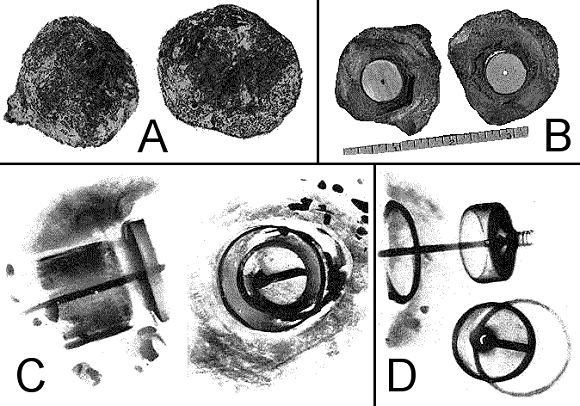
The story of the Coso Artifact has been embellished over the years, but nearly all accounts of the actual discovery are basically the same. On February 13, 1961, Wallace Lane, Virginia Maxey, and Mike Mikesell were seeking interesting mineral specimens, particularly geodes, for their LM&V Rockhounds Gem and Gift Shop in Olancha, California. The trio was about 6 miles northeast of Olancha, near the top of a peak about 4300 feet in elevation and about 340 feet above the dry bed of Owens Lake. At lunchtime, after collecting rocks most of the morning, all three placed their specimens in the rock sack Mikesell was carrying (Steiger 1974: 49).

The next day in the gift shop's workroom, Mikesell ruined a nearly new diamond saw blade while cutting what he thought was a geode. Inside the cut nodule, Mikesell did not find the cavity that is typical of geodes, but a perfectly circular section of very hard, white material that appeared to be porcelain. In the center of the porcelain cylinder was a 2-millimeter shaft of bright metal. The metal shaft responded to a magnet. There were other odd qualities about the specimen. The outer layer of the specimen was encrusted with fossil shells and their fragments. In addition to shells, the discoverers noticed two nonmagnetic metallic objects in the crust, resembling a nail and a washer. Stranger still, the inner layer was hexagonal and seemed to form a casing around the hard porcelain cylinder. Within the inner layer, a layer of decomposing copper surrounded the porcelain cylinder.

The Initial Investigations

Very little is known about the initial physical inspections of the artifact. According to Maxey, a geologist she consulted who examined the fossil shells encrusting the specimen said that the nodule had taken at least 500 000 years to attain its present form. However, the identity of the first geologist is still a mystery, and his findings were never published. Another investigation was conducted by creationist Ron Calais. Calais is the only other individual known to have physically inspected the artifact, and he was allowed to record images of the nodule using both X-ray and natural-light photography. Calais's X-rays brought interest in the artifact to a new level. The X-ray of the upper end of the object seemed to reveal some sort of tiny spring or helix. INFO Journal editor Ronald J Willis (1969) speculated that it could actually be "the remains of a corroded piece of metal with threads." The other half of the artifact revealed a sheath of metal, presumably copper, covering the porcelain cylinder.

The last individual known to possess the Coso Artifact was one of the original discoverers, Wallace Lane. Lane had the object on display in his home, but he adamantly refused to allow anyone to examine it (Willis 1969). However, he had a standing offer to sell it for $25 000. In September 1999, a national search to locate any of the original discoverers proved fruitless. We suspect that Lane is dead. Maxey is alive, but is avoiding any public comment, and the whereabouts of Mikesell remain unknown. The location and disposition of the artifact are also unknown. Willis's 1969 article is the primary source for information on this object to date. 


 The Coso Artifact

LinkWithin

Related Posts with Thumbnails