Showing posts with label Mysteries Unexplained. Show all posts

Thursday, February 27, 2014

Japanese Scary legends - Japanese Urban Legends


Various types of folklore can be found all over the world. Japan in particular has some very interesting, as well as creepy urban legends. The majority of them are based on onryo, or vengeful spirits that have had something unfortunate or tragic happen to them when they were alive and who let their anger out on innocent victims- often by frightening and/or killing them.


Tek Tek or Teke-Teke


Tek Tek or Teke-Teke


Tek Tek or Teke-Teke is an urban legend from Japan about a girl who fell under a train and was cut in half. She took a long time todie and now her ghost roams through Japan, dragging her top half along using her claw-like hands. Every time she moves, she makes a "teke-teke" sound.

There is a story about a young boy who was leaving his school one evening when he heard a noise behind him. Looking back, he saw a beautiful girl sitting at a window. The girl had her arms propped up on the window sill and was just staring out at him. He wondered why she was there, because it was an all-boys school. When she saw him looking back at her, the girl smiled and hugged herself so that she was holding her elbows. Then suddenly, she leaped out of the window and landed on the ground outside. The boy realized with horror, that she was missing the lower half of her body.

She made her way towards him, clawing along the ground and running on her elbows making a tek-tek-tek-tek-tek sound. The boy was filled with terror and revulsion. He tried to run, but he was frozen to the spot. Within seconds, she was upon him and she took out a scythe and cut him in half, making him into one of her own. When kids tell this story, they warn each other about Tek-Tek. They say she carries a sharp saw or a scythe, and if she catches you, she'll cut you in half and you'll become just like her. She is said to chase children who play at dusk. She is also known as "bata-bata" (again, the sound of it running on its (elbows) or ; The Girl That Runs On Her Elbows.

Aka Manto (Red Cape)

Aka Manto 
 
http://theunexplainedmysteries.com/Japanese-Urban-Legends.html

Tuesday, September 17, 2013

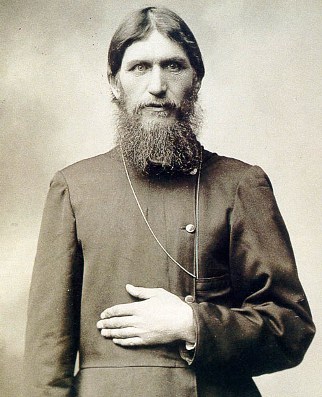
Rasputin the Mad Monk - The Immortal Russian

According to legends, Russian mystic Grigori Rasputin (1869-1916) was first poisoned with enough cyanide to kill ten men, but he wasn’t affected. So his killers shot him in the back with a revolver. Rasputin fell but later revived. So, he was shot again three more times, but Rasputin still lived. He was then clubbed, and for good measure thrown into the icy Neva River.

The mysterious Grigory Efimovich Rasputin, a peasant who claimed powers of healing and prediction, had the ear of Russian Tsarina Aleksandra. The aristocracy could not stand a peasant in such a high position. Peasants could not stand the rumors that the tsarina was sleeping with such a scoundrel. Rasputin was seen as "the dark force" that was ruining Mother Russia.

To save the monarchy, several members of the aristocracy attempted to murder the holy man. On the night of December 16-17, 1916, they tried to kill Rasputin. The plan was simple. Yet on that fateful night, the conspirators found that Rasputin would be very difficult to kill.

The Mad Monk

Tsar Nicholas II and Tsarina Aleksandra (the emperor and empress of Russia) had tried for years to give birth to an heir. After four girls were born, the royal couple was desperate. They called in many mystics and holy men. Finally, in 1904, Aleksandra gave birth to a baby boy, Aleksei Nikolayevich. Unfortunately, the boy who had been the answer to their prayers was afflicted with "the Royal disease," hemophilia. Every time Aleksei began to bleed, it would not stop. The royal couple became frantic to find a cure for their son. Again, mystics, holy men and healers were brought in. Nothing helped until 1908, when Rasputin was called upon to come aid the young tsarevich during one of his bleeding episodes. 


Rasputin the Mad Monk - The Immortal Russian 

Tuesday, March 19, 2013

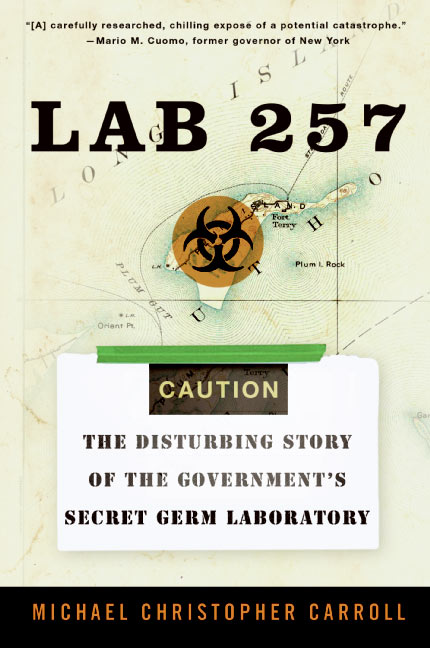
The Government's Secret Lab 257 - The Horrific Secrets of Plum Island

Lurking in the dark waters of Long Island Sound is a mysterious place known as Plum Island. Just ten miles off the coast of Connecticut, this tiny speck of land has long been rumored to be the epicenter of top-secret biowarfare research. The U.S. government acknowledges that the island is home to a scientific facility. Its stated purpose is to study animal-borne diseases. But investigators are beginning to uncover startling new facts about this forbidding place. Insiders and ex-employees have come forward to tell their stories. From security breaches in germ labs, to escaped diseases and potential mass epidemics, this is the real Plum Island story. But the government denies anything is wrong.

Plum Island's Secret Past

Although the origins of Plum Island are shrouded in secrecy, investigations have revealed the startling fact that, in the 1950s, the lab was run by a German scientist named Erich Traub, who was brought to America after the Second World War. His specialty in the Third Reich was virus and vaccine research. Along with rocket scientists like Werner von Braun, Traub was spirited out of post-war Germany to help jump-start the Cold War against the Soviet Union. The well-documented U.S. government project to recruit German scientists and technicians was known as Operation Paperclip. President Truman approved the project, so long as only nominal Nazi party members without SS affiliation were recruited. However, because the Nazi party promoted so many of its top scientists, Operation Paperclip ended up white-washing the pasts of many of its recruits in order to get them into the U.S.

Traub's particular expertise was in disease-carrying insects—in particular, the common tick. Ticks are often carried aloft by birds, and can therefore quickly spread over large swaths of territory. Called "vectors," ticks and mosquitoes are also genetically similar. Both contain bacteriophages or plasmids that transfer genetic material into a cell, or from one bacterium to another. In other words, they can infect whatever host animal with which they come in contact. Multiply this by millions, and ticks become the perfect insect army. 


The Government's Secret Lab 257 - The Horrific Secrets of Plum Island

Thursday, January 31, 2013

Japanese Scary legends - Japanese Urban Legends


Various types of folklore can be found all over the world. Japan in particular has some very interesting, as well as creepy urban legends. The majority of them are based on onryo, or vengeful spirits that have had something unfortunate or tragic happen to them when they were alive and who let their anger out on innocent victims- often by frightening and/or killing them.


Tek Tek or Teke-Teke


Tek Tek or Teke-Teke


Tek Tek or Teke-Teke is an urban legend from Japan about a girl who fell under a train and was cut in half. She took a long time todie and now her ghost roams through Japan, dragging her top half along using her claw-like hands. Every time she moves, she makes a "teke-teke" sound.

There is a story about a young boy who was leaving his school one evening when he heard a noise behind him. Looking back, he saw a beautiful girl sitting at a window. The girl had her arms propped up on the window sill and was just staring out at him. He wondered why she was there, because it was an all-boys school. When she saw him looking back at her, the girl smiled and hugged herself so that she was holding her elbows. Then suddenly, she leaped out of the window and landed on the ground outside. The boy realized with horror, that she was missing the lower half of her body.

She made her way towards him, clawing along the ground and running on her elbows making a tek-tek-tek-tek-tek sound. The boy was filled with terror and revulsion. He tried to run, but he was frozen to the spot. Within seconds, she was upon him and she took out a scythe and cut him in half, making him into one of her own. When kids tell this story, they warn each other about Tek-Tek. They say she carries a sharp saw or a scythe, and if she catches you, she'll cut you in half and you'll become just like her. She is said to chase children who play at dusk. She is also known as "bata-bata" (again, the sound of it running on its (elbows) or ; The Girl That Runs On Her Elbows.

Aka Manto (Red Cape)

Aka Manto


Aka Manto is a spirit which haunts bathrooms, usually the last toilet stall in the women's/girl's bathroom. Some versions describe him as wearing a mask to cover his extremely handsome face, which had caused him stalking problems in life. When the unlucky victim is on the toilet, a mysterious voice will ask them if they want red paper or blue paper. If you answer red paper, you are killed violently and drenched in blood. If you ask for blue, you are strangled or bled dry, leaving your face/skin blue. Attempting to ask for any other colour of paper will result in hands appearing (sometimes coming out of the toilet you're sitting on), that will drag you into the fires of hell. In other versions the ghost will simply ask you if you want a red vest and will then rip the skin from your back. He could also ask you if you want a red or blue cloak. The only answer that will spare the person is to refuse anything he offers. 


Japanese Scary legends - Japanese Urban Legends

Friday, November 30, 2012

Unexplained Phenomenon of NAGA Fire Balls

Naga Fire balls

The Naga fireballs of the Mekong river are not a question of ‘If’, but a question of ‘What’. They are one of the most well documented unexplained phenomena in the entire world. Every year during October on the night of Wan Awk Pansa thousands of spectators gather on the banks of the Mekong river in Thailand and Laos to see the legendary Naga breathe forth balls of fire from the river itself. Many have been watching this every year for their entire life. The balls themselves are reddish in color and are about the size of an egg. They slowly and silently rise from the river before accelerating high into the air where they disappear. There can be anywhere from tens to thousands of these glowing orbs per night. The balls themselves are seen either side of the festival night, which attests to the fact it’s more than likely of natural origin rather than an organized display by officials.

Their supernatural origin is not without opposition. Manas Kanoksin, a doctor from Nong Khai strongly believes that fermenting sediment on the river’s bottom causes pockets of methane gas to form, and that the Earth’s position in relation to the sun during those days of the year causes them to rise, then spontaneously ignite in the presence of ionized oxygen. Italian chemists Luigi Garlaschelli and Paolo Boschetti, have replicated the lights by adding chemicals to the gases formed by rotting compounds. But other researchers dismiss this theory, pointing out that the rocky river bottom doesn’t have much sediment, and that the water’s turbulence would break up any such methane bubbles before they reached the water’s surface. Whatever the cause, the Naga fireballs of the Mekong are one of the least known, most spectacular of phenomena to observe.

Each year, hundreds of fireballs spontaneously explode out of Thailand’s Mekong River. Known as “bung fai paya nak” or “Naga fireballs,” they have appeared on the “late autumn night of the full moon at the end of the Buddhist Lent for as long as anyone can remember,” according to a 2002 Time magazine story about the phenomenon. Some believe the balls come from the breath of Naga, a mythical serpent that haunts the river. (Locals use old grainy pictures and postcards of the mythical beast to prove its presence to tourists.) Others believe the fireballs are actually pockets of methane bubbling up from the river, but many locals remain convinced that the fireballs are of a supernatural origin.

Naga Lights

Weird things are happening some 70 - 100 kilometres downstream from the Vientiane - capital of Laos. In the nights from the muddy waters of Mekong river appear red glowing balls which quickly rise up in the air and disappear without noise (some, who manage to be close to the lights, report silent hiss). These mysterious sparkles are small, but sometimes they reach a size of a basketball.

These are not some ghosts seen by occasional people and questioned by majority. Ghost fireballs of Mekong have been seen by thousands of people, photographed and captioned on movies and, after all, investigated by scientists looking for the explanation of this interesting phenomenon.
Unexplained Phenomenon of NAGA Fire Balls 


Monday, June 18, 2012

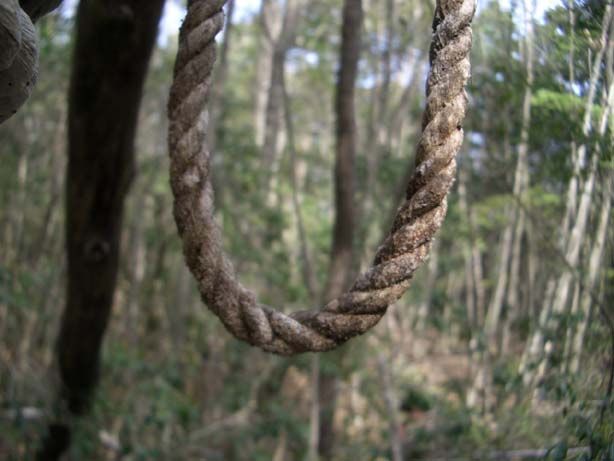
Creepy Places - Aokigahara Suicide Forest


Called "the perfect place to die," the Aokigahara forest has the unfortunate distinction as the world's second most popular place to take one's life. (The first is the Golden Gate Bridge.) Since the 1950s, Japanese businessmen have wandered in, and at least 500 of them haven't wandered out, at an increasing rate of between 10 and 30 per year. Recently these numbers have increased even more, with a record 78 suicides in 2002.

Japanese spiritualists believe that the suicides committed in the forest have permeated Aokigahara's trees, generating paranormal activity and preventing many who enter from escaping the forest's depths. Complicating matters further is the common experience of compasses being rendered useless by the rich deposits of magnetic iron in the area's volcanic soil.

Due to the vastness of the forest, desperate visitors are unlikely to encounter anyone once inside the so-called "Sea of Trees," so the police have mounted signs reading "Your life is a precious gift from your parents," and "Please consult the police before you decide to die!" on trees throughout.

Contemporary news outlets noted the recent spike in suicides in the forest, blamed more on Japan’s economic downturn than on the romantic ending of Seicho Matsumoto’s novel Kuroi Jukai, which revitalized the so-called Suicide Forest’s popularity among those determined to take their final walk. (The novel culminates in Aokigahara as the characters are driven to joint-suicide.) 


Unexplained Mysteries - Creepy Places - Aokigahara Suicide Forest

Friday, March 2, 2012

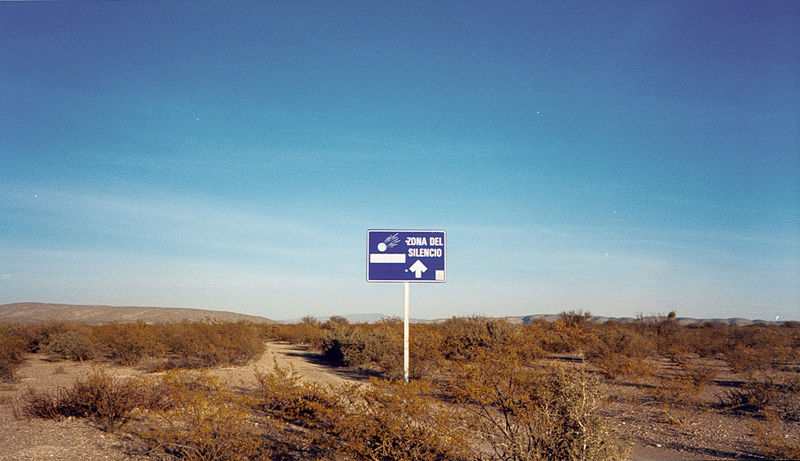
Unsolved Mysteries of Zone of Silence

There exist a number of "accursed sites" on the surface of our planet. Some of these locations are the sites of gravitational or atmospheric disturbances that still remain unexplained by twentieth century science. Such anomalous areas possess properties which interfere sporadically with humans and their equipment. One area worthy of mention surrounds the Mediterranean island of Elba (famous for being Napoleon's first place of exile), and is the bane of maritime aviation in the Mediterranean; another spot is Mt. Stredohori in Czechoslovakia, where an unknown force drains car engines of power throughout the length of a 75-foot stretch of road.

However, we need not travel so far to encounter a part of the world that is even more perplexing than these others, although it remains little known to most people: Mexico's mysterious, magical zona del silencio--the Zone of Silence, just four hundred miles away from El Paso, Texas. Deserts are often considered to be mysterious enough without the added weirdness that this patch of earth some four hundred miles from El Paso has to offer. It is a place which gobbles up radio and TV signals, and which has of late been associated with the UFO phenomenon.

There is much about our world that we still do not understand. Scientists tell us that natural mysteries abound in every corner of the Earth, from the lifeless desert of Chile to the bottomless depths of the Pacific, there are things we simply do not comprehend.

Perhaps this is the best way to describe a place in northern Mexico in the middle of the hot, searing, punishing Chihuahuan desert, a place commonly called the "Zone of Silence" (Zona-del-Silencio) by the few locals, scientists, students and visitors that wander there from time to time in search of answers. It is a strange place to experience, one of those mysterious natural wonders that beg our attention and muddle our senses. It is sometimes difficult to tell what is truth and what is not; to recognize what you see as real or not.

Drive 400 hundred miles west of El Paso and you enter into an unforgiving section of foreboding semiarid desert landscape that begs for mercy but offers none. The nearest settlement is Ceballos, a ragtag community that holds on precariously to its existence some 25 miles across the barren plain from the heart of "The Zone". Here life is challenging, and there is a constant, delicate balance between death and survival. 


Unsolved Mysteries of Zone of Silence

Friday, February 3, 2012

The Coso Artifact

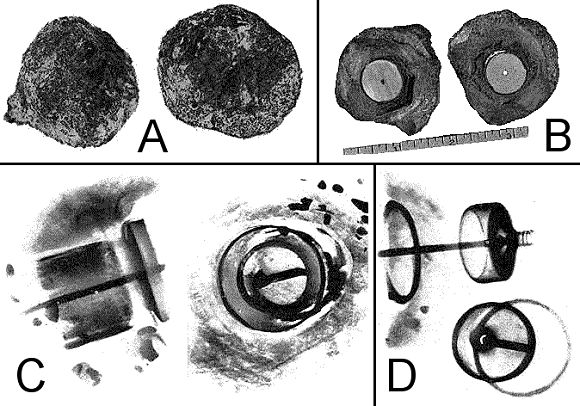
The story of the Coso Artifact has been embellished over the years, but nearly all accounts of the actual discovery are basically the same. On February 13, 1961, Wallace Lane, Virginia Maxey, and Mike Mikesell were seeking interesting mineral specimens, particularly geodes, for their LM&V Rockhounds Gem and Gift Shop in Olancha, California. The trio was about 6 miles northeast of Olancha, near the top of a peak about 4300 feet in elevation and about 340 feet above the dry bed of Owens Lake. At lunchtime, after collecting rocks most of the morning, all three placed their specimens in the rock sack Mikesell was carrying (Steiger 1974: 49).

The next day in the gift shop's workroom, Mikesell ruined a nearly new diamond saw blade while cutting what he thought was a geode. Inside the cut nodule, Mikesell did not find the cavity that is typical of geodes, but a perfectly circular section of very hard, white material that appeared to be porcelain. In the center of the porcelain cylinder was a 2-millimeter shaft of bright metal. The metal shaft responded to a magnet. There were other odd qualities about the specimen. The outer layer of the specimen was encrusted with fossil shells and their fragments. In addition to shells, the discoverers noticed two nonmagnetic metallic objects in the crust, resembling a nail and a washer. Stranger still, the inner layer was hexagonal and seemed to form a casing around the hard porcelain cylinder. Within the inner layer, a layer of decomposing copper surrounded the porcelain cylinder.

The Initial Investigations

Very little is known about the initial physical inspections of the artifact. According to Maxey, a geologist she consulted who examined the fossil shells encrusting the specimen said that the nodule had taken at least 500 000 years to attain its present form. However, the identity of the first geologist is still a mystery, and his findings were never published. Another investigation was conducted by creationist Ron Calais. Calais is the only other individual known to have physically inspected the artifact, and he was allowed to record images of the nodule using both X-ray and natural-light photography. Calais's X-rays brought interest in the artifact to a new level. The X-ray of the upper end of the object seemed to reveal some sort of tiny spring or helix. INFO Journal editor Ronald J Willis (1969) speculated that it could actually be "the remains of a corroded piece of metal with threads." The other half of the artifact revealed a sheath of metal, presumably copper, covering the porcelain cylinder.

The last individual known to possess the Coso Artifact was one of the original discoverers, Wallace Lane. Lane had the object on display in his home, but he adamantly refused to allow anyone to examine it (Willis 1969). However, he had a standing offer to sell it for $25 000. In September 1999, a national search to locate any of the original discoverers proved fruitless. We suspect that Lane is dead. Maxey is alive, but is avoiding any public comment, and the whereabouts of Mikesell remain unknown. The location and disposition of the artifact are also unknown. Willis's 1969 article is the primary source for information on this object to date. 


 The Coso Artifact

Monday, August 22, 2011

Hidden Secrets of the DOLLAR

There is definitely something strange and weird about the USA Dollar. From hidden secrets and symbols to cataclysmic prophecies the Dollar has it all. Just have a look at this initial collection of bizarre findings.

These secrets only seem to appear in the Dollar currency. We've looked for similar effects in the Pound, the Rupee, the Euro and even the Rand without any success. However, with the Dollar we just keep on finding them! After Months of study we can honestly say that the Dollar is the most complex, intelligent, intricate, mysterious and beautiful of currencies. It is the perfect representation of Art and Science.

9/11 TRADE CENTRE - PROPHECY OF DOOM OR AN INCITEMENT TO TERRORISM

Secrets of the Dollar

We first saw this in an email but checked it out for ourselves. This is an ordinary 20 Dollar banknote that we had in one of our wallets. It was first printed in 1928 and is known as the "Jackson Bill". The version shown in the images was printed in 2003 (after the 9/11 attacks but the image of the White House is essentially the same as in earlier versions). We are trying to access an original 1928 bill and to see if the effect described below is the same.


Please feel free to try this for yourself - we did! The secrets become clear. First take the 20 Dollar Bill and fold it in half as shown in the diagram to the right.


Then do a 45 degree fold to match up perfectly with the centre of the Bill's width. (Fig 3) Repeat the same process with the opposite side and ensure that the centre line and the top of the banknote are in alignment. (Fig 2)


An image immediately becomes clear. It is the top of a three or four story building with smoke billowing out of its central facade. It looks very similar (but definitely not identical) to the classic photograph of the Pentagon after it was struck by a Boeing 757 - Flight 77.


This, in itself, is strangely disturbing but simply turning the folded 20 dollar bill to its opposite side reveals an even more concerning picture. It is a single skyscraper in the process of collapsing in exactly the same manner as the second doomed tower of the New York World Trade Centre did (WTC2).


This alone should give you pause for thought but now unfold the banknote and the creases form an octagonal design. (Shown in the diagram with red over-lines) The exact centre point lines up with Oval Office which is exactly on the other side of the building at a 13 degree trajectory. It is widely believed that the White house was supposed to be the 3rd target of the 9/11 attacks.


Are these "Coincidences" a 1920's prophecy of doom or were these "strange images" the very reason that the targets were selected in the first place. Did someone show Osama the trick and say ... "Hey! I know what we should attack." 


Read more on Hidden Secrets of Dollar

Wednesday, July 20, 2011

Stigmata

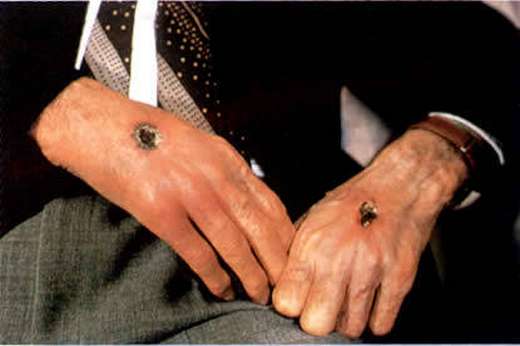
Most people have at least heard of stigmata even if they are not entirely sure what it is since the word is casually tossed around on occasion and was even turned into a thriller movie during the late 1990s. However, the question of what it actually is other than bleeding in seemingly random places along the body with no obviously visible reason like a cut or stabbing by a knife. Let us take a look into the mystery that is the stigmata and see if we can find a place for it in our modern world.

Stigmata (singular stigma) are bodily marks, sores, or sensations of pain in locations corresponding to the crucifixion wounds of Jesus, such as the hands and feet. In some cases, rope marks on the wrists have accompanied the wounds on the hands.

The term originates from the line at the end of Saint Paul's Letter to the Galatians where he says, "I bear on my body the marks of Jesus." Stigmata is the plural of the Greek word st??µa stigma, meaning a mark or brand such as might have been used for identification of an animal or slave. An individual bearing stigmata is referred to as a stigmatic or a stigmatist.

Stigmata are primarily associated with the Roman Catholic faith. Many reported stigmatics are members of Catholic religious orders. St. Francis of Assisi was the first recorded stigmatic in Christian history. For over fifty years Padre Pio of Pietrelcina reported stigmata which were studied by several 20th century physicians, whose independence from the Church is not known. The observations were reportedly unexplainable and the wounds never became infected.


Stigmata


A high percentage (perhaps over 80%) of all stigmatics are women. In his Stigmata: A Medieval Phenomenon in a Modern Age, Edward Harrison suggests that there is no single mechanism whereby the marks of stigmata were produced.

What is it ?

Strictly speaking, stigmata are marks on someone’s body that correspond to the crucifixion wounds of Jesus as stated in Christianity’s bible—with particular emphasis on marks that occur on the person’s hands or feet. Stigmata is actually the plural form of a Greek word “stigma” which literally translates as a brand or mark that was used in the identification of a domesticated animal or slave. The word stigmata as applied to marks or wounds associated with those of Jesus actually comes from Paul’s letter to the Galatians at the end line of the writing where he stays that he bears “on (his) body the marks of Jesus.” The reported cases of stigmata show some, a few, or all five of the “holy wounds” that were inflicted on Jesus according to writing of his crucifixion in the bible, which include a wound in the side of a torso from a lance and ones in the hands and feet from nails. 


More on Stigmata

Friday, May 6, 2011

Flatwoods Monster - Phantom of Flatwoods

The Flatwoods Monster, also known as the Braxton County Monster or the Phantom of Flatwoods, is an alleged unidentified extraterrestrial or cryptid reported to be sighted in the town of Flatwoods in Braxton County, West Virginia, on September 12, 1952. Stories of the creature are an example of a purported close encounter of the third kind.

Appearance

There are two entities associated with the Flatwoods Monster. The first was described as being a large, pulsating, red ball of light that hovered above or rested upon the ground. Ufologists believe that it may have been a powered craft that was piloted by the second entity.

Various descriptions of the second entity exist. Most agree that it was at least 10 feet tall and that it had a red face which appeared to glow from within, and a green body. Witnesses described the creature's head as having bulging, non-human eyes and as either being shaped like a heart/an Ace of Spades, or as having a large heart/Ace of Spades shaped cowling behind it. The creature's body was described as being man-shaped and clad in a dark pleated skirt; later described as being green. Some accounts record that the creature had no visible arms, while others describe it as having short, stubby arms; ending in long, claw-like fingers, which protruded from the front of its body.

Reported in Flatwoods, Virginia, on the night of September 12, 1952, the Flatwoods Monster is said to have been an alien from another planet because the creature was first seen after an apparent UFO crash. Stories of the creature are an example of a purported close encounter of the third kind.

A simple sighting of a UFO is called a close encounter of the first kind. A close encounter of the second kind is when a UFO physically affects the environment, such as causing a car’s engine to stall. However, what happens when UFOs land and aliens exit the craft? These cases are termed close encounters of the third kind. There have been literally thousands of reported UFO landings across the world. More than 2,000 of these cases involve physical trace evidence of the landing. The Flatwoods Monster case is only one example. Many other equally shocking cases exist. What makes landing cases so interesting is that they make the usual Air Force explanations of misperception or hallucination much harder to accept.

The incident began when three boys spotted an odd sphere of light moving across the sky that appeared to landing behind a hill. When the weird glowing object stayed there, six of the children decided to get closer. They started the 15-minute hike to the landing spot. Along the way, two of the boys, Edison and Freddie May, stopped at their house and told their mother that they were going with their friends to see a landed flying saucer. Their mother, Kathleen May, was skeptical, abut also curious. She said, “You’re not going by yourself!” It was just getting dark, so she grabbed a flashlight and joined the boys. By now it was already dark. The group of six children and one adult crept towards the glowing object. As they approached, they could see that the object was sphere-shaped, and was pulsating with light. 


More on  Flatwoods Monster  - Phantom of Flatwoods

Freemasons Secrets and FreeMason Conspiracy

Masonic conspiracy theories

Masonic conspiracy theories are conspiracy theories involving Freemasonry; hundreds of such conspiracy theories have been described since the late 18th century. Generally, these theories fall into three distinct categories: political (usually involving allegations of control of government, particularly in the United States and the United Kingdom), religious (usually involving allegations of anti-Christian or Satanic beliefs or practices), and cultural (usually involving popular entertainment). Many conspiracy theory writers have connected Freemasons (and the Knights Templar) with worship of the devil; these ideas are based on misinterpretations of the doctrines of those organizations.

Of the claims that Freemasonry exerts control over politics, perhaps the best-known example is the New World Order theory, but there are others. These mainly involve aspects and agencies of the United States government, but actual events outside the US (such as the Propaganda Due scandal in Italy) are often used to lend credence to claims.

Another set of theories has to do with Freemasonry and religion, particularly that Freemasonry deals with "the occult". These theories have their beginnings in the Taxil hoax.[9][10] In addition to these, there are various theories that focus on the embedding of symbols in otherwise ordinary items, such as street patterns, national seals, etc.

There are Masonic conspiracy theories dealing with every aspect of society. The majority of these theories are based on one or more of the following assumptions:

* That Freemasonry is its own religion, requires belief in a unique Masonic "god", and that belief in this Masonic "god" is contrary to the teachings of various mainstream religions (although usually noted in terms of being specifically contrary to Christian belief.)
* That the 33rd degree of the Scottish Rite is more than an honorary degree, coupled with the belief that most Freemasons are unaware of hidden or secretive ruling bodies within their organization that govern them, conduct occult ritual, or control various positions of governmental power.
* That there is a centralized worldwide body that controls all Masonic Grand Lodges, and thus, all of Freemasonry worldwide acts in a unified manner. 


More at  Freemasons Secrets and FreeMason Conspiracy

Thursday, November 4, 2010

The Cursed Ring

In the vault of a Los Angeles bank lies a silver ring set with a semiprecious stone. It is not a particularly pretty ring or even a very valuable one, and chances are that no one will ever dare to wear it again. The ring lies in the vault because it bears one of the most malignant curses in the history of the occult. Successive owners have suffered injury, misfortune, even death. And many people still believe it was this ring that sent Rudolph Valentino to a premature grave. Certainly, the violent incidents that have surrounded it over the years can hardly be shrugged off as mere coincidences.

Rudolph Valentino (May 6, 1895 – August 23, 1926) was an Italian actor, sex symbol, and early pop icon. Known as the "Latin Lover", he was one of the most popular stars of the 1920s, and one of the most recognized stars from the silent film era. He is best known for his work in The Sheik and The Four Horsemen of the Apocalypse.

Valentino was born Rodolfo Alfonso Raffaello Piero Filiberto Guglielmi in Castellaneta, Italy, to a French mother, Marie Berthe Gabrielle Barbin (1856 - 1919), and Giovanni Antonio Giuseppe Fidele Guglielmi, a veterinarian who died of malaria, then widespread in Southern Italy, when Valentino was 11. He had an older brother, Alberto (1892-1981), a younger sister, Maria, and an older sister Beatrice who died in infancy.

As a child, Valentino was reportedly spoiled and troublesome. His mother coddled him while his father disapproved of his behavior. He did poorly in school, and was eventually enrolled in agricultural school where he received a degree. After living in Paris in 1912, he soon returned to Italy. Unable to secure employment, he departed for the United States in 1913. He was processed at Ellis Island at age 18 on December 23, 1913.

In 1917, Valentino joined an operetta company that traveled to Utah where it disbanded. He then joined an Al Jolson production of Robinson Crusoe Jr., travelling to Los Angeles. By fall, he was in San Francisco with a bit part in a theatrical production of Nobody Home. While in town, Valentino met actor Norman Kerry, who convinced him to try a career in cinema, still in the silent film era.

By 1919, he had carved out a career in bit parts. It was a bit part as a "cabaret parasite" in the drama The Eyes of Youth that caught the attention of screenwriter June Mathis, who thought he would be perfect for her next movie.

It was in 1920 that Valentino, at the peak of his success, saw the ring in a San Francisco jeweller's. The proprietor warned him that the ring was a jinx, but Valentino still bought it. He wore the ring in his next picture, The Young Rajah. It was the biggest flop of his career and he was off the screen for the next two years. Valentino did not wear the ring again until he used it as a costume prop in The Son of the Sheik. Three weeks after finishing this film, he went to New York on vacation. While wearing the ring, he suffered an acute attack of appendicitis. Two weeks later, he was dead. 


Read more at  The Cursed Ring

Wednesday, June 23, 2010

'Blood' runs from image of Christ

Thousands of pilgrims have overwhelmed a small church in Argentina after blood was said to be oozing down the face of an image of Jesus Christ.

A red substance was photographed running from the forehead of Jesus and down his cheek in a church depiction of the Last Supper.

Local priest Father Jorge Gandur said the 'ooze comes from one of the wounds on the left side of the forehead of Christ produced by the crown of thorns'.

The stains were first noticed on Friday by two men who had entered the Oratory of the Sacred Heart of Jesus in Yerba Buena, Tucuman province.

The pair reported the substance to Father Gandur, who took samples of the substance to be scientifically tested to see if it was human blood.

After local media were tipped off that the men had seen Christ weeping 'tears of blood' the streets surrounding the church became jammed pilgrims wanting to see the phenomenon for themselves. 


More at  http://theunexplainedmysteries.com/jesus-christ-blood.html

Monday, January 18, 2010

Dog alerts owner after sensing earthquake


Amazing CCTV footage has been released showing a dog warning its owner after seemingly sensing an imminent earthquake. The footage has become a hit on Youtube with over 600,000 hits. Some believe it demonstrates a 'sixth sense' in dogs while others are more skeptical, suggesting that the tremors would have been strong enough for a human to feel prior to the main quake.
The animal sprung into action after picking up early tremors of the 6.5 magnitude quake which shook buildings in California last weekend. The dog, Sophie, had been lolling on the floor of the newsroom of the Times-Standard newspaper in the town of Eureka on Saturday afternoon when she detected the first vibrations.

Tuesday, January 5, 2010

Dead boy has "miraculous powers"


  • Parents say oil weeps from son's bedroom
  • "Has healing powers"
  • "He's worthy of sainthood"

A SYDNEY couple believes their son - "hand-picked by God" - could be Australia's first male saint.

Mike Tannous died three years ago but a mysterious oil that weeps from the walls of his bedroom has been hailed by his parents, George and Lina, as having helped heal dozens of people, The Daily Telegraph reports.

The oil started to appear in the Guildford home just weeks after the 17-year-old died in a car accident in September 2006.

"Mike is a messenger between us and God. He has healed so many people," Mrs Tannous said.

Extensive scientific testing of the oil has failed to identify exactly what it is but that has not stopped hundreds praying at the home.

The Tannous' push for sainthood for their son emerged as Mary MacKillop fever swept the nation.

Sydney Archbishop Cardinal George Pell suggested yesterday crusader for convicts Caroline Chisholm and Sydney's first Archbishop John Bede Polding to be considered as "would-be saints" after Mother MacKillop's canonisation.

But Mr Tannous said the next saint would be his son, and the family was documenting his healing powers.

"Our boy is a saint. This is him talking to us, talking to other people," he said.

Last year a woman who lived near the Tannous' house was told by doctors she could not have the third child she desperately wanted.

"She came here and prayed . . . one month later she came with a box of chocolates and said 'Guess what, I am pregnant'," Mike's aunt Susan Sawan said.

Since Pope Benedict XVI confirmed Mother MacKillop's second miracle, scores of people have flocked to the Tannous' house. 


Read more at http://theunexplainedmysteries.com/dead-boy-powers.html

Sunday, November 8, 2009

Colossal 'sea monster' unearthed


The fossilised skull of a colossal "sea monster" has been unearthed along the UK's Jurassic Coast.

The ferocious predator, which is called a pliosaur, terrorised the oceans 150 million years ago. The skull is 2.4m long, and experts say it could belong to one of the largest pliosaurs ever found: measuring up to 16m in length.

The fossil, which was found by a local collector, has been purchased by Dorset County Council. It was bought with money from the Heritage Lottery Fund, and it will now be scientifically analysed, prepared and then put on public display at Dorset County Museum.


Palaeontologist Richard Forrest told the BBC: "I had heard rumours that something big was turning up. But seeing this thing in the flesh, so to speak, is just jaw dropping. It is simply enormous."

Pliosaurs were a form of plesiosaur, a group of giant aquatic reptiles that dominated the seas around the same time that dinosaurs roamed the Earth.

They had short necks and huge, crocodilian-like heads that contained immensely powerful jaws and a set of huge, razor-sharp teeth. Using four paddle-like limbs to propel their bulky bodies through the water, they made easy work of passing prey such as dolphin-like ichthyosaurs and even other plesiosaurs.

David Martill, a palaeontologist from the University of Portsmouth, said: "These creatures were monsters.

"They had massive big muscles on their necks, and you would have imagined that they would bite into the animal and get a good grip, and then with these massive neck muscles they probably would have thrashed the animals around and torn chunks off.

"It would have been a bit of a blood bath."

Big contender

Experts think this latest discovery could represent one of the largest pliosaurs ever found.

Dr Martill said: "This thing is absolutely enormous. When I saw it, it really just hit me how big it was."

The fossil comprises a lower jaw and upper skull.

http://theunexplainedmysteries.com/sea-monster.html

Wednesday, October 14, 2009

Jack the Ripper's identity finally uncovered?

With the fragment of human kidney sent in the mail to the police came a letter: "I send you half the kidney I took from one woman ... and the other piece I fried and ate ..." The writer's return address: "From Hell." It was the fall of 1888, and all of London instantly knew that the gruesome missive came from "Jack the Ripper," who had just slashed to death his fourth known victim, 43 year old Catherine Eddowes.

All four women had been pathetic prostitutes, aging and worn, forced to ply their degrading trade in the slum district known as Whitechapel. A veritable cesspool of the most wretchedly impoverished people, it had narrow streets and alleys that led through a filthy maze of gin shops, brothels, and opium dens. Fewer than half the children survived to the age of five; up to seven people were packed into each tiny room of this garbage strewn warren. To fend off starvation in such desperate circumstances, many young women had no alternative but to become streetwalkers. Such women, for unexplained reasons, were the prey of the Ripper, who was never identified nor apprehended.

Mei Trow used modern police forensic techniques, including psychological and geographical profiling, to identify Robert Mann, a morgue attendant, as the killer. His theory, the result of two years intensive research, is explored in a Discovery Channel documentary, Jack the Ripper: Killer Revealed.

Trow's research is rooted in information from a 1988 FBI examination of the Ripper case, which had worked up a comprehensive criminal personality profile.

The portrait drawn up of Jack was as a white male from the lower social classes, most likely the product of a broken home.

It was also thought he would have had a menial job but with some anatomical knowledge, something like a butcher, mortuary or medical examiner's assistant or hospital attendant.

Because of prolonged periods without human interaction, Jack would also have been socially inept

It is known that Mann was from an extremely deprived background. His father was absent for much of his upbringing and he had spent some time as a child in a workhouse.

Trow said: "I wanted to go beyond the myth of a caped man with a top hat and knife, and get to the reality, and the reality is simply that Jack was an ordinary man."


Read more at http://theunexplainedmysteries.com/jack-the-ripper-revealed.html

Wednesday, September 30, 2009

Panama: youngsters claim to have killed an alien

The discovery of a strange creature in Cerro Azul, Panama, sparked controversy among the people, for what some say might be a creature from another planet, others simply believe that it si just an animal.

Two young men were having fun on the hill when they saw at the entrance of a cave a creature that was approaching them. They were frightened and stoned it to death. Panama’s Channel 13 showed images of a strange creature that appeared last weekend in Cerro Azul, east of Panama City, and that alarmed local residents.

According to Telemetro, polemic unleashed between those who believe it is an animal and those who think it’s an extraterrestrial creature. No authority said anything about the find. Telemetro said four children, aged between 15 and 16 , saw the “thing” out of the water fall of Cerro Azul and stoned it to death, afraid of being attacked.

Thursday, June 25, 2009

CT scans reveal mummies' long-lost secrets


A long line of hospital staff wraps around the corridor outside a small conference room in New York to catch a glimpse of the precious cargo.

Inside are the three frail bodies in open wooden crates causing all the commotion. Another body -- a prince no less -- is a few rooms down in a computer tomography scanner.

The bodies are part of the Brooklyn Museum's collection of 11 Egyptian mummies, transported to the North Shore University Hospital to be scanned. The goal: Find out who they are, how they might have died and establish a chronology of advances in ancient Egypt's mummification techniques.

The process is not necessarily new. Egyptian mummies have been exposed to radiographic study since 1896 and CT scans, which conducts imaging by sections, for more than two decades.

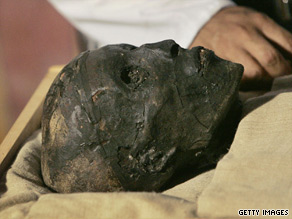
Perhaps the most famous of them, King Tutankhamun (c. 1355-346 B.C.), was scanned in 2005 right outside the vault that holds his sarcophagus. The scan resulted in more than 17,000 images that were analyzed by an international team of radiologists, pathologists and anatomists, led by the world-renowned Zahi Hawass, the secretary general of Egypt's Supreme Council of Antiquities.

The scope and ability of CT scan technology are proving invaluable in learning more about the funeral rituals of ancient Egyptians and the mummies themselves. Whereas conventional X-rays cannot clearly distinguish soft tissue from bone and can see only two planes, CT scanning can differentiate among the various types of bone and soft tissue, and reconstruct three-dimensional images that "show fine detail inside coronary arteries down to 0.6 millimeters" said Amgad Makaryus, director of cardiac CT and magnetic resonance imaging at North Shore, providing a better chance at diagnosis and differentiation among diseases.

"CT has proved to be exceptionally well-suited for studying the fragile, wrapped figures of Egyptian mummies, especially those still contained within their decorated plasterlike shells, or cartonnages," according to an article by a team of eight researchers, led by Derek N.H. Notman, published in the American Journal of Roentgenology.

Read complete story at http://www.cnn.com/2009/TECH/science/06/25/mummy.scans/index.html

LinkWithin

Related Posts with Thumbnails