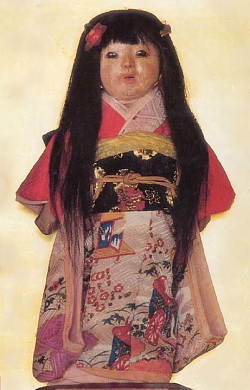
The haunted japanese doll Okiku, possessed by the spirit of a 10 year old girl who took refuge inside it. Some time after the funeral
of the girl, the hair of the doll began to grow. Although the doll’s
hair is cut regularly, the hair grows again and again. A mysterious doll
possessed by the spirit of a child has captured the curiosity of people
across Japan for decades. The legendary Okiku doll, named after the
girl who long ago used to play with it, is a 40-centimeter (16-in) tall
kimono-clad figure with beady black eyes -- and hair that grows.
The Okiku doll has resided at the Mannenji temple in the town of
Iwamizawa (Hokkaido prefecture) since 1938. According to the temple, the
traditional doll initially had
short cropped hair, but over time it has grown to about 25 centimeters
(10 in) long, down to the doll's knees. Although the hair is
periodically trimmed, it reportedly keeps growing back.
It is said that the doll was originally purchased in 1918 by a 17-year-old boy named Eikichi Suzuki while visiting
Sapporo for a marine exhibition. He bought the doll on Tanuki-koji --
Sapporo's famous shopping street -- as a souvenir for his 2-year-old
sister, Okiku. The young girl loved the doll and played with it every
day, but the following year, she died suddenly of a cold. The family
placed the doll in the household altar and prayed to it every day in
memory of Okiku.
Some time later, they noticed the hair had started to grow. This was
seen as a sign that the girl's restless spirit had taken refuge in the
doll.
This doll was originally purchased in 1918 by a Eikichi Suzuki in Sapporo, where he saw a beautiful Japanese doll
with a Kimono. Eikichi bought this doll for her sister, who is two
years old named Okiku. She loved this doll and play it every day. But
unfortunately, Okiku died shortly afterwards of a fever. Then at his funeral,
family want to put a doll into his coffin, but somehow they forgot. The
girl’s family then put the doll on the household altar and pray for
every day in order to commemorate Okiku.
Some time later, they saw the hair began grows. According to this story
is the spirit of the girl who took refuge inside the doll.
Okiku - Ghost Story of Japanese Haunted Devil Doll

In
popular medieval legend, a White Lady is fabled to appear by day as
well as by night in a house in which a family member is soon to die.
According to The Nuttall Encyclopaedia, these spirits were regarded as
the ghosts of deceased ancestresses.
Castle Huntly, Scotland, is said to be haunted by a young woman dressed
in flowing white robes. There are various stories concerning her
history, one of which is that she was a daughter of the Lyon family who
occupied the castle in the 17th century. When her affair with a
manservant was discovered she was banished to a tower on the
battlements. Unable to endure her suffering, she threw herself to her
death from the tower. The ghost of the White Lady has been seen a number
of times over the years, often on the grounds surrounding the castle.
She has also been seen in the room in which she was imprisoned.
Darwen is reportedly haunted by a ghost. In Darwen's old cemetery there is a gravestone of a supposed white lady,
whose eyes open when they are touched. There have been reported
sightings of her ghost walking around the area at night, seeking her
child. The white lady of Darwen is said to have died during childbirth,
or to have been raped and murdered by a group of men who stole her
child. She is said to manifest in response to the spoken phrase "White
lady, white lady, I stole your black baby", before attacking the speaker
and causing them to faint. Local folklore says that the white lady of
Darwen killed a group of teenagers who were on a camping trip in the
White Hall Park in the late 1980s, within two hours of them visiting her
grave.
The White Lady of Willow Park is native to a small,
heavily-wooded park of Newton-le-Willows, Merseyside, in northwest
England. She is thought to be the tormented spirit of a bride who was
drowned in the lake by her husband on their wedding night. Variations on
her method of death include being bricked up in a cave and hanging
herself in the kitchen.
Urban Legends of White Lady Ghost

The
game was played as night fell upon the region using three separate
rooms. In preparation, participants would light 100 andon in the third
room and position a single mirror on the surface of a small table. When
the sky was at its darkest, guests gathered in the first of the three
rooms, taking turns orating tales of ghoulish encounters and reciting
folkloric tales passed on by villagers who claimed to have experienced
supernatural encounters. These tales soon became known as kaidan. Upon
the end of each kaidan, the story-teller would enter the third room and
extinguished one andon, look in the mirror and make their way back to
the first room. With each passing tale, the room slowly grew darker and
darker as the participants reached the one hundredth tale, creating a
safe haven for the evocation of spirits.
However, as the game reached the ninety-ninth tale, many participants
would stop, fearful of invoking the spirits they had been summoning.
While the exact origins of Hyakumonogatari Kaidankai are unknown, it was
believed that it was first played amongst the samurai class as a test
of courage. In Ogita Ansei's 1660 nursery tale "Otogi Monogatari" a
version of the game was described in which the narrative tells of
several young samurai telling tales in the Hyakumonogatari Kaidankai
fashion. In the tale, as one samurai finished the one hundredth tale, he
began to extinguish the candle when suddenly he sees a giant gnarled
hand descend upon him from above. While some of the samurai cowered in
fear, a swipe of his sword revealed the hand to be merely the shadow of a
spider.
At first, the game of Hyakumonogatari Kaidankai was popular amongst the
aristocratic warrior class, but it soon garnered favorable reputation
amongst the working class peasants and town people. With a heightened
interest in telling newer and original kaidan, people began scouring the
countryside for tales of the mysterious, many of which combined a
mixture of ghostly vengeance and elements of karma in Buddhism.
Japanese culture and heritage are rich with spirituality and
superstition. In Japan, you should "cleanse" yourself after going to a
funeral by throwing salt over your body. Cutting your fingernails in the
evening is bad luck, and so is using or referring to the number four
(homonym for death) or nine (homonym for suffering). However, few
practices are quite as fascinating as the 100 ghost stories game. This
was a popular parlor game called Hyakumonogatari Kaidankai, from the Edo
period (1603 - 1868). It worked as follows:
Urban Legend of 100 Candles Game - Hyakumonogatari Kaidankai
Various
types of folklore can be found all over the world. Japan in particular
has some very interesting, as well as creepy urban legends. The majority
of them are based on onryo, or vengeful spirits that have had something
unfortunate or tragic happen to them when they were alive and who let
their anger out on innocent victims- often by frightening and/or killing
them.
Tek Tek or Teke-Teke

Tek Tek or Teke-Teke is an urban legend from Japan about a girl who fell
under a train and was cut in half. She took a long time todie and now
her ghost roams through Japan, dragging her top half along using her
claw-like hands. Every time she moves, she makes a "teke-teke" sound.
There is a story about a young boy who was leaving his school one
evening when he heard a noise behind him. Looking back, he saw a
beautiful girl sitting at a window. The girl had her arms propped up on
the window sill and was just staring out at him. He wondered why she was
there, because it was an all-boys school.
When she saw him looking back at her, the girl smiled and hugged herself
so that she was holding her elbows. Then suddenly, she leaped out of
the window and landed on the ground outside. The boy realized with
horror, that she was missing the lower half of her body.
She made her way towards him, clawing along the ground and running on
her elbows making a tek-tek-tek-tek-tek sound. The boy was filled with
terror and revulsion. He tried to run, but he was frozen to the spot.
Within seconds, she was upon him and she took out a scythe and cut him
in half, making him into one of her own.
When kids tell this story, they warn each other about Tek-Tek. They say
she carries a sharp saw or a scythe, and if she catches you, she'll cut
you in half and you'll become just like her. She is said to chase
children who play at dusk. She is also known as "bata-bata" (again, the
sound of it running on its (elbows) or ; The Girl That Runs On Her
Elbows.
Aka Manto (Red Cape)

Aka Manto is a spirit which haunts bathrooms, usually the last toilet
stall in the women's/girl's bathroom. Some versions describe him as
wearing a mask to cover his extremely handsome face, which had caused
him stalking problems in life. When the unlucky victim is on the toilet,
a mysterious voice will ask them if they want red paper or blue paper.
If you answer red paper, you are killed violently and drenched in blood.
If you ask for blue, you are strangled or bled dry, leaving your
face/skin blue. Attempting to ask for any other colour of paper will
result in hands appearing (sometimes coming out of the toilet you're
sitting on), that will drag you into the fires of hell. In other
versions the ghost will simply ask you if you want a red vest and will
then rip the skin from your back. He could also ask you if you want a
red or blue cloak. The only answer that will spare the person is to
refuse anything he offers.
Japanese Scary legends - Japanese Urban Legends

This is popular Japanese story is about a poem called “Tomino’s Hell.” They say that you should
only read with your mind, and never out loud. If you were to read it
out loud, then you must take responsibility for your actions.
Tomino is a japanese urban legend about a poem that kills anyone who recites it out loud.In this world there are things that you should
never say out loud, and the Japanese poem “Tomino’s Hell” is one of
them. According to the legend, if you read this poem out loud, disaster
will strike. At best, you will feel very ill or injure yourself. At
worst, you could die.
One person said: “I once read Tomino’s Hell on the air for an online
radio show called Radio Urban Legends. At first everything was normal,
but gradually my body, it became difficult to read. I read half of it
and then broke down and threw it away. Two days later I got injured and I
was left with seven stitches. I do not want to think that this was
because of the poem.”
This is a rough English translation:
Tomino’s Hell
The older sister vomits blood, the younger sister spits fire.
Cute Tomino spits treasured jewels.
Tomino died alone and fell into hell.
Hell, darkness, with no flowers.
Is it Tomino’s older sister that whips?
The number of red welts is worrisome.....
Continue Reading Tomino’s Hell - Japanese Urban Legend