The Hope diamond has intrigued people for centuries. Its perfect quality, its large size 45.52 carats (9.10 g), and its rare color (fancy deep blue diamond) make it strikingly unique and beautiful, currently housed in the Smithsonian Natural History Museum in Washington, D.C. The Hope Diamond is blue to the naked eye because of trace amounts of boron within its crystal structure, but it exhibits red phosphorescence under ultraviolet light. It is classified as a type IIb diamond, which are semiconductive and usually phosphoresce. The Hope diamond phosphoresces a strong red color, which will last for several seconds after exposure to short wave ultra-violet light. The first known precursor to the Hope Diamond was the Tavernier Blue diamond, a crudely cut triangular shaped stone of 115 carats (22.44 g) (This diamond was much larger than the present weight of the Hope diamond because the Hope has been cut down at least twice in the past three centuries.) The diamond is believed to have come from the Kollur mine in Golconda, India, and is famous for supposedly being cursed.
The Tavernier Blue named for the French merchant-traveler Jean-Baptiste Tavernier who brought it to Europe. His book, the Six Voyages (Le Six Voyages de...), contains sketches of several large diamonds he sold to Louis XIV in 1669; while the blue diamond is shown among these, Tavernier makes no direct statements about when and where he obtained the stone.
The historian Richard Kurin builds a plausible case for 1653 as the year of acquisition, and an origin from the Kollur mine in Guntur district Andhra Pradesh (a part of the Golconda kingdom), India. The history of the stone which was eventually named the Hope diamond began when Tavernier obtained the blue diamond during one of his five voyages to India between the years 1640 and 1667. While there, he stole a large blue diamond from the forehead (or eye) of a statue of the Hindu goddess Sita, the wife of Rama, the Sixth Avatar of Vishnu. Where it had been set as one of two matching eyes, and the temple priests then laid a curse on whoever might possess the missing stone.
Early in the year 1669, Tavernier sold this blue diamond along with approximately one thousand other diamonds to King Louis XIV of France for 220,000 livres, the equivalent of 147 kilograms of pure gold. There has been some controversy regarding the actual weight of the stone; Morel believes that the 112 3/16 carats stated in Tavernier's invoice would be in old French carats, thus 115.28 metric carats. For this transgression, according to the legend, Tavernier was torn apart by wild dogs on a trip to Russia (after he had sold the diamond).
This was the first horrible death attributed to the curse, but the historical record shows that he actually lived to the age of 84 (it is not known how he died).
In 1678, Louis XIV commissioned the court jeweller, Sieur Pitau, to recut the Tavernier Blue, resulting in a 67 1/8 carat (13.4 g) stone which royal inventories thereafter listed as the Blue Diamond of the Crown (diamant bleu de la Couronne de France,), but later English-speaking historians have simply called it the French Blue. It was set in gold and suspended on a neck ribbon for the King to wear on ceremonial occasions.
Read more on Unsolved Mystery of Hope Diamond (Cursed Diamond)
Tuesday, November 9, 2010
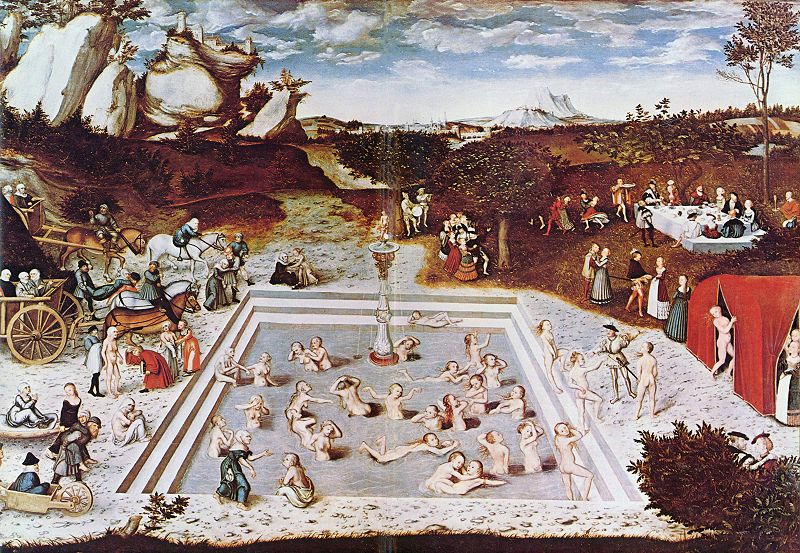
Fountain of Youth
The Fountain of Youth is a legendary spring that reputedly restores the youth of anyone who drinks of its waters. Florida is often said to be its location, and stories of the fountain are some of the most persistent associated with the state.
A long-standing story is that Spanish explorer Juan Ponce de León, Puerto Rico's first Governor, was searching for the Fountain of Youth when he traveled to present-day Florida in 1513, but the story did not start with him, nor was it unique to the New World. Tales of healing waters date to at least the time of the Alexander Romance, and were popular right up to the European Age of Exploration. The later legend derives from the "Water of Life" tale in the Eastern versions of the Alexander Romance, where Alexander and his servant cross the Land of Darkness to find the restorative spring. The servant in that story is in turn derived from Middle Eastern legends of Al-Khidr, a sage who appears also in the Qur'an. Arabic and Aljamiado versions of the Alexander Romance were very popular in Spain during and after the period of Moorish rule, and would have been known to the explorers who journeyed to America.
There are countless indirect sources for the tale as well. Eternal youth is a gift frequently sought in myth and legend, and stories of things such as the philosopher's stone, universal panaceas, and the elixir of life are common throughout Eurasia and elsewhere. An additional hint may have been taken from the account of the Pool of Bethesda in the Gospel of John, in which Jesus heals a man at the pool in Jerusalem.
The Arawaks and the land of Bimini
The native stories about the curative spring were related to the mythical land of "Beimeni", or Beniny, a land of wealth and prosperity. The spring was purportedly located on an island called Boinca. Although subsequent interpretations suggested the land was located in the vicinity of the Bahamas, the natives were referring to a location in the Gulf of Honduras.
The islands of Bimini in the Bahamas were known as La Vieja during the Ponce expedition. According to legend, the Spanish heard of Bimini from the Arawaks in Hispaniola, Cuba, and Puerto Rico. Sequene, an Arawak chief from Cuba, had purportedly been unable to resist the lure of Bimini and its restorative fountain. He gathered a troupe of adventurers and sailed north, never to return. Word spread among Sequene's more optimistic tribesmen that he and his followers had located the Fountain of Youth and were living in luxury in Bimini. Bimini and its curative waters were widespread subjects in the Caribbean. Italian-born chronicler Peter Martyr d'Anghiera (Peter Martyr) told of them in a letter to the pope in 1513, though he didn't believe the stories and was dismayed that so many others did.
Read more about Fountain of Youth
A long-standing story is that Spanish explorer Juan Ponce de León, Puerto Rico's first Governor, was searching for the Fountain of Youth when he traveled to present-day Florida in 1513, but the story did not start with him, nor was it unique to the New World. Tales of healing waters date to at least the time of the Alexander Romance, and were popular right up to the European Age of Exploration. The later legend derives from the "Water of Life" tale in the Eastern versions of the Alexander Romance, where Alexander and his servant cross the Land of Darkness to find the restorative spring. The servant in that story is in turn derived from Middle Eastern legends of Al-Khidr, a sage who appears also in the Qur'an. Arabic and Aljamiado versions of the Alexander Romance were very popular in Spain during and after the period of Moorish rule, and would have been known to the explorers who journeyed to America.
There are countless indirect sources for the tale as well. Eternal youth is a gift frequently sought in myth and legend, and stories of things such as the philosopher's stone, universal panaceas, and the elixir of life are common throughout Eurasia and elsewhere. An additional hint may have been taken from the account of the Pool of Bethesda in the Gospel of John, in which Jesus heals a man at the pool in Jerusalem.
The Arawaks and the land of Bimini
The native stories about the curative spring were related to the mythical land of "Beimeni", or Beniny, a land of wealth and prosperity. The spring was purportedly located on an island called Boinca. Although subsequent interpretations suggested the land was located in the vicinity of the Bahamas, the natives were referring to a location in the Gulf of Honduras.
The islands of Bimini in the Bahamas were known as La Vieja during the Ponce expedition. According to legend, the Spanish heard of Bimini from the Arawaks in Hispaniola, Cuba, and Puerto Rico. Sequene, an Arawak chief from Cuba, had purportedly been unable to resist the lure of Bimini and its restorative fountain. He gathered a troupe of adventurers and sailed north, never to return. Word spread among Sequene's more optimistic tribesmen that he and his followers had located the Fountain of Youth and were living in luxury in Bimini. Bimini and its curative waters were widespread subjects in the Caribbean. Italian-born chronicler Peter Martyr d'Anghiera (Peter Martyr) told of them in a letter to the pope in 1513, though he didn't believe the stories and was dismayed that so many others did.
Read more about Fountain of Youth
Thursday, November 4, 2010
The Cursed Ring
In the vault of a Los Angeles bank lies a silver ring set with a semiprecious stone. It is not a particularly pretty ring or even a very valuable one, and chances are that no one will ever dare to wear it again. The ring lies in the vault because it bears one of the most malignant curses in the history of the occult. Successive owners have suffered injury, misfortune, even death. And many people still believe it was this ring that sent Rudolph Valentino to a premature grave. Certainly, the violent incidents that have surrounded it over the years can hardly be shrugged off as mere coincidences.
Rudolph Valentino (May 6, 1895 – August 23, 1926) was an Italian actor, sex symbol, and early pop icon. Known as the "Latin Lover", he was one of the most popular stars of the 1920s, and one of the most recognized stars from the silent film era. He is best known for his work in The Sheik and The Four Horsemen of the Apocalypse.
Valentino was born Rodolfo Alfonso Raffaello Piero Filiberto Guglielmi in Castellaneta, Italy, to a French mother, Marie Berthe Gabrielle Barbin (1856 - 1919), and Giovanni Antonio Giuseppe Fidele Guglielmi, a veterinarian who died of malaria, then widespread in Southern Italy, when Valentino was 11. He had an older brother, Alberto (1892-1981), a younger sister, Maria, and an older sister Beatrice who died in infancy.
As a child, Valentino was reportedly spoiled and troublesome. His mother coddled him while his father disapproved of his behavior. He did poorly in school, and was eventually enrolled in agricultural school where he received a degree. After living in Paris in 1912, he soon returned to Italy. Unable to secure employment, he departed for the United States in 1913. He was processed at Ellis Island at age 18 on December 23, 1913.
In 1917, Valentino joined an operetta company that traveled to Utah where it disbanded. He then joined an Al Jolson production of Robinson Crusoe Jr., travelling to Los Angeles. By fall, he was in San Francisco with a bit part in a theatrical production of Nobody Home. While in town, Valentino met actor Norman Kerry, who convinced him to try a career in cinema, still in the silent film era.
By 1919, he had carved out a career in bit parts. It was a bit part as a "cabaret parasite" in the drama The Eyes of Youth that caught the attention of screenwriter June Mathis, who thought he would be perfect for her next movie.
It was in 1920 that Valentino, at the peak of his success, saw the ring in a San Francisco jeweller's. The proprietor warned him that the ring was a jinx, but Valentino still bought it. He wore the ring in his next picture, The Young Rajah. It was the biggest flop of his career and he was off the screen for the next two years. Valentino did not wear the ring again until he used it as a costume prop in The Son of the Sheik. Three weeks after finishing this film, he went to New York on vacation. While wearing the ring, he suffered an acute attack of appendicitis. Two weeks later, he was dead.
Read more at The Cursed Ring
Rudolph Valentino (May 6, 1895 – August 23, 1926) was an Italian actor, sex symbol, and early pop icon. Known as the "Latin Lover", he was one of the most popular stars of the 1920s, and one of the most recognized stars from the silent film era. He is best known for his work in The Sheik and The Four Horsemen of the Apocalypse.
Valentino was born Rodolfo Alfonso Raffaello Piero Filiberto Guglielmi in Castellaneta, Italy, to a French mother, Marie Berthe Gabrielle Barbin (1856 - 1919), and Giovanni Antonio Giuseppe Fidele Guglielmi, a veterinarian who died of malaria, then widespread in Southern Italy, when Valentino was 11. He had an older brother, Alberto (1892-1981), a younger sister, Maria, and an older sister Beatrice who died in infancy.
As a child, Valentino was reportedly spoiled and troublesome. His mother coddled him while his father disapproved of his behavior. He did poorly in school, and was eventually enrolled in agricultural school where he received a degree. After living in Paris in 1912, he soon returned to Italy. Unable to secure employment, he departed for the United States in 1913. He was processed at Ellis Island at age 18 on December 23, 1913.
In 1917, Valentino joined an operetta company that traveled to Utah where it disbanded. He then joined an Al Jolson production of Robinson Crusoe Jr., travelling to Los Angeles. By fall, he was in San Francisco with a bit part in a theatrical production of Nobody Home. While in town, Valentino met actor Norman Kerry, who convinced him to try a career in cinema, still in the silent film era.
By 1919, he had carved out a career in bit parts. It was a bit part as a "cabaret parasite" in the drama The Eyes of Youth that caught the attention of screenwriter June Mathis, who thought he would be perfect for her next movie.
It was in 1920 that Valentino, at the peak of his success, saw the ring in a San Francisco jeweller's. The proprietor warned him that the ring was a jinx, but Valentino still bought it. He wore the ring in his next picture, The Young Rajah. It was the biggest flop of his career and he was off the screen for the next two years. Valentino did not wear the ring again until he used it as a costume prop in The Son of the Sheik. Three weeks after finishing this film, he went to New York on vacation. While wearing the ring, he suffered an acute attack of appendicitis. Two weeks later, he was dead.
Read more at The Cursed Ring
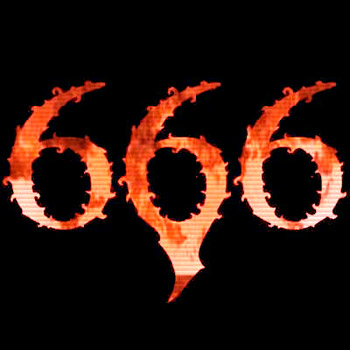
666 - Number of beast Antichrist
The association of the number 666 with the Antichrist is derived from Revelation 13:18 in which John the Revelator is told in his apocalyptic vision that the number of the Beast is 666 and that the number stands for a person. In John’s world of the first century, the Beast that ruled the Earth would have been the emperor, the caesar, of the Roman Empire, Nero (37C.E.–68 C.E.). Using the Hebrew alphabet, the numerical value of “Caesar Nero,” the merciless persecutor of the early Christians, is 666. Although Jesus (c. 6 B.C.E.–c. 30 C.E.) made it clear when speaking to the apostles that no one will know the exact hour or day of his Second Coming, for many centuries certain Christian theologians have associated the rise of the Antichrist to power and his achievement of a seven-year reign over all the
Earth as a kind of catalyst that would set in motion Armageddon, the last final battle between good and evil—the ultimate clash between the armies of Jesus Christ and Satan. Ever since the Protestant Reformation, the pope has been a favorite of certain Evangelicals for the ignominious title. Many of the pontiffs in the Middle Ages did exercise great power over the rulers and the people of the emerging European nations; and consequently, there were numerous embittered princes and fiery Protestant leaders who did seek to affix the blame for a large number of repressive social and religious programs on the Vatican.
However, contemporary popes have wielded little political influence, surely none that would place them in world-threatening positions. There have been such men as Aleister Crowley (1875–1947), who actually appeared to covet and campaign for the position by calling himself the Beast and 666. Hollywood has capitalized on the fascination of certain Christians and horror movie fans with the menacing evil of the Antichrist and depicted him in a number of motion pictures.
In Rosemary’s Baby (1968), an unsuspecting young wife (Mia Farrow) is selected to bear the Antichrist after her husband (John Cassavetes) makes a pact with Satan. The Omen (1976) spawned a series of three films that follow the Antichrist from early childhood to his position of wealth, power, and charismatic mastery as an adult. In the first of these films, Gregory Peck, as the unsuspecting surrogate father of the Antichrist, is warned of his son’s true identity by a number of priests and other individuals who all meet untimely warnings as the babble of the demented, he is later shocked to discover the numerals “666” on his son’s scalp and he resolves to do whatever must be done to stop Satan’s will from being accomplished. In spite of a valiant effort on the part of the father, who now concludes rightfully that his true son was killed and supplanted by the disciples of the Antichrist, the demon seed continues his destructive path to world domination in two additional films.
Read more at http://theunexplainedmysteries.com/666.html
Earth as a kind of catalyst that would set in motion Armageddon, the last final battle between good and evil—the ultimate clash between the armies of Jesus Christ and Satan. Ever since the Protestant Reformation, the pope has been a favorite of certain Evangelicals for the ignominious title. Many of the pontiffs in the Middle Ages did exercise great power over the rulers and the people of the emerging European nations; and consequently, there were numerous embittered princes and fiery Protestant leaders who did seek to affix the blame for a large number of repressive social and religious programs on the Vatican.
However, contemporary popes have wielded little political influence, surely none that would place them in world-threatening positions. There have been such men as Aleister Crowley (1875–1947), who actually appeared to covet and campaign for the position by calling himself the Beast and 666. Hollywood has capitalized on the fascination of certain Christians and horror movie fans with the menacing evil of the Antichrist and depicted him in a number of motion pictures.
In Rosemary’s Baby (1968), an unsuspecting young wife (Mia Farrow) is selected to bear the Antichrist after her husband (John Cassavetes) makes a pact with Satan. The Omen (1976) spawned a series of three films that follow the Antichrist from early childhood to his position of wealth, power, and charismatic mastery as an adult. In the first of these films, Gregory Peck, as the unsuspecting surrogate father of the Antichrist, is warned of his son’s true identity by a number of priests and other individuals who all meet untimely warnings as the babble of the demented, he is later shocked to discover the numerals “666” on his son’s scalp and he resolves to do whatever must be done to stop Satan’s will from being accomplished. In spite of a valiant effort on the part of the father, who now concludes rightfully that his true son was killed and supplanted by the disciples of the Antichrist, the demon seed continues his destructive path to world domination in two additional films.
Read more at http://theunexplainedmysteries.com/666.html
Monday, October 25, 2010
The Haunted History Of Halloween - Video
The Haunted History Of Halloween Video - Part 1
Halloween, celebrated each year on October 31, is a mix of ancient Celtic practices, Catholic and Roman religious rituals and European folk traditions that blended together over time to create the holiday we know today. Straddling the line between fall and winter, plenty and paucity and life and death, Halloween is a time of celebration and superstition. Halloween has long been thought of as a day when the dead can return to the earth, and ancient Celts would light bonfires and wear costumes to ward off these roaming ghosts.Watch the complete Haunted History Of Halloween Video
Friday, October 15, 2010
Halloween Fun Facts and Trivia - 100 Interesting Halloween Facts
Below you'll find some interesting Halloween facts, traditions and other bits of information relating to the history of Halloween. You can always find a way to use these interesting Halloween facts at your party, for instance in a Halloween quiz.
Behind the name "Halloween", or the "Hallow E'en" as they call it in Ireland, means 'All Hallows Eve', or the night before the 'All Hallows', also called 'All Hallowmas', or 'All Saints', or 'All Souls' Day, observed on November 1.
One story says that on Nov. 1 the disembodied spirits of all those who had died throughout the preceding year would come back in search of living bodies to possess for the next year. It was believed to be their only hope for the afterlife. The Celts believed all laws of space and time were suspended during this time, allowing the spirit world to intermingle with the living.
Naturally, the still living did not want to be possessed. So on the night of October 31, villagers would extinguish the fires in their homes, to make them cold and undesirable. They would then dress up in all manner of ghoulish costumes and noisily paraded around the neighborhood, being as destructive as possible in order to frighten away spirits looking for bodies to possess.
Another one of those interesting Halloween facts has to do with the custom of trick-or-treating. This custom is thought to have originated not with the Irish Celts, but with a ninth-century European custom called "souling". On November 2, All Souls Day, early Christians would walk from village to village begging for "soul cakes," made out of square pieces of bread with currants. The more soul cakes the beggars would receive, the more prayers they would promise to say on behalf of the dead relatives of the donors. At the time, it was believed that the dead remained in limbo for a time after death, and that prayer, even by strangers, could expedite a soul's passage to heaven.
Another assumption: On the evening before Samhain (another name for Halloween), people left food on their doorsteps to keep hungry spirits from entering the house. Festivalgoers started dressing in ghost, witch, and goblin costumes so that wandering spirits would leave them alone. To this day, these are Halloween's most popular costumes.
The Irish used turnips as their "Jack's lanterns" originally. But when the immigrants came to America , they found that pumpkins were far more plentiful than turnips. So the Jack-O-Lantern in America was a hollowed-out pumpkin, lit with an ember.
Growing big pumpkins is a big-time and serious hobby. Top prize money for the biggest giant pumpkin is as much as $25,000 dollars at fall festivals. The current world record for giant pumpkins is 1446 pounds (that's a lot of pumpkin pies!).
More interesting Halloween facts have to do with witches. "Witch" comes from the Saxon word wicca which means 'wise one'. Witches were thought to be wise enough to tell the future.
Read more Halloween Fun Facts and Halloween History
Friday, October 8, 2010
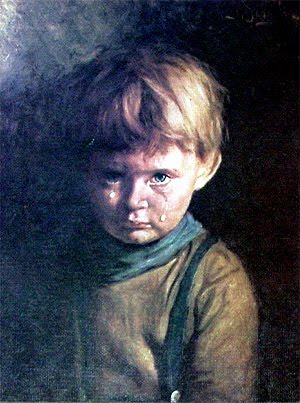
Crying Boy Cursed Painting
‘The Curse of the Crying Boy’ appeared out of the blue one morning in 1985. The Sun, at that time the most popular tabloid newspaper in the English-speaking world, published on page 13 of its 4 September edition a story headlined: “Blazing Curse of the Crying Boy”. It told how Ron and May Hall blamed a cheap painting of a toddler with tears rolling down his face for a fire which gutted their terraced council home in Rotherham, a mining town in South Yorkshire. The blaze broke out in a chip-pan in the kitchen of their home of 27 years and spread rapidly. But although the downstairs rooms of the house were badly damaged, the framed print of the Crying Boy escaped unscathed. It continued to hang there, surrounded by a scene of devastation.
Normally a chip-pan blaze would merit nothing more than a couple of paragraphs in a local newspaper. What transformed this story into a page lead in Britain’s leading tabloid was the intervention of Ron Hall’s brother Peter, a firefighter based in Rotherham. A colleague of Peter’s, station officer Alan Wilkinson, said he knew of numerous other cases where prints of the ‘Crying Boy’ had turned up, undamaged, in the ruins of homes destroyed by fires. Accompanying the article was a photograph of a ‘Crying Boy’, with the caption: “Tears for fears… the portrait that firemen claim is cursed.”
The firemen concerned had not actually used the word ‘cursed’, but nevertheless the newspaper report had helped to give the story a certain level of credibility. The paper added that an estimated 50,000 ‘Crying Boy’ prints, signed ‘G Bragolin’, had been sold in branches of British department stores, particularly in the working class areas of northern England. Examples could be seen hanging in the front rooms of family homes across the nation, and one story even suggested a quarter of a million had been sold.
After one month of hearing all the tales, the “Sun” gave their readers the chance to bring their “Crying boy” paintings and agreed to have a very large bon fire to rid everyone of this cursed or jinxed painting. All paintings that were brought to the newspaper were in fact burned and everyone rejoiced. However, the story goes on. There have been reports of the crying boy painting being found in charred homes untouched since 1985 and as recent as 1988.
Typical of these additional stories was that told by Dora Mann, from Mitcham, Surrey, who claimed her house was gutted just six months after she bought a print of the painting. “All my paintings were destroyed – except the one of the Crying Boy,” she claimed. Sandra Kaske, of Kilburn, North Yorkshire, said that she, her sister-in-law, and a friend had all suffered disastrous fires since they acquired copies. Another family, from Nottingham, blamed the print for a blaze which had left them homeless. Brian Parks, whose wife and three children needed treatment for smoke inhalation, said he had destroyed his copy after returning from hospital to find it hanging – undamaged, of course – on the blackened wall of his living room. As the stories accumulated, new details emerged that encouraged the idea that possession of a print put owners at risk of fire or serious injury.
Read more on The Cursed Painting of Crying Boy
Normally a chip-pan blaze would merit nothing more than a couple of paragraphs in a local newspaper. What transformed this story into a page lead in Britain’s leading tabloid was the intervention of Ron Hall’s brother Peter, a firefighter based in Rotherham. A colleague of Peter’s, station officer Alan Wilkinson, said he knew of numerous other cases where prints of the ‘Crying Boy’ had turned up, undamaged, in the ruins of homes destroyed by fires. Accompanying the article was a photograph of a ‘Crying Boy’, with the caption: “Tears for fears… the portrait that firemen claim is cursed.”
The firemen concerned had not actually used the word ‘cursed’, but nevertheless the newspaper report had helped to give the story a certain level of credibility. The paper added that an estimated 50,000 ‘Crying Boy’ prints, signed ‘G Bragolin’, had been sold in branches of British department stores, particularly in the working class areas of northern England. Examples could be seen hanging in the front rooms of family homes across the nation, and one story even suggested a quarter of a million had been sold.
After one month of hearing all the tales, the “Sun” gave their readers the chance to bring their “Crying boy” paintings and agreed to have a very large bon fire to rid everyone of this cursed or jinxed painting. All paintings that were brought to the newspaper were in fact burned and everyone rejoiced. However, the story goes on. There have been reports of the crying boy painting being found in charred homes untouched since 1985 and as recent as 1988.
Typical of these additional stories was that told by Dora Mann, from Mitcham, Surrey, who claimed her house was gutted just six months after she bought a print of the painting. “All my paintings were destroyed – except the one of the Crying Boy,” she claimed. Sandra Kaske, of Kilburn, North Yorkshire, said that she, her sister-in-law, and a friend had all suffered disastrous fires since they acquired copies. Another family, from Nottingham, blamed the print for a blaze which had left them homeless. Brian Parks, whose wife and three children needed treatment for smoke inhalation, said he had destroyed his copy after returning from hospital to find it hanging – undamaged, of course – on the blackened wall of his living room. As the stories accumulated, new details emerged that encouraged the idea that possession of a print put owners at risk of fire or serious injury.
Read more on The Cursed Painting of Crying Boy
The Mysterious Case of Bridey Murphy
In the 1950s hypnotist Morey Bernstein of Pueblo, Colorado, was working with one of his clients, a twenty-nine-year old housewife and mother named Virginia Tighe when, during one of their sessions, she spoke with the voice and memories of a nineteenth-century Irishwoman named Bridey Murphy. The first time this occurred, Bernstein had been trying to help Tighe to remember her childhood and had casually suggested that she “go to some other place in some other time.” He meant for her to remember some other period of her life, but instead she seemed to jump to the life of someone else who had lived long before. In an Irish accent, she told Bernstein that she, Bridey Murphy, had been born in 1798 and died in 1864 of complications from a broken hip. Virginia Tighe herself was born in the Midwest in 1923, had never been to Ireland, and did not speak with even the slightest hint of an Irish accent.
In this and subsequent hypnosis sessions, she also provided Bernstein with numerous details about her family, experiences, likes and dislikes. For example, she gave the name of the Catholic church in Belfast, Ireland, where she had married Sean Brian Joseph McCarthy in 1818 and offered detailed descriptions of places where she had shopped for food. She also told Bernstein about the time in-between lives, when the spirit waited for a new existence. During this period, she said, she could travel anywhere with just a thought.
Her tale began in 1806 when Bridey was eight years old and living in a house in Cork. She was the daughter of Duncan Murphy, a barrister, and his wife Kathleen. At the age of 17 she married lawyer Sean Brian McCarthy and moved to Belfast. Bridey told of a fall that caused her death and of watching her own funeral, describing her tombstone and the state of being in life after death. It was, she recalled, a feeling of neither pain nor happiness. Somehow, she was reborn in America, although Bridey was not clear how this reincarnation happened.
Bernstein tape-recorded each session, and in 1956 he published a book based on his work, "The Search for Bridey Murphy". (Bernstein called Tighe “Ruth Simmons” in his writings in order to protect her anonymity, but journalists soon uncovered her real name.) Skeptics soon began noting flaws in Tighe’s story. Many of her place descriptions, including details about where Murphy had bought her food, were accurate, but other facts were not. The same was true of her language; some of the words she used were appropriate diction for a nineteenth-century Irishwoman, but others were those of a twentieth-century American. In addition, neither skeptics nor believers could find any evidence that anyone named Bridey Murphy had ever lived. Searches of church baptismal records and other records turned up nothing.
Read more on Bridey Murphy Reincarnation case
Monday, October 4, 2010
4000-year-old Aryan city discovered in Russia
Spiral cities built on remote Russian plains by swastika-painting Aryans
Russian archaeologists have unearthed some ancient and virtually unknown settlements which they believe were built by the original Aryan race about 4000 years ago.
According to the team which has discovered 20 of the spiral-shaped settlements in remote part of Russia steppe in southern Siberia bordering Kazakhstan, the buildings date back to the beginning of Western civilisation in Europe.
The Bronze-age settlements, the experts said, could have been built shortly after the Great Pyramid some 4000 years ago by the original Aryan race whose swastika symbol was later adopted by the Nazis in the 1930s.
TV historian Bettany Hughes, who explored the desolate part of the Russian steppe for BBC programme 'Tracking The Aryans', said: "Potentially, this could rival ancient Greece in the age of the heroes."
"Because I have written a lot about the Bronze Age world, there always seemed to be this huge missing piece of the jigsaw puzzle," Hughes was quoted as saying by the Daily Mail.
She said: "We are all told that there is this kind of mother tongue, proto-Indo-European, from which all the languages we know emerge.
"I was very excited to hear on the archaeological grapevine that in exactly the period I am an expert in, this whole new Bronze Age civilisation had been discovered on the steppe of southern Siberia."
The remains of the ancient city were explored for the first time around 20 years ago shortly after then Soviet officials relaxed strict laws banning non-military aerial photography.
But because of the region is so remote the incredible cities have remained virtually unknown to the rest of Europe until now, according to the archaeologists
Read more on this unexplained mystery
Russian archaeologists have unearthed some ancient and virtually unknown settlements which they believe were built by the original Aryan race about 4000 years ago.
According to the team which has discovered 20 of the spiral-shaped settlements in remote part of Russia steppe in southern Siberia bordering Kazakhstan, the buildings date back to the beginning of Western civilisation in Europe.
The Bronze-age settlements, the experts said, could have been built shortly after the Great Pyramid some 4000 years ago by the original Aryan race whose swastika symbol was later adopted by the Nazis in the 1930s.
TV historian Bettany Hughes, who explored the desolate part of the Russian steppe for BBC programme 'Tracking The Aryans', said: "Potentially, this could rival ancient Greece in the age of the heroes."
"Because I have written a lot about the Bronze Age world, there always seemed to be this huge missing piece of the jigsaw puzzle," Hughes was quoted as saying by the Daily Mail.
She said: "We are all told that there is this kind of mother tongue, proto-Indo-European, from which all the languages we know emerge.
"I was very excited to hear on the archaeological grapevine that in exactly the period I am an expert in, this whole new Bronze Age civilisation had been discovered on the steppe of southern Siberia."
The remains of the ancient city were explored for the first time around 20 years ago shortly after then Soviet officials relaxed strict laws banning non-military aerial photography.
But because of the region is so remote the incredible cities have remained virtually unknown to the rest of Europe until now, according to the archaeologists
Read more on this unexplained mystery
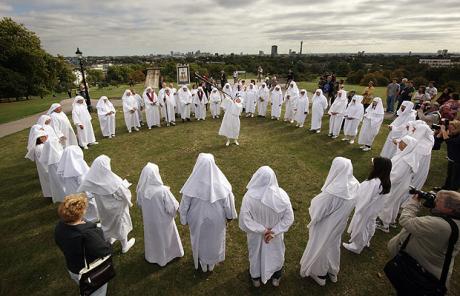
Druidry recognised as religion in Britain for first time
The Druid Network has been given charitable status by the Charity Commission for England and Wales, the quango that decides what counts as a genuine faith as well as regulating fundraising bodies.
It guarantees the modern group, set up in 2003, valuable tax breaks but also grants the ancient religion equal status to more mainstream denominations. This could mean that Druids, the priestly caste in Celtic societies across Europe, are categorised separately in official surveys of religious believers.
Supporters say the Charity Commission’s move could also pave the way for other minority faiths to gain charitable status.
Phil Ryder, Chair of Trustees for The Druid Network, said it had taken four years for the group to be recognised by the regulator. “It was a long and at times frustrating process, exacerbated by the fact that the Charity Commissioners had no understanding of our beliefs and practices, and examined us on every aspect of them. Their final decision document runs to 21 pages, showing the extent to which we were questioned in order to finally get the recognition we have long argued for,” he said.
Emma Restall Orr, founder of The Druid Network, added: “The Charity Commission now has a much greater understanding of Pagan, animist, and polytheist religions, so other groups from these minority religions – provided they meet the financial and public benefit criteria for registration as charities - should find registering a much shorter process than the pioneering one we have been through.”
In its assessment of the Druid Network’s application, the Charity Commission accepts that Druids worship nature, in particular the sun and the earth but also believe in the spirits of places such as mountains and rivers as well as “divine guides” such as Brighid and Bran.
The document lists the “commonality of practice” in Druidry, including its eight major festivals each year; rituals at different phases of the moon; rites of passage and gatherings of bards on sacred hills, known as “gorsedd”.
Labels:
Druid,
Druidry,
Druidry religion,
Neo-Druidism,
Neo-Druidry,
unexplained,
unsolved
Tuesday, September 28, 2010
Unsolved Murder Mystery of Black Dahlia and Torso Slayer
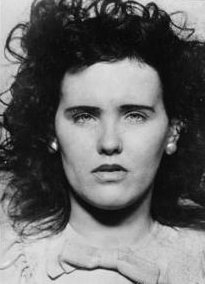
She was known as the “Black Dahlia”. She had jet black hair and preferred black dresses and lingerie. Those who knew her best said she had a tattoo of an exotic flower on her inner thigh. She wanted desperately to be a Hollywood actress, but her fame would not come from the movies. It would come from her death, a murder which has gone unsolved for 60 years.
Elizabeth Short(July 29, 1924 – ca. January 15, 1947) was an American woman and the victim of a gruesome and much-publicized murder. She acquired the moniker The Black Dahlia posthumously by newspapers in the habit of nicknaming crimes they found particularly colorful. Short was found mutilated, her body severed at the waist, on January 15, 1947, in Leimert Park, Los Angeles, California. Short's unsolved murder has been the source of widespread speculation along with several books and film adaptations.
On a cold morning in January 1947, the nude, mutilated body of 22-year-old Elizabeth Short was discovered in a vacant lot in the Leimert Park area of Los Angeles. What made the murder so unique was the barbaric nature of the crime. The Black Dahlia’s body had been neatly severed in half, gutted and drained of blood. Author Lawrence P. Scherb put the unusual crime into perspective:
“Her face had been very brutally cut from ear to ear in a grin. Her throat had been cut and she had been mutilated sexually. Basically, she was the worst case of a sex crime in the history of Los Angeles County.”
The case of The Black Dahlia has fascinated crime writers for generations, and almost every one of them has a different theory about the killer. Lawrence Scherb has studied the Black Dahlia case extensively. Now, he believes he knows the identity of the man who so brutally murdered Elizabeth Short.
Elizabeth Short’s life was as sad as it was brief. Like so many other young women, Elizabeth had been lured to Hollywood with dreams of becoming a star. Her career was going nowhere and she was running out of cash. According to some, she eventually drifted into prostitution.
In her final days, Elizabeth seemed to be constantly on the move. According to Lawrence Scherb, she was last seen leaving a diner in San Diego with a man who has never been positively identified:
"She called him Red when she spoke to him in the diner and he did have reddish colored hair. However, the police were never able to positively identify him, although some people felt that he might have been Robert Manley."
Read more at Black Dahlia Murder Mystery
Elizabeth Short(July 29, 1924 – ca. January 15, 1947) was an American woman and the victim of a gruesome and much-publicized murder. She acquired the moniker The Black Dahlia posthumously by newspapers in the habit of nicknaming crimes they found particularly colorful. Short was found mutilated, her body severed at the waist, on January 15, 1947, in Leimert Park, Los Angeles, California. Short's unsolved murder has been the source of widespread speculation along with several books and film adaptations.
On a cold morning in January 1947, the nude, mutilated body of 22-year-old Elizabeth Short was discovered in a vacant lot in the Leimert Park area of Los Angeles. What made the murder so unique was the barbaric nature of the crime. The Black Dahlia’s body had been neatly severed in half, gutted and drained of blood. Author Lawrence P. Scherb put the unusual crime into perspective:
“Her face had been very brutally cut from ear to ear in a grin. Her throat had been cut and she had been mutilated sexually. Basically, she was the worst case of a sex crime in the history of Los Angeles County.”
The case of The Black Dahlia has fascinated crime writers for generations, and almost every one of them has a different theory about the killer. Lawrence Scherb has studied the Black Dahlia case extensively. Now, he believes he knows the identity of the man who so brutally murdered Elizabeth Short.
Elizabeth Short’s life was as sad as it was brief. Like so many other young women, Elizabeth had been lured to Hollywood with dreams of becoming a star. Her career was going nowhere and she was running out of cash. According to some, she eventually drifted into prostitution.
In her final days, Elizabeth seemed to be constantly on the move. According to Lawrence Scherb, she was last seen leaving a diner in San Diego with a man who has never been positively identified:
"She called him Red when she spoke to him in the diner and he did have reddish colored hair. However, the police were never able to positively identify him, although some people felt that he might have been Robert Manley."
Read more at Black Dahlia Murder Mystery
UFO incursions at nuclear weapon sites in US and UK
FORMER members of the US Air Force claim aliens interfered with nuclear weapons - including during one famous incident in Britain.
UFO researcher Robert Hastings held a press conference in Washington to "address the vital issue of UFO incursions at US nuclear weapons sites over the past six decades".
Mr Hastings said: "More than 100 former or retired US Air Force personnel - once trusted to operate or guard weapons of mass destruction - have come forward and revealed ongoing UFO surveillance of, and occasional interference with, our nuclear weapons.
"This information alters the historical perspective on the nuclear arms race and much, much more.
"The fact that the Pentagon and CIA have successfully kept the truth from public view for so long is in itself mind-boggling."
The Rendlesham Forest incident, often described as "Britain's Roswell" was used as one example of evidence aliens had targeted nuclear weapons.
Labels:
ufo attack,
ufo incursion,
ufo video,
unsolved mysteries
Friday, September 24, 2010
Draugr - Unexplained Mysteries of one who walks after death
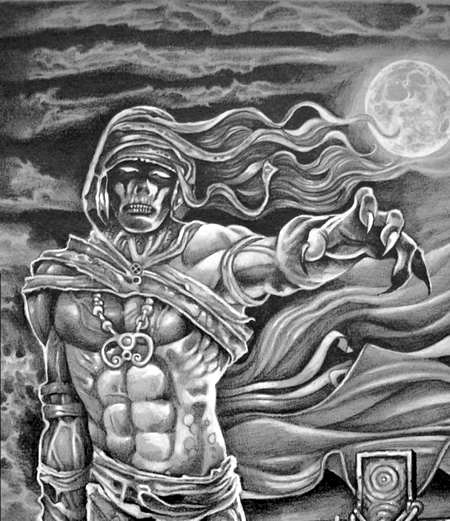
A draugr or draug (original Old Norse plural draugar, as used here, not draugrs), or draugen (Nor., Swe. and Dan., meaning "the draug"), also known as aptrgangr (lit. "after-goer," or "one who walks after death") is an undead creature from Norse mythology. The original Norse meaning of the word is ghost, and in older literature one will find clear distinctions between sea-draug and land-draug. Draugar were believed to live in the graves of dead Vikings, being the body of the dead. Views differ on whether the personality and soul of the dead person lingers in the draugr. As the graves of important men often contained a good amount of wealth, the draugr jealously guards his treasures, even after death.
Traits
Draugar possess superhuman strength, can increase their size at will and carry the unmistakable stench of decay. The draugr's body, however does not decay and this odor was most likely due to the draugr being a host for diseases. The draugr's ability to increase its size also increased its weight as it did so, and the body of the draugr was described as being extremely heavy. It is possibly that the draugr could also be heavy without increasing its size, as this could help explain its immense strength, but the strength of the draugr could also be independent of its size or weight. The weight of the draugr may also only increase as size does. Thorolf of Eyrbyggja Saga was "uncorrupted, and with an ugly look about him... swollen to the size of an ox," and his body could not be raised without levers, it was so heavy. They are also noted for the ability to rise from the grave as wisps of smoke, possibly meaning they also have the ability to turn into smoke at will, although it is much more likely that this is an interperatation of their ability to "swim" through solid rock[5], which would be useful as a means of exiting their graves. Whether or not they can become intangible to other materials is not certain. In folklore the draugar slay their victims through various methods including crushing them with their enlarged forms, devouring their flesh, devouring them whole in their enlarged froms, inderectly killing them by driving them mad, and drinking their blood. Animals feeding near the grave of a draugr are often driven mad by the creature's influence.[ They may also die from being driven mad. Thorolf of the Eyrbyggja saga, for example, caused birds that flew over his howe to drop dead. Draugr are also noted as being able to drive living people insane. This may have been a method of the draugr to create more of his kind, similar to a vampire. The eyes of the draugr may be connected to this as their eyes are noted as being terrifying to look at, causing intense fear in even the bravest heroes. The power of the draugr's eyes, however, are never fully explained.
The draugr's victims were not limited to trespassers in its howe. The roaming ghosts decimated livestock by running the animals to death while either riding them or pursuing them in some hideous, half-flayed form. Shepherd, whose duties to their flocks left them out of doors at night time, were also particular targets for the hunger and hatred of the undead:
"... the oxen which had been used to haul Thorolf's body were ridden to death by demons, and every single beast that came near his grave went raving mad and howled itself to death. The shepherd at Hvamm often came racing home with Thorolf after him. One day that autumn neither sheep nor shepherd came back to the farm."
Draugr are noted for having numerous magical abilities, referred to as "trollskap" resembling those of living witches and wizards, such as shape-changing, controlling the weather, and seeing into the future. Among the creatures that a draugr may turn into are a seal, a great flayed bull, a grey horse with no ears or tail and a broken back, and a cat that would sit upon a sleeper's chest and grow steadily heavier until the victim suffocated The draugr Thrain shape-shifted into a "cat-like creature" (kattakyn) in Hromundar saga Greipssonar:
"Then Thrain turned himself into a troll, and the barrow was filled with a horrible stench; and he stuck his claws into the back of Hromund's neck, tearing the flesh from his bones..."
More on this unexplained mystery at http://theunexplainedmysteries.com/Draugr.html
Traits
Draugar possess superhuman strength, can increase their size at will and carry the unmistakable stench of decay. The draugr's body, however does not decay and this odor was most likely due to the draugr being a host for diseases. The draugr's ability to increase its size also increased its weight as it did so, and the body of the draugr was described as being extremely heavy. It is possibly that the draugr could also be heavy without increasing its size, as this could help explain its immense strength, but the strength of the draugr could also be independent of its size or weight. The weight of the draugr may also only increase as size does. Thorolf of Eyrbyggja Saga was "uncorrupted, and with an ugly look about him... swollen to the size of an ox," and his body could not be raised without levers, it was so heavy. They are also noted for the ability to rise from the grave as wisps of smoke, possibly meaning they also have the ability to turn into smoke at will, although it is much more likely that this is an interperatation of their ability to "swim" through solid rock[5], which would be useful as a means of exiting their graves. Whether or not they can become intangible to other materials is not certain. In folklore the draugar slay their victims through various methods including crushing them with their enlarged forms, devouring their flesh, devouring them whole in their enlarged froms, inderectly killing them by driving them mad, and drinking their blood. Animals feeding near the grave of a draugr are often driven mad by the creature's influence.[ They may also die from being driven mad. Thorolf of the Eyrbyggja saga, for example, caused birds that flew over his howe to drop dead. Draugr are also noted as being able to drive living people insane. This may have been a method of the draugr to create more of his kind, similar to a vampire. The eyes of the draugr may be connected to this as their eyes are noted as being terrifying to look at, causing intense fear in even the bravest heroes. The power of the draugr's eyes, however, are never fully explained.
The draugr's victims were not limited to trespassers in its howe. The roaming ghosts decimated livestock by running the animals to death while either riding them or pursuing them in some hideous, half-flayed form. Shepherd, whose duties to their flocks left them out of doors at night time, were also particular targets for the hunger and hatred of the undead:
"... the oxen which had been used to haul Thorolf's body were ridden to death by demons, and every single beast that came near his grave went raving mad and howled itself to death. The shepherd at Hvamm often came racing home with Thorolf after him. One day that autumn neither sheep nor shepherd came back to the farm."
Draugr are noted for having numerous magical abilities, referred to as "trollskap" resembling those of living witches and wizards, such as shape-changing, controlling the weather, and seeing into the future. Among the creatures that a draugr may turn into are a seal, a great flayed bull, a grey horse with no ears or tail and a broken back, and a cat that would sit upon a sleeper's chest and grow steadily heavier until the victim suffocated The draugr Thrain shape-shifted into a "cat-like creature" (kattakyn) in Hromundar saga Greipssonar:
"Then Thrain turned himself into a troll, and the barrow was filled with a horrible stench; and he stuck his claws into the back of Hromund's neck, tearing the flesh from his bones..."
More on this unexplained mystery at http://theunexplainedmysteries.com/Draugr.html
Labels:
after-goer,
draug,
draugar,
draugr,
draugrs,
one who walks after death,
the draug
Unexplained Mysteries - Myhtical creature GREMLIN
Gremlin is an English folkloric creature, commonly depicted as mischievous and mechanically oriented, with a specific interest in aircraft. Although their origin is found in myths among airmen, claiming that the gremlins were responsible for sabotaging aircraft, John W. Hazen states that "some people" derive the name from the Old English word gremian, "to vex". Since World War II, different fantastical creatures have been referred to as gremlins, bearing varying degrees of resemblance to the originals.
The term "gremlin" was derived from the Old English word greme, which means to vex and annoy, commonly depicted as mischievous and mechanically oriented, with a specific interest in aircraft. The word "gremlin" originated in Royal Air Force (RAF) aviators' slang in Malta, the Middle East and India, with the earliest recorded printed use being in a poem published in the journal Aeroplane, in Malta on April 10, 1929. The concept of gremlins responsible for sabotaging aircraft was popularised during World War II among airmen of the UK's RAF, in particular the men of the high-altitude Photographic Reconnaissance Units (PRU) of RAF Benson, RAF Wick and RAF St Eval. The creatures were responsible for otherwise inexplicable accidents which sometimes occurred during their flights. Gremlins were also thought at one point to have enemy sympathies, but investigations revealed that enemy planes had similar and equally inexplicable mechanical problems. And that is certainly what the gremlins did to the pilots and their aircraft in World War II (1939–45) when the pesky entities were routinely blamed for engine troubles, electronic failures, and any other thing that might go wrong with an airplane.
An early reference to the Gremlin is in an article by Hubert Griffith in the servicemen's fortnightly Royal Air Force Journal dated April 18, 1942 although that article states the stories had been in existence for several years, and there are later recollections of it having been told by Battle of Britain Spitfire pilots as early as 1940. Later sources have sometimes claimed that the concept goes back to World War I, but there is no print evidence of this. Dave Stern, an aerospace, aviation, and history writer, says that the legend began in 1923 when a British navy pilot crashed into the sea. Once he was rescued, he blamed the accident on some little people who had jumped out of a beer bottle and had tormented him all night. It was these wee troublemakers who had followed him into the airplane, entered into the engine, messed with the flight controls, and caused him to crash. Not long after this reported gremlin attack, some pilots and mechanics stationed at an overseas RAF aerodrome complained of being bothered by the annoying entities, and by 1925, British pilots were cussing the little monsters and blaming gremlins for almost anything that might possibly go wrong with their aircraft.
Read more at http://theunexplainedmysteries.com/gremlin.html
Labels:
gremlin,
gremlin history,
gremlin myth,
unsolved mysteries
Monday, September 20, 2010
Queen Nefertiti bust may have had a facelift
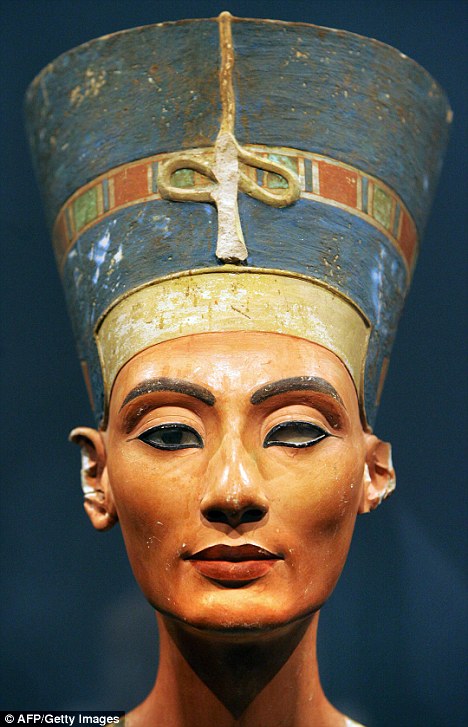
An ancient Egyptian queen who was been hailed for thousands of years as the perfect example of beauty may not have been such a looker after all, researchers have claimed.
The 3,300-year-old carved bust of Queen Nerfititi with her aquiline nose and high cheek bones has won her admiring fans around the world.
But a delicately carved face in the limestone core of the famous bust suggests the royal sculptor at the time may have smoothed creases around the mouth and fixed a bumpy nose to depict the 'Beauty of the Nile' in a better light.
TV Historian Bettany Hughes was part of a team that made the discovery which is supported by earlier research from German scientists who studied the 20 inch bust of Nefretiti whose name means 'the beautiful one has come'.
Ms Hughes and her team carried out a CT scan of the bust and discovered a second limestone model with a bent nose and wrinkles around the eyes which may have been used as a template for the bust.
'That statue is still very beautiful nut not as beautiful. It showed her nose was bent, and that she had wrinkles around her eyes. It's a real portrait of a real woman,' Ms Hughes told The Independent Woodstock Literary Festival on Saturday.
'We're now going to a tomb in the Valley of the Kings where we think Nefertiti's sister is to see if the dynasty has the same features.
'All of life is in classical antiquity and articulated in the most beautiful, evocative and sensual way. We are denuding society if we don't allow young people to revel in that beautiful world.' The bust of Nefertiti, who died around 1330 BC aged between 29 and 38, is one of the most widely recognised Ancient Egyptian items after the mask of the king Tutenkhamen who may have been her son.
It was found in Egypt in 1912 at Tell el-Amarna, the short-lived capital of Nefertiti's husband, the Pharaoh Akhenaten. It is now housed in Berlin's Altes Museum.
Read more on this unexplained mystery
The 3,300-year-old carved bust of Queen Nerfititi with her aquiline nose and high cheek bones has won her admiring fans around the world.
But a delicately carved face in the limestone core of the famous bust suggests the royal sculptor at the time may have smoothed creases around the mouth and fixed a bumpy nose to depict the 'Beauty of the Nile' in a better light.
TV Historian Bettany Hughes was part of a team that made the discovery which is supported by earlier research from German scientists who studied the 20 inch bust of Nefretiti whose name means 'the beautiful one has come'.
Ms Hughes and her team carried out a CT scan of the bust and discovered a second limestone model with a bent nose and wrinkles around the eyes which may have been used as a template for the bust.
'That statue is still very beautiful nut not as beautiful. It showed her nose was bent, and that she had wrinkles around her eyes. It's a real portrait of a real woman,' Ms Hughes told The Independent Woodstock Literary Festival on Saturday.
'We're now going to a tomb in the Valley of the Kings where we think Nefertiti's sister is to see if the dynasty has the same features.
'All of life is in classical antiquity and articulated in the most beautiful, evocative and sensual way. We are denuding society if we don't allow young people to revel in that beautiful world.' The bust of Nefertiti, who died around 1330 BC aged between 29 and 38, is one of the most widely recognised Ancient Egyptian items after the mask of the king Tutenkhamen who may have been her son.
It was found in Egypt in 1912 at Tell el-Amarna, the short-lived capital of Nefertiti's husband, the Pharaoh Akhenaten. It is now housed in Berlin's Altes Museum.
Read more on this unexplained mystery
Subscribe to:
Posts (Atom)