Showing posts with label Halloween costume. Show all posts

Monday, October 25, 2010

The Haunted History Of Halloween - Video


The Haunted History Of Halloween Video - Part 1

Halloween, celebrated each year on October 31, is a mix of ancient Celtic practices, Catholic and Roman religious rituals and European folk traditions that blended together over time to create the holiday we know today. Straddling the line between fall and winter, plenty and paucity and life and death, Halloween is a time of celebration and superstition. Halloween has long been thought of as a day when the dead can return to the earth, and ancient Celts would light bonfires and wear costumes to ward off these roaming ghosts. 


Watch the complete Haunted History Of Halloween Video

Friday, October 15, 2010

Halloween Fun Facts and Trivia - 100 Interesting Halloween Facts


Below you'll find some interesting Halloween facts, traditions and other bits of information relating to the history of Halloween. You can always find a way to use these interesting Halloween facts at your party, for instance in a Halloween quiz.

Behind the name "Halloween", or the "Hallow E'en" as they call it in Ireland, means 'All Hallows Eve', or the night before the 'All Hallows', also called 'All Hallowmas', or 'All Saints', or 'All Souls' Day, observed on November 1.

One story says that on Nov. 1 the disembodied spirits of all those who had died throughout the preceding year would come back in search of living bodies to possess for the next year. It was believed to be their only hope for the afterlife. The Celts believed all laws of space and time were suspended during this time, allowing the spirit world to intermingle with the living.

Naturally, the still living did not want to be possessed. So on the night of October 31, villagers would extinguish the fires in their homes, to make them cold and undesirable. They would then dress up in all manner of ghoulish costumes and noisily paraded around the neighborhood, being as destructive as possible in order to frighten away spirits looking for bodies to possess.

Another one of those interesting Halloween facts has to do with the custom of trick-or-treating. This custom is thought to have originated not with the Irish Celts, but with a ninth-century European custom called "souling". On November 2, All Souls Day, early Christians would walk from village to village begging for "soul cakes," made out of square pieces of bread with currants. The more soul cakes the beggars would receive, the more prayers they would promise to say on behalf of the dead relatives of the donors. At the time, it was believed that the dead remained in limbo for a time after death, and that prayer, even by strangers, could expedite a soul's passage to heaven.

Another assumption: On the evening before Samhain (another name for Halloween), people left food on their doorsteps to keep hungry spirits from entering the house. Festivalgoers started dressing in ghost, witch, and goblin costumes so that wandering spirits would leave them alone. To this day, these are Halloween's most popular costumes. 


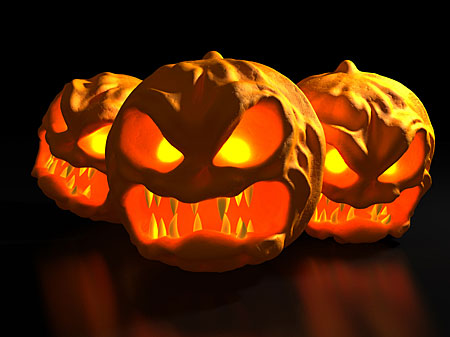
The Irish used turnips as their "Jack's lanterns" originally. But when the immigrants came to America , they found that pumpkins were far more plentiful than turnips. So the Jack-O-Lantern in America was a hollowed-out pumpkin, lit with an ember.

Growing big pumpkins is a big-time and serious hobby. Top prize money for the biggest giant pumpkin is as much as $25,000 dollars at fall festivals. The current world record for giant pumpkins is 1446 pounds (that's a lot of pumpkin pies!).

More interesting Halloween facts have to do with witches. "Witch" comes from the Saxon word wicca which means 'wise one'. Witches were thought to be wise enough to tell the future.


Read more Halloween Fun Facts  and Halloween History

Saturday, October 25, 2008

History of Mysterious Halloween

Halloween is a holiday celebrated on the night of October 31, usually by children dressing in costumes and going door-to-door collecting candy. It is celebrated in much of the Western world, though most commonly in the United States, the United Kingdom, the Republic of Ireland, Canada and sometimes in Australia and New Zealand. Irish, Scots and other immigrants brought older versions of the tradition to North America in the 19th century. Most other Western countries have embraced Halloween as a part of American pop culture in the late 20th century.

The term "Halloween" derives from Hallowe'en, an old contraction, still retained in Scotland and some parts of Canada, of "All Hallow's Eve," so called as it is the day before All Saints day (observed by some Christians, including Roman Catholics), which used to be called "All Hallows," derived from All Hallowed Souls.

In Ireland, the name was Hallow Eve and this name is still used by some older people. Halloween was formerly also sometimes called All Saints' Eve. The holiday was a day of religious festivities in various northern European pagan traditions, until it was appropriated by Christian missionaries (along with Christmas and Easter, two other traditional northern European pagan holidays) and given a Christian reinterpretation.

In Mexico, All Saint's Day, following Halloween, is the Day of the Dead.

Halloween is also called "Pooky Night" in some parts of Ireland, presumably named after the puca, a mischievous spirit.

"Punkie Night" is observed on the last Thursday in October in the village of Hinton St. George in the county of Somerset in England. On this night, children carry lanterns made from hollowed-out mangel-wurzels (a kind of beet; in modern days, pumpkins are used) with faces carved into them. They bring these around the village, collecting money and singing the punkie song. 'Punkie' is derived from 'pumpkin' or 'punk,' meaning 'tinder.'

Though the custom is only attested over the last century, and the mangel-wurzel itself was introduced into English agriculture in the late 18th century, "Punkie Night" appears to be much older even than the fable that now accounts for it. The story goes that the wives of Hinton St. George went looking for their wayward husbands at the fair held nearby at Chiselborough, the last Thursday in October, but first hollowed out mangel wurzels in order to make lanterns to light their way. The drunken husbands saw the eerie lights, thought they were "goolies" (the restless spirits of children who had died before they were baptized), and fled in terror. Children carry the punkies now. The event has spread since about 1960 to the neighboring village of Chiselborough.

In the United Kingdom, the pagan Celts celebrated the Day of the Dead on Halloween. The spirits supposedly rose from the dead and, in order to attract them, food was left on the doors. To scare off the evil spirits, the Celts wore masks. When the Romans invaded Britain, they embellished the tradition with their own, which is the celebration of the harvest and honoring the dead.

These traditions were then passed on to the United States. Anoka, Minnesota, USA, the self-proclaimed "Halloween Capital of the World," celebrates with a large civic parade.
Halloween is sometimes associated with the occult. Many European cultural traditions hold that Halloween is one of the "liminal" times of the year when the spirit world can make contact with the natural world and when magic is most potent.

Read complete history of halloween at http://theunexplainedmysteries.com/halloween.html

LinkWithin

Related Posts with Thumbnails