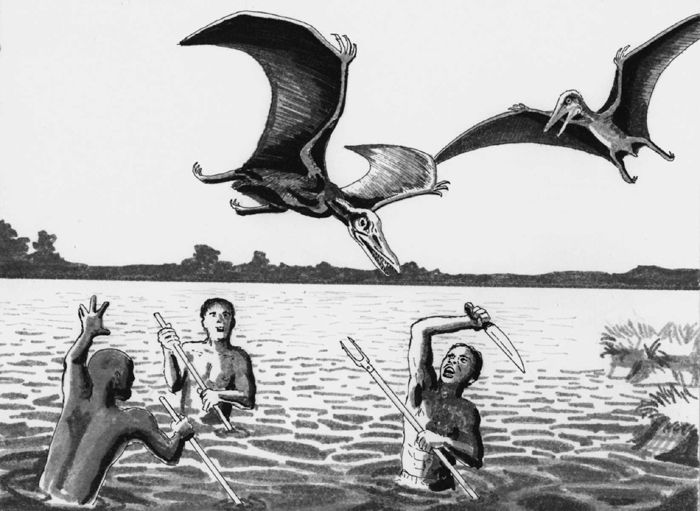
 The Kongamato ("breaker of boats") is a reported pterosaur-like creature from the border area of Zambia, Angola and Congo. Suggested identities include a modern-day Rhamphorhynchus, a misidentified bird (such as the very large and peculiar Saddle-billed Stork), or a giant bat.
Frank Melland, in his 1923 book In Witchbound Africa, describes it as living along certain rivers, and very dangerous, often attacking small boats. It was red, with a wingspan of 4 to 7 feet. Members of the local Kaonde tribe identified it as a pterodactyl after being shown a picture of one from Melland's book collection.
In 1956 an engineer, J.P.F. Brown, allegedly saw the creature at Fort Rosebery near Lake Bangweulu in Northern Rhodesia (now Zambia). It was about 6:00 p.m. when he saw two creatures flying slowly and silently directly overhead. He observed that they looked prehistoric. He estimated a wingspan of about 3 to 3 1/2 feet (1 meter) and a beak-to-tail length of about 4 1/2 feet (1.5 meters). It reportedly had a long thin tail, and a narrow head which he likened to an elongated snout of a dog.
Some 65 million years ago, starting in the Jurassic and lasting into the Cretaceous, there existed a powerful flying reptile known as the Pterosaurs. The majority of fossils found have been in marine deposits, which means they probably were fish eaters and spent most of their time over coastal waters. These Pterosaurs apparently managed to fly with no feathers, their main aerodynamic feature where wings of membrane supported by an enormously elongated fourth finger. They had hollow limb bones and a large keeled breastbone attached to strong wing muscles which where needed for true flight, not just gliding.
The large expenditure of energy required to remain in flight for long periods of time, and the resulting loss of heat caused by the surface of their wings exposed to moving air, means that they must have had some method of regulating body heat, although it is doubtful they were truly warm blooded as mammals are. The majority of the Pterosaurs species where anywhere from the size of a sparrow to the size of an eagle, however some larger species have been discovered. The Pteranodon with a wingspan of 27 ft. and the colossal Quetzalcoatlus, with a wingspan of 50 ft, possibly 60 ft. are two examples of these larger species. Some pterosaurs even had fur, although they are in now way related to mammals. It would seem impossible that these creatures could have survived to the present day. After all, if they existed surely people would see them flying about as they hunted for food. How could a flying population of reptiles remain hidden? There are reports that people have been seeing flying creatures that match the description of pterosaurs for a hundreds of years. People have even been reportedly killed by these ancient flying creatures.
Read more at http://theunexplainedmysteries.com/Kongamato.html
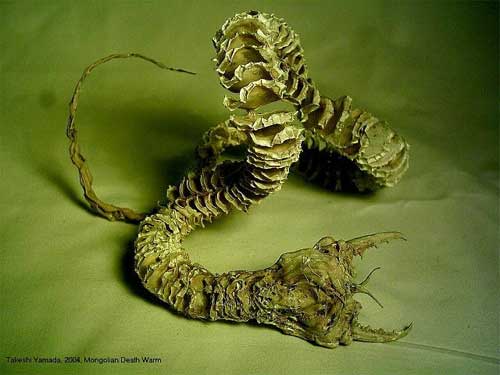 The Mongolian Death Worm is a cryptid purported to exist in the Gobi Desert. It is generally considered a cryptozoological creature; one whose sightings and reports are disputed or unconfirmed.
It is described as a bright red worm with a wide body that is 0.6 to 1.5 meters (2 to 5 feet) long. In general, scientists reject the possibility that such mega-fauna cryptids exist, because of the improbably large numbers necessary to maintain a breeding population[1] and because climate and food supply issues make their survival in reported habitats unlikely.
The local name is allghoi, which means "blood filled intestine worm" because it is reported to look like the intestine of a cow. It is the subject of a number of extraordinary claims by Mongolian locals—such as the ability of the worm to spew forth sulfuric acid that, on contact, will turn anything it touches yellow and corroded (which would kill a human), and its purported ability to kill at a distance by means of electric discharge.
The Mongolian Death Worm, known to Mongolias nomadic tribesmen as the allghoi khorkhoi (sometimes given as allerghoi horhai or olgoj chorchoj) or intestine worm for its resemblance to a sort of living cows intestine. It is said to be red in colour, and is sometimes described as having darker spots or blotches, and sometimes said to bear spiked projections at both ends. They are said to be thick bodied and between 2 and 5 feet long.
The Mongolian Death Worm is said to inhabit the Southern Gobi Desert in Mongolia. The first reference in English to this remarkable beast appears in Professor Roy Chapman Andrews 1926 book On the Trail of Ancient Man, although the American palontologist (apparently the inspiration for the Indiana Jones character) was not entirely convinced by the tales of the monster he heard at a gathering of Mongolian officials: None of those present ever had seen the creature, but they all firmly believed in its existence and described it minutely.
Czech Explorer Ivan Mackerle: "Sausage-like worm over half a metre (20 inches) long, and thick as a mans arm, resembling the intestine of cattle. Its tail is short, as [if] it were cut off, but not tapered. It is difficult to tell its head from its tail because it has no visible eyes, nostrils or mouth. Its colour is dark red, like blood or salami It moves in odd ways either it rolls around or squirms sideways, sweeping its way about. It lives in desolate sand dunes and in the hot valleys of the Gobi desert with saxaul plants underground. It is possible to see it only during the hottest months of the year, June and July; later it burrows into the sand and sleeps. It gets out on the ground mainly after the rain, when the ground is wet. It is dangerous, because it can kill people and animals instantly at a range of several metres."
The creature is reported to be able to spray an acid like substance that causes death instantly. It is also claimed that this creature has the ability to kill from a distance with some sort of super charged electrical charge. Numerous Mongolians have reported seeing this creature including a Mongolian Premier. The creature is reported to hibernate during most of the year except for June and July when it becomes active.
It is believed that touching any part of the worm will bring instant death, and its venom supposedly corrodes metal. Local folklore also tells of a predilection for the color yellow and local parasitic plants such as the Goyo. It is also believed that the worm likes to get out on the ground generally after the rain, when the ground is still wet.
Read more at http://theunexplainedmysteries.com/Mongolian-death-worm.html


