Showing posts with label Mummies. Show all posts

Thursday, August 22, 2013

Mummy Juanita - Inca Girl Frozen For 500 Years

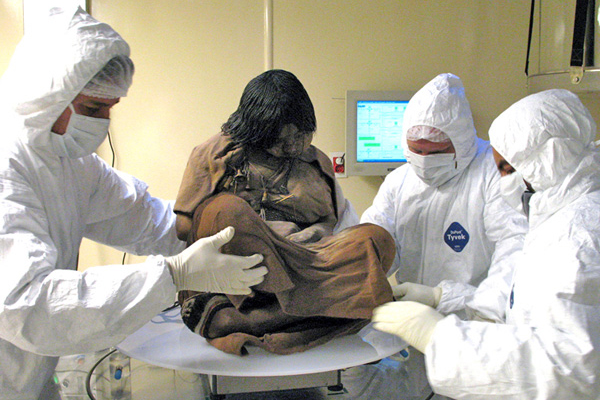
Initially this might look to you like any normal girl being treated by a doctor,the girl in the photo is not any normal living girl but the mummy of a 15 year old child who has been dead for about 500 years.

She was found in 1999 near Llullaillaco's 6739 meter summit. An Argentine-Peruvian expedition found the perfectly preserved body and she was nicknamed "La doncella" which means “The maiden”. According to the Inca she was chosen to go and live with the gods. But in reality she was a sacrifice to the Inca Gods and had been brutally killed in the name of religion.

Scientists say that her organs are intact and its as if she had died just a few weeks ago. From testing the samples of her hair they could determine the type of diet she was on before her death. This lead to the discovery that the Incan fattened their children before killing them. Months or even years before the sacrifice pilgrimage these children were given diets which were those of the elite, consisting of maize and animal proteins.

Judging from the condition of the body, it is believed that she was drugged and left to die in the mountains. It would not have taken much time for her to die due to the high exposure. The Incan high priests took their victims to high mountaintops for sacrifice. As the journey was extremely long and arduous, especially so for the younger victims, coca leaves were fed to them to aid them in their breathing so as to allow them to reach the burial site alive. Upon reaching the burial site, the children were given an intoxicating drink to minimize pain, fear, and resistance, then killed them either by strangulation, a blow to their head or by leaving them to lose consciousness in the extreme cold and die of exposure. 


Mummy Juanita - Inca Girl Frozen For 500 Years

Thursday, June 25, 2009

CT scans reveal mummies' long-lost secrets


A long line of hospital staff wraps around the corridor outside a small conference room in New York to catch a glimpse of the precious cargo.

Inside are the three frail bodies in open wooden crates causing all the commotion. Another body -- a prince no less -- is a few rooms down in a computer tomography scanner.

The bodies are part of the Brooklyn Museum's collection of 11 Egyptian mummies, transported to the North Shore University Hospital to be scanned. The goal: Find out who they are, how they might have died and establish a chronology of advances in ancient Egypt's mummification techniques.

The process is not necessarily new. Egyptian mummies have been exposed to radiographic study since 1896 and CT scans, which conducts imaging by sections, for more than two decades.

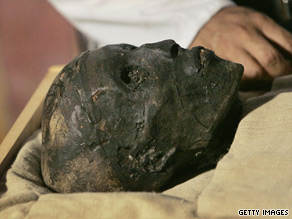
Perhaps the most famous of them, King Tutankhamun (c. 1355-346 B.C.), was scanned in 2005 right outside the vault that holds his sarcophagus. The scan resulted in more than 17,000 images that were analyzed by an international team of radiologists, pathologists and anatomists, led by the world-renowned Zahi Hawass, the secretary general of Egypt's Supreme Council of Antiquities.

The scope and ability of CT scan technology are proving invaluable in learning more about the funeral rituals of ancient Egyptians and the mummies themselves. Whereas conventional X-rays cannot clearly distinguish soft tissue from bone and can see only two planes, CT scanning can differentiate among the various types of bone and soft tissue, and reconstruct three-dimensional images that "show fine detail inside coronary arteries down to 0.6 millimeters" said Amgad Makaryus, director of cardiac CT and magnetic resonance imaging at North Shore, providing a better chance at diagnosis and differentiation among diseases.

"CT has proved to be exceptionally well-suited for studying the fragile, wrapped figures of Egyptian mummies, especially those still contained within their decorated plasterlike shells, or cartonnages," according to an article by a team of eight researchers, led by Derek N.H. Notman, published in the American Journal of Roentgenology.

Read complete story at http://www.cnn.com/2009/TECH/science/06/25/mummy.scans/index.html

Friday, December 12, 2008

Mystery Pyramid Built by Newfound Ancient Culture?

Several stone sculptures recently found in central Mexico point to a previously unknown culture that likely built a mysterious pyramid in the region, archaeologists say.

Archaeologists first found the objects about 15 years ago in the valley of Tulancingo, a major canyon that drops off into Mexico's Gulf Coast.

Most of the 41 artifacts "do not fit into any of the known cultures of the Valley of Tulancingo, or the highlands of central Mexico," said Carlos Hernández, an archaeologist at Mexico's National Institute of Anthropology and History in the central state of Hidalgo.

Many of the figures are depicted in a sitting position, with their hands placed on their knees.

Some have headdresses or conical hats with snakes at the base, which could represent Ehécatl-Quetzalcóatl, the Aztec god of the wind. One figure shows a man emerging from the jaws of a jaguar.

The sculptures are also made of flat stucco—a combination of fine sand, lime, and water—and painted blue or green to the give the appearance of jade.

All of the artifacts date to the Epiclassic period between A.D. 600 to 900. Some Mexican and foreign archaeologists have said the sculptures weren't ancient and thus false, Hernández said.

"But by linking all the characteristics that make them different, [such as their location in Tulancingo and time period], allows us to say that they should be considered as a product of a different culture [called Huajomulco]."

The culture is named after an area in Hidalgo.

Baffling Pyramid

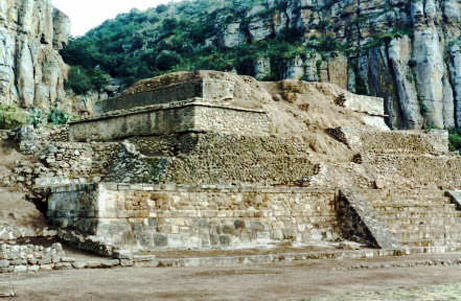
Some of the artifacts were also found near the mysterious Huapalcalco pyramid in Hidalgo, whose origin has been a source of debate among archaeologists.

The pyramid's proportions, along with smaller structures that were painted black and white, do not correspond to the Toltec or Teotihuacan cultures of the same area and time period.

The Teotihuacan people, who lived from 400 B.C. to A.D. 700, constructed one of the largest pyramid complexes in the pre-Hispanic Americas, which refers to cultures that lived on the continent before the Spanish conquest of the Western Hemipshere.

The Toltecs, who came afterward, were made up of several groups of South Americans that together formed an empire famous for its artists and builders in the Teotihuacan capital of Tula from A.D. 900 until the 1100s.

The pottery found at the site—rough, cylindrical vessels that are gray and reddish-brown in color—is also not familiar to experts.

Based on the artifacts' discovery near the pyramid,"it is likely that the Huapalcalco pyramid has been built by people from this new culture," Hernández said. Thomas Charlton, an archaeologist at University of Iowa, has worked in the state of Hidalgo.

He said that ample evidence—including the new artifacts—links a new pre-Hispanic culture to the Huapalcalco pyramid. "It's a reasonable hypothesis [that] near the Valley of Tulancingo, there is a site that looks like it existed between the fall of the Teotihuacan and the beginning of the Tula [Toltec]," Charlton added.

"We know that there's an occupation [from this time] near Tulancingo.

"After the Teotihuacan, there were all sorts of smaller states throughout Mexico. It's part of the cycle after the fall of an empire."

Creative Era

Michael Smith, an archaeologist at Arizona State University, agreed.

"The notion that there would be an independent culture in [the Epiclassic] period is not surprising at all," he said.

"It was a very creative period, with rich development."

Future excavations of Huapalcalco should solidify the link to a new pre-Hispanic culture, and help archaeologists glean clues about this lost time, Hernández said.

"The [Epiclassic] period is considered a time of dynamic development—new trade, cities, and development," said Arizona State's Smith, "but one we don't know much about."

For more unsolved mysteries

Monday, November 19, 2007

Unexplained Egypt's fantastic and weird history


Pyramids were a big signal to tell grave robbers where the pharaoh's treasure was hidden. That's why, by Tutankhamun's time, pharaohs were buried underground.. Unexplained mysteries and werid stories of Egypt Mummies ..


LinkWithin

Related Posts with Thumbnails