Friday, February 3, 2012

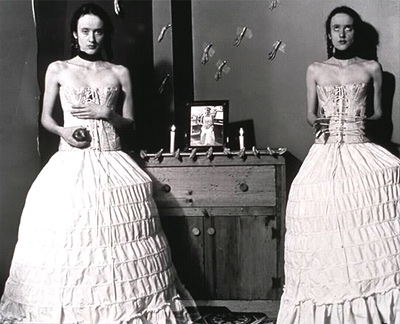
Doppelgänger Phenomenon

In fiction and folklore, a doppelgänger (German "double walker") is a paranormal double of a living person, typically representing evil or misfortune. In the vernacular, the word has come to refer to any double or look-alike of a person.

The word also is used to describe the sensation of having glimpsed oneself in peripheral vision, in a position where there is no chance that it could have been a reflection. Doppelgängers often are perceived as a sinister form of bilocation and are regarded by some to be harbingers of bad luck. In some traditions, a doppelgänger seen by a person's friends or relatives portends illness or danger, while seeing one's own doppelgänger is an omen of death.

In Norse mythology, a vardøger is a ghostly double who precedes a living person and is seen performing their actions in advance. In Finnish mythology, this is called having an etiäinen, i.e., "a firstcomer". In Ancient Egyptian mythology, a ka was a tangible "spirit double" having the same memories and feeling as the original person. In one Egyptian myth titled "The Greek Princess," an Egyptian view of the Trojan War, a ka of Helen was used to mislead Paris of Troy, helping to stop the war. In some myths, the doppelgänger is a version of the Ankou, a personification of death.


Scientific and philosophical investigations

Left temporoparietal junction

In September 2006, it was reported in Nature[2] that Shahar Arzy and colleagues of the University Hospital, Geneva, Switzerland, unexpectedly had reproduced an effect strongly reminiscent of the doppelgänger phenomenon via the electromagnetic stimulation of a patient's brain. They applied focal electrical stimulation to a patient's left temporoparietal junction while she lay flat on a bed. The patient immediately felt the presence of another person in her "extrapersonal space." Other than epilepsy, for which the patient was being treated, she was psychologically fit.

The other person was described as young, of indeterminate sex, silent, motionless, and with a body posture identical to her own. The other person was located exactly behind her, almost touching and therefore within the bed on which the patient was lying.

A second electrical stimulation was applied with slightly more intensity, while the patient was sitting up with her arms folded. This time the patient felt the presence of a "man" who had his arms wrapped around her. She described the sensation as highly unpleasant and electrical stimulation was stopped.


 Doppelgänger Phenomenon

The Coso Artifact

The story of the Coso Artifact has been embellished over the years, but nearly all accounts of the actual discovery are basically the same. On February 13, 1961, Wallace Lane, Virginia Maxey, and Mike Mikesell were seeking interesting mineral specimens, particularly geodes, for their LM&V Rockhounds Gem and Gift Shop in Olancha, California. The trio was about 6 miles northeast of Olancha, near the top of a peak about 4300 feet in elevation and about 340 feet above the dry bed of Owens Lake. At lunchtime, after collecting rocks most of the morning, all three placed their specimens in the rock sack Mikesell was carrying (Steiger 1974: 49).

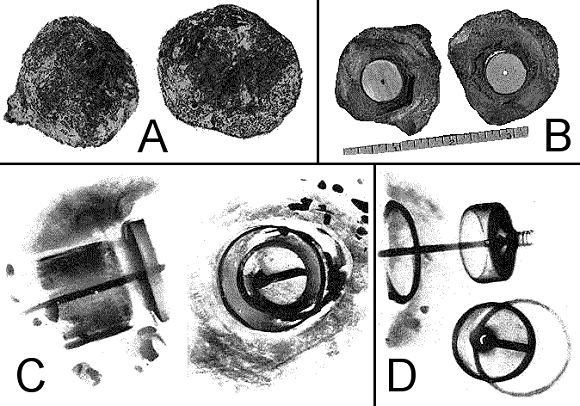
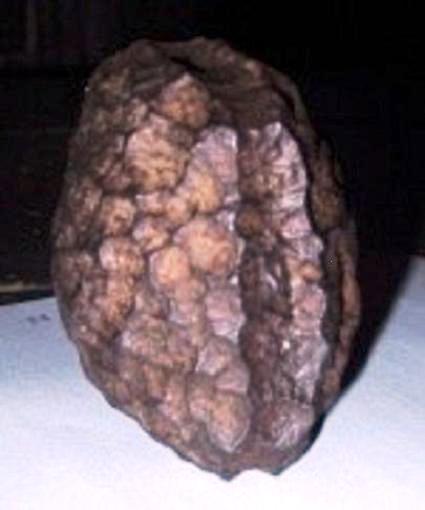
The next day in the gift shop's workroom, Mikesell ruined a nearly new diamond saw blade while cutting what he thought was a geode. Inside the cut nodule, Mikesell did not find the cavity that is typical of geodes, but a perfectly circular section of very hard, white material that appeared to be porcelain. In the center of the porcelain cylinder was a 2-millimeter shaft of bright metal. The metal shaft responded to a magnet. There were other odd qualities about the specimen. The outer layer of the specimen was encrusted with fossil shells and their fragments. In addition to shells, the discoverers noticed two nonmagnetic metallic objects in the crust, resembling a nail and a washer. Stranger still, the inner layer was hexagonal and seemed to form a casing around the hard porcelain cylinder. Within the inner layer, a layer of decomposing copper surrounded the porcelain cylinder.

The Initial Investigations

Very little is known about the initial physical inspections of the artifact. According to Maxey, a geologist she consulted who examined the fossil shells encrusting the specimen said that the nodule had taken at least 500 000 years to attain its present form. However, the identity of the first geologist is still a mystery, and his findings were never published. Another investigation was conducted by creationist Ron Calais. Calais is the only other individual known to have physically inspected the artifact, and he was allowed to record images of the nodule using both X-ray and natural-light photography. Calais's X-rays brought interest in the artifact to a new level. The X-ray of the upper end of the object seemed to reveal some sort of tiny spring or helix. INFO Journal editor Ronald J Willis (1969) speculated that it could actually be "the remains of a corroded piece of metal with threads." The other half of the artifact revealed a sheath of metal, presumably copper, covering the porcelain cylinder.

The last individual known to possess the Coso Artifact was one of the original discoverers, Wallace Lane. Lane had the object on display in his home, but he adamantly refused to allow anyone to examine it (Willis 1969). However, he had a standing offer to sell it for $25 000. In September 1999, a national search to locate any of the original discoverers proved fruitless. We suspect that Lane is dead. Maxey is alive, but is avoiding any public comment, and the whereabouts of Mikesell remain unknown. The location and disposition of the artifact are also unknown. Willis's 1969 article is the primary source for information on this object to date. 


 The Coso Artifact

The Salzburg Cube


The Wolfsegg Iron, also known as The Salzburg Cube, is a small cuboid mass of iron that was found buried in Tertiary lignite in Wolfsegg, Austria, in 1885.[1] It weighs 785 grams and measures 67 x 67 x 47mm. Four of its sides are roughly flat, while the two remaining sides (opposite each other) are convex. A fairly deep groove is incised all the way around the object, about mid-way up its height.

Originally identified as being of meteoric origin, a suggestion later ruled out by analysis, it seems most likely that it is a piece of cast iron used as ballast in mining machinery.

In the year 1885 AD, a workman named Reidl, who worked at a foundry in Schöndorf/Vöcklabruck (Austria), founded by Isidor Braun (1801-1866), broke open a block of brown coal that had been mined at Wolfsegg. He found an unusual metal cube/ cuboid like object embedded in the block.

The Tertiary coal deposit in which it had been embedded is generally dated to about 60 million years ago.

The workman Reidl, and/or his work mates must have found the metal object unusual and significant because they took it to their boss. The son of Isidor Braun, the mines founder, took the artifact to the Heimathaus (Museum) in Vöcklabruck. In 1886, the mining engineer Adolf Gurlt (Professor of Geology at the University of Bonn) suggested that it was meteoritic in origin.

A cast is kept in the Oberosterreichisches Landesmuseum in Linz, where the original object was exhibited from 1950 to 1958. In 1966-67, the object was analysed by at the Vienna Naturhistorisches Museum, using electron-beam microanalysis, which found no traces of nickel, chromium or cobalt in the iron, suggesting that it is not of meteoric origin, while the lack of sulphur shows that it is not a pyrites. Because of its low magnesium content, Dr Gero Kurat (born 1938) of the Museum and Dr Rudolf Grill (1910-1987) of the Geologische Bundesanstalt of Vienna thought it might be cast iron. A further investigation by Hubert Mattlianer, in 1973, concluded that it had been cast using the cire perdue (lost wax) technique.

Some say that the edges were sharp and straight, and there was little doubt that this was a machine made instrument that seemed part of a much larger instrument. It was made of iron, carbon, and a trace of nickel. The cube measured 2 1/2" by 1 4/5", weighed 28 oz., and had an incision that ran around it horizontally. 

The Salzburg Cube 

Monday, December 5, 2011

800-year-old remains of witch discovered in Italian graveyard

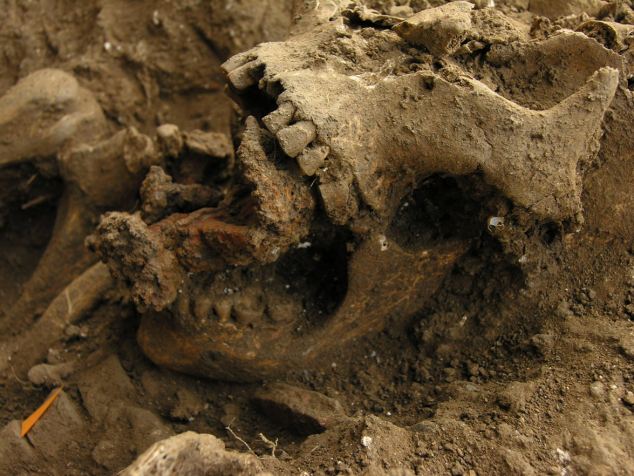
These are the 800 year old remains of what archaeologists believe was a witch from the Middle Ages after seven nails were found driven through her jaw bone.

The grim discovery was made during a dig on what is thought to be a 'witches graveyard' after another woman's skeleton was found surrounded by 17 dice - a game which women were forbidden from playing 800 years ago.

Experts say they believe the women are aged around 25 - 30 years old and were found buried in a simple shallow grave in the ground with no coffin or shroud.

The macabre remains were found during a dig close to the sea at Piombino near Lucca in Italy's Tuscany region and the woman had seven nails through her jaw as well as another 13 nails surrounding her skeleton.

Archaeologist Alfonso Forgione, from L'Aquila University, who is leading the dig, is convinced that the women were suspected witches because of the circumstances in which they were buried.

He said: 'It's a very unusual discovery and at the same time fascinating. I have never seen anything like this before. I'm convinced because of the nails found in the jaw and around the skeleton the woman was a witch.
800-year-old remains of witch discovered - with seven nails in jaw


Top 10 Bermuda Triangle Theories


The Bermuda Triangle is a geographic area with it's points being at Miami, Florida, the island of Bermuda, and San Juan Puerto Rico. In this area, over the course of time, many different aircraft and boats have mysteriously disappeared without a trace, leading many to believe that the triangle has something unusual about it that is swallowing up people, planes, and boats.

All of these incidences have relatively similar aspects in that they don't show up later as wreckage, and that in the cases of the aircraft, there was never any oil slicks found on the ocean, which are common indicators of where a crash took place for sea crashes. There are also a number of wrecks that have taken place that have been accounted for, and were the cause of natural calamities or human error. It depends largely on what you're willing to believe.

Here are the top ten theories that attempt to explain the mystery behind the Bermuda Triangle.

1. Attack by Pirates

pirates-bermuda-triangle

Although this theory cannot be totally ruled out, it fails to explain the reason for the disappearance of the aircrafts. According to this theory, the reason why so many ships disappeared is because of pirates who are especially active in this part of the Atlantic. Piracy has been the reason behind the destruction and disappearance of many a large vessel in the past, in different parts of the world. Some theorists are of the opinion that in addition to piracy, attack by enemy vessels might also be a reason. This theory might prove to be true for at least some of the disappearances in the past.

2. Strong Magnetic Field

magnetic-field-bermuda-triangle

This theory says that the root cause behind the notorious reputation of the Bermuda Triangle is the Earth’s magnetic field in that particular region. It has been frequently observed that compasses begin to spin rapidly near the Bermuda Triangle and navigation equipments stop functioning properly. This is because it is one of the two places on earth where the geographic north and magnetic north coincide. Due to this, electromagnetic storms originating below the earth's surface rise up to the atmosphere and leave a fog behind. The strong magnetic effects in the region is believed to be responsible for so many people vanishing into thin air.

3. Effect of a Comet

comet-bermuda-triangle

The first theory that we'll discuss here is the theory that a comet from outer space crashed into the earth some thousands of years ago, near the area, which is now the Bermuda Triangle. People who believe in this theory also seem to believe that somewhere in the depths of the ocean, there must lie the remains of this comet and it is the electromagnetic attractions of the comet that causes all the havoc, including disruptions of aircraft signals. No traces of a comet or anything similar to it has been found yet and in the absence of a proof, this theory remains nothing but an assumption. 


Top 10 Bermuda Triangle Theories

Ka’aba and its Mysterious Black Stone


The Black Stone is a Muslim relic, which according to Islamic tradition dates back to the time of Adam and Eve. Historical research claims that the Black Stone marked the Kaaba as a place of worship during pre-Islamic pagan times. It is the eastern cornerstone of the Kaaba, the ancient stone building towards which Muslims pray, in the center of the Grand Mosque in Mecca, Saudi Arabia. The Stone is a dark rock, polished smooth by the hands of millions of pilgrims, that has been broken into a number of fragments cemented into a silver frame in the side of the Kaaba. Although it has often been described as a meteorite, this hypothesis is still under consideration.

Muslim pilgrims circle the Kaaba as part of the Tawaf ritual of the Hajj. Many of them try, if possible, to stop and kiss the Black Stone, emulating the kiss that Islamic tradition records that it received from the Islamic Prophet Muhammad. If they cannot reach it, they point to it on each of their seven circuits around the Kaaba.

Physical description

The Black Stone, surrounded by its silver frame and the black cloth kiswah on the Kaaba in Mecca.

The Black Stone consists of a number of fragments held together by a silver frame, which is fastened by silver nails to the Stone. Some of the smaller fragments have been cemented together to form the seven or eight fragments visible today. The Stone's exposed face measures about 20 centimetres (7.9 in) by 16 centimetres (6.3 in). Its original size is unclear; its recorded dimensions have changed considerably over time, as the stone has been remodelled. In the 10th century, an observer described it as being one cubit (slightly over 1.5 feet (0.46 m) long). By the early 17th century, it was recorded as measuring 1.5 yards (1.4 m) by 1.33 yards (1.22 m). According to Ali Bey in the 18th century, it was 42 inches (110 cm) high, and Muhammad Ali reported it as being 2.5 feet (0.76 m) long by 1.5 feet (0.46 m) wide.

The Black Stone was first described in Western literature in the 19th and early 20th centuries by European travelers in Arabia, who visited the Kaaba in the guise of pilgrims. Swiss traveler Johann Ludwig Burckhardt visited Mecca in 1814, and provided a detailed description in his 1829 book Travels in Arabia:

It is an irregular oval, about seven inches in diameter, with an undulated surface, composed of about a dozen smaller stones of different sizes and shapes, well joined together with a small quantity of cement, and perfectly well smoothed; it looks as if the whole had been broken into as many pieces by a violent blow, and then united again. It is very difficult to determine accurately the quality of this stone which has been worn to its present surface by the millions of touches and kisses it has received. It appeared to me like a lava, containing several small extraneous particles of a whitish and of a yellow substance. Its colour is now a deep reddish brown approaching to black. It is surrounded on all sides by a border composed of a substance which I took to be a close cement of pitch and gravel of a similar, but not quite the same, brownish colour. This border serves to support its detached pieces; it is two or three inches in breadth, and rises a little above the surface of the stone. Both the border and the stone itself are encircled by a silver band, broader below than above, and on the two sides, with a considerable swelling below, as if a part of the stone were hidden under it. The lower part of the border is studded with silver nails. 


Ka’aba and its Mysterious Black Stone 

Tuesday, October 11, 2011

Disappearance of Amber Room

The Amber Room (In English sometimes known as Amber Chamber, German: Bernsteinzimmer) in the Catherine Palace of Tsarskoye Selo near Saint Petersburg is a complete chamber decoration of amber panels backed with gold leaf and mirrors. Due to its singular beauty, it was sometimes dubbed the "Eighth Wonder of the World".

Before it was lost, the original Amber Room represented a joint effort of German and Russian craftsmen. Construction of the Amber Room began in 1701 to 1709 in Prussia. The room was designed by German baroque sculptor Andreas Schlüter and constructed by the Danish amber craftsman Gottfried Wolfram and remained at Charlottenburg Palace until 1716 when it was given by Prussian king Friedrich Wilhelm I to his then ally, Tsar Peter the Great of the Russian Empire. In Russia it was expanded and after several renovations, it covered more than 55 square meters and contained over six tons of amber. The Amber Room was looted during World War II by Nazi Germany and brought to Königsberg. Knowledge of its whereabouts was lost in the chaos at the end of the war.

In 1979 efforts began to rebuild the Amber room at Tsarskoye Selo. In 2003, after decades of work by Russian craftsmen, financed by donations from Germany, the reconstructed Amber Room was inaugurated in the Catherine Palace in Saint Petersburg, Russia.

The Baltic region is known to contain huge deposits of amber. In fact, some estimates claim up to 80% of the world’s supply of the fossilized tree resin is located there. Its warm, golden glow is prized by artists and collectors alike. The highest quality of amber has been used for ornamental and jewelry production since Neolithic times.

Perhaps the best known and inspired use of amber was the creation of the Amber Room in 1709 by designer Andreas Schluter and amber craftsman Gottfried Wolfram.

Upon completion, the Amber Room was proudly displayed at the Charlottenberg Palace in Prussia. It was considered a true masterpiece. During a visit to Prussia in 1712, Czar Peter the Great of Russia confided in King Friedrich Wilhelm I on how much he adored this stunning room. In order to cement an alliance against Sweden, King Wilhelm I presented the Amber Room as a gift to Czar Peter the Great. The royal gift was shipped over water to Russia in 18 large boxes in 1716.

Once in Russia, the Amber Room was further built upon and renovated. In its final form in 1763, the Amber Room spanned 55 meters and contained over six tons of amber. It was located in the Catherine Palace of St. Petersburg and admired by the lucky few who were able to see it. The feeling one would get visiting the Amber Room can be described as the following:

“When the daylight was shining through the wide windows, it replaced hundreds of lighting candles and created thousands of reflections in the mirrors. This light made multicolored Amber walls shine more beautiful than gold and created a deeply lasting impression never forgotten by any visitor.”

Most words cannot describe the awe someone would feel while in this room. In fact, many considered the Amber Room the “Eighth Wonder of the World”. 


Disappearance of Amber Room

Bernardo Vazquez: The Vanishing Sorceror

Twenty-year-old Bernardo Vazquez was obsessed with the unknown and black magic, as well as getting rich. People who knew him in San Juan, Puerto Rico say he may have succeeded with a bizarre experiment that made him invisible. After consulting his books on the occult, he one day told his mother that he had learned how to become invisible - through a strange ritual involving a black cat, wood from an old coffin and a tin can. He believed that by boiling the cat and using a resulting bone to place under his tongue he could be invisible at will.

One night be barricaded himself in his room at the back of the house to carry out the ritual. His mother became concerned when he never came out, and she called the authorities. They had to break into his room where they found the disturbing remnants of his ritual - the burned wood and a disemboweled black cat. But Bernardo was nowhere to be found. Did he indeed become invisible... or did he vanish into the unknown?

Bernardo Vazquez was a young man, around 20 years old. That was way back during the Depression in 1936. We used to live on Fernandez Juncos Avenue in San Juan, Puerto Rico. At that time I was nine years old and even then I was very inquisitive over anything that had to do with the unknown. Mama shared the same predilection and she used to explain in detail whatever situation occurred that was hard for me to understand.

When Bernardo started coming around during the afternoon hours, telling his mystery tales, Mama would let me stay so I could enjoy the stories. Many years later, after hearing numerous frightening tales, I realize how dreadful his confessions really were.

The young man was always in a hurry, and in his mind the most important wish was to obtain immeasurable riches-with no concern as to how he obtained them. He was an avid reader, especially books on black magic. His appearance was anemic and his eyes had a penetrating look. We never heard him talk about his family, and the only person he talked to in our neighborhood was Mama. It was not easy for him to get familiar and he waited some time to trust Mama with his secrets.

With his mysterious look and his whispered voice, Bernardo intrigued anyone he talked to. Mama and I would listen to him as if we were in a hypnotic trance, and when she thought that she had heard of all Bernardo’s schemes and everything related to the unknown, out of nowhere he bewildered us with something different. Sometimes when he left late in the afternoon he gave us a ceremonial farewell, leaving us with something new:

“I will come back tomorrow with news of my new ‘job.’ Now I must leave-it is getting late and the cemeteries are closed by five o’clock.”

Mama felt sorry for him. She did not agree with his beliefs, and always dismissed him with a blessing. Sometimes, she advised him of the danger that he was getting himself into. “A lot of people call the diablo, Bernardo,” she said, “but only a few are brave enough to welcome him.”

Those were words with light. Bernardo never knew the terrible destiny that was waiting for him. He asked to be rich at all risks, even trading his life for it. He wanted power, without giving any care as to whom he was dealing with. 


Read more on  The Vanishing Sorceror

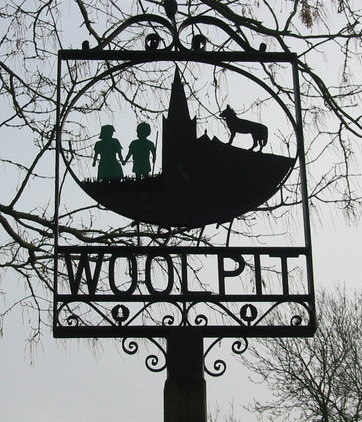
Green children of Woolpit

The green children of Woolpit reportedly appeared in the village of Woolpit in Suffolk, England, some time in the 12th century, perhaps during the reign of King Stephen. The children, brother and sister, were of generally normal appearance except for the green colour of their skin. They spoke in an unknown language, and the only food they would eat was green beans. Eventually they learned to eat other food and lost their green pallor, but the boy was sickly and died soon after the children were baptised. The girl adjusted to her new life, but she was considered to be "rather loose and wanton in her conduct". After she learned to speak English the girl explained that she and her brother had come from St Martin's Land, an underground world whose inhabitants are green.

The only near-contemporary accounts are contained in Ralph of Coggeshall's Chronicum Anglicanum and William of Newburgh's Historia rerum Anglicarum, written in about 1189 and 1220 respectively. Between then and their rediscovery in the mid-19th century, the green children seem to surface only in Bishop Francis Godwin's fantastical The Man in the Moone, in which William of Newburgh's account is reported.

Two approaches have dominated explanations of the story of the green children: that it is a typical folk tale describing an imaginary encounter with the inhabitants of another world, perhaps one beneath our feet or even extraterrestrial, or it is a garbled account of a historical event. The story was praised as an ideal fantasy by the English anarchist poet and critic Herbert Read in his English Prose Style, published in 1931. It provided the inspiration for his only novel, The Green Child, written in 1934.

Sources

The village of Woolpit is in the county of Suffolk, East Anglia, about 7 miles (11 km) east of the town of Bury St Edmunds. During the Middle Ages it belonged to the Abbey of Bury St Edmunds, and was part of one of the most densely populated areas in rural England. Two writers, Ralph of Coggeshall (died c. 1226) and William of Newburgh (c. 1136–1198), reported on the sudden and unexplained arrival in the village of two green children during one summer in the 12th century. Ralph was the abbot of a Cistercian monastery at Coggeshall, about 26 miles (42 km) south of Woolpit. William was a canon at the Augustinian Newburgh Priory, far to the north in Yorkshire. William states that the account given in his Historia rerum Anglicarum (c. 1189) is based on "reports from a number of trustworthy sources"; Ralph's account in his Chronicum Anglicanum, written some time during the 1220s, incorporates information from Sir Richard de Calne of Wykes, who reportedly gave the green children refuge in his manor, 6 miles (9.7 km) to the north of Woolpit. The accounts given by the two authors differ in some details.

Story

One day at harvest time, according to William of Newburgh during the reign of King Stephen (1135–1154), the villagers of Woolpit discovered two children, a brother and sister, beside one of the wolf pits that gave the village its name. Their skin was green, they spoke an unknown language, and their clothing was unfamiliar. Ralph reports that the children were taken to the home of Richard de Calne. Ralph and William agree that the pair refused all food for several days until they came across some green beans, which they consumed eagerly. The children gradually adapted to normal food and in time lost their green colour. The boy, who appeared to be the younger of the two, became sickly and died shortly after he and his sister were baptised.

After learning to speak English the children – Ralph says just the surviving girl – explained that they came from a land where the sun never shone, and the light was like twilight. William says the children called their home St Martin's Land; Ralph adds that everything there was green. According to William the children were unable to account for their arrival in Woolpit; they had been herding their father's cattle when they heard a loud noise (according to William, the bells of Bury St Edmunds) and suddenly found themselves by the wolf pit where they were found. Ralph says that they had become lost when they followed the cattle into a cave, and after being guided by the sound of bells eventually emerged into our land.

According to Ralph the girl was employed as a servant in Richard de Calne's household for many years, where she was considered to be "very wanton and impudent". She eventually married a man from King's Lynn, about 40 miles (64 km) from Woolpit, where Ralph said she was still living shortly before he wrote. Based on his research into Richard de Calne's family history the astronomer and writer Duncan Lunan has concluded that the girl was given the name "Agnes", and that she married a royal official named Richard Barre. 


Read more on  Green children of Woolpit

Monday, August 22, 2011

Hidden Secrets of the DOLLAR

There is definitely something strange and weird about the USA Dollar. From hidden secrets and symbols to cataclysmic prophecies the Dollar has it all. Just have a look at this initial collection of bizarre findings.

These secrets only seem to appear in the Dollar currency. We've looked for similar effects in the Pound, the Rupee, the Euro and even the Rand without any success. However, with the Dollar we just keep on finding them! After Months of study we can honestly say that the Dollar is the most complex, intelligent, intricate, mysterious and beautiful of currencies. It is the perfect representation of Art and Science.

9/11 TRADE CENTRE - PROPHECY OF DOOM OR AN INCITEMENT TO TERRORISM

Secrets of the Dollar

We first saw this in an email but checked it out for ourselves. This is an ordinary 20 Dollar banknote that we had in one of our wallets. It was first printed in 1928 and is known as the "Jackson Bill". The version shown in the images was printed in 2003 (after the 9/11 attacks but the image of the White House is essentially the same as in earlier versions). We are trying to access an original 1928 bill and to see if the effect described below is the same.


Please feel free to try this for yourself - we did! The secrets become clear. First take the 20 Dollar Bill and fold it in half as shown in the diagram to the right.


Then do a 45 degree fold to match up perfectly with the centre of the Bill's width. (Fig 3) Repeat the same process with the opposite side and ensure that the centre line and the top of the banknote are in alignment. (Fig 2)


An image immediately becomes clear. It is the top of a three or four story building with smoke billowing out of its central facade. It looks very similar (but definitely not identical) to the classic photograph of the Pentagon after it was struck by a Boeing 757 - Flight 77.


This, in itself, is strangely disturbing but simply turning the folded 20 dollar bill to its opposite side reveals an even more concerning picture. It is a single skyscraper in the process of collapsing in exactly the same manner as the second doomed tower of the New York World Trade Centre did (WTC2).


This alone should give you pause for thought but now unfold the banknote and the creases form an octagonal design. (Shown in the diagram with red over-lines) The exact centre point lines up with Oval Office which is exactly on the other side of the building at a 13 degree trajectory. It is widely believed that the White house was supposed to be the 3rd target of the 9/11 attacks.


Are these "Coincidences" a 1920's prophecy of doom or were these "strange images" the very reason that the targets were selected in the first place. Did someone show Osama the trick and say ... "Hey! I know what we should attack." 


Read more on Hidden Secrets of Dollar

The Legend of Morrow Road


Morrow Road Haunting

The story goes that a mother and child went missing from their home on this road sometime in the late 1800's. The little boy disappeared into thin air and shortly after, the mother also vanished. It is believed she died a terrifying death while searching for her son. Locals say the ghostly figure of a mother can still be seen wandering old Morrow Road to this day.

Morrow Road is a small road in southeast Michigan stretching from Clay Twp to Cottreville. (Locals say Algonac to Marine City--the closest cities). Recently the southern half was paved, but prior it was a narrow dirt road and before that an old cow path. Sometime in the late 1800s a mother had a child and they lived on Morrow Road. Shortly after they went missing, most believe the child disappeared first. The frantic mother searched and searched and never found the boy.

Legend says the middle-aged woman died searching for her child. What is even more disturbing is that many people claim that the woman haunts Morrow Road as a ghost in eternal search for her child till this very day. 


What makes the legend interesting is that there are many versions of how this story came to be. What happened to the child? What happened to the woman? How did they disappear? Why do people claim to see orbs in the woods at night? Has anyone really seen the woman with bloody hands wandering down the road? Is there a monster in the woods? Is there any validity from those who claim to hear a baby crying near the south bridge?

Unsolved Mysteries apparently believed it to be interesting enough, as they did a mini-feature of the legend in the early 90's. Detroit's Channel 4 News covered the story as well not long after.

There have been many claims to sightings of a ghost and/or a baby or child at night. Many teenagers have pranked fellow drive-by's as well by using the legend to scare their girlfriends or simply have some fun at night. They stage elements from the variations of the legend: from the hanging a dummy woman's body from a tree to lighting a fire on the bridge to see her face in the flames. Clay Township police can confirm this.

But one thing is for sure: Morrow Road is one of Michigan's oldest legends-- and like a true legend, it cannot be proven...nor disproved. 


The Legend of Morrow Road 

Monday, July 25, 2011

The Curse of 27 - The Forever 27 Club

Amy Winehouse - The Curse of 27The 27 Club, also occasionally known as the Forever 27 Club or Club 27, is a name for a group of influential rock music artists who died at the age of 27.

The Curse of 27 is the belief that 27 is an unlucky number due to the number of famous musicians and entertainers who have died at the age. Robert Johnson, Jim Morrison, Brian Jones, Jimi Hendrix, Ron "Pigpen" McKernan, Janis Joplin, Jonathan Brandis, Kurt Cobain and more recently, Amy Winehouse, are all believed to have been affected by the Curse of 27. The number 27 has been said to "follow" and bring bad luck to people. They see it random times through out the day, on the clock, on television, in phone numbers, math problems, dates, jersey numbers, etc.

The impetus for the club's creation were the deaths of Jones, Hendrix, Joplin and Morrison. Cobain, who died in 1994, was later added by some. With the exception of Joplin, there is controversy surrounding their deaths. According to the book Heavier Than Heaven, when Cobain died, his sister claimed that as a kid he would talk about how he wanted to join the 27 Club. On the fifteenth anniversary of Kurt Cobain's death, National Public Radio's Robert Smith said, "The deaths of these rock stars at the age of 27 really changed the way we look at rock music.

When legendary Blues man, Robert Johnson, was killed at the age of 27, his death is said to have spawned a curse. The legend unfolds like this: Johnson, always enamored of the Blues and desiring the ability to play guitar was, unfortunately, a mediocre talent. He disappeared for a time, during which he sold his soul to the devil by making a crossroads deal, in exchange for an unparalleled talent with the guitar. Suddenly he was a Blues master, composing songs about the crossroads and hellhounds on his trail. Johnson's ability made him popular with many (especially the ladies), but there were some who were suspicious and jealous of his talents (particularly the ladies' husbands). In 1938, he was supposedly given a bottle of wine which had been poisoned by one such jealous spouse. Johnson died a long, agonizing death. He was 27.


Robert Johnson

Robert Johnson

Since that day, it is said that many musicians - especially those of particularly high quality - would succumb to the curse and die, at the height of their careers, at the age of 27. While it is true that many musicians did, in fact, die at this age, it is hardly a magical number. Just as strong a case - if not more compelling - could be made for the age of 28. Twenty-seven by no means stands out. I have catalogued all musicians in the Archive that have died at age 27 since Robert Johnson; the list isn't nearly as long as one might think. Not including Johnson, there are 21 musicians who died at age 27 from 1938 to 2011 - that's one person roughly every three-and-a-half years. And although many of these performers were wildly famous and indisputable legends, most were supporting players in moderately successful bands.The Curse of 27


The Curse of 27 - The Forever 27 Club 

Wednesday, July 20, 2011

Ghost Haunting - Moberly–Jourdain Incident

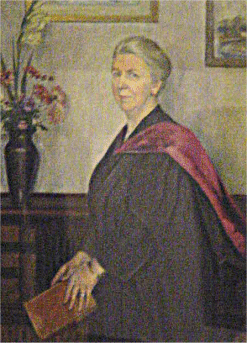
The Moberly–Jourdain incident, or the Ghosts of Petit Trianon or Versailles was an event that occurred on 10 August 1901 in the gardens of the Petit Trianon, involving two female academics, Charlotte Anne Moberly (1846–1937) and Eleanor Jourdain (1863–1924). The women were both from educated backgrounds; Moberly's father was a teacher and a bishop, and Jourdain's father was a vicar. During a trip to Versailles, they visited the Petit Trianon, a small chateau in the grounds of the Palace of Versailles, where they allegedly experienced a time slip, and saw Marie Antoinette as well as other people of the same period. After researching the history of the palace, and comparing notes of their experience, they published their work pseudonymously in a book entitled An Adventure, under the names of Elizabeth Morison and Frances Lamont, in 1911. Their story caused a sensation, and was subject to much ridicule.

Background

Moberly, born in 1846, was the tenth of fifteen children. She came from a professional background; her father, George Moberly, was the headmaster of Winchester College and later Bishop of Salisbury. In 1886 Moberly became the first Principal of a hall of residence for young women, St. Hugh's College in Oxford. It became apparent that Moberly needed someone to help run the college, and Jourdain was asked to become Moberly's assistant.

Charlotte Anne Moberly

Jourdain, born in 1863, was the eldest of ten children[6] and her father, The Reverend Francis Jourdain, was the vicar of Ashbourne in Derbyshire. She was the sister of art historian Margaret Jourdain and mathematician Philip Jourdain. She went to school in Manchester, unlike most girls of the time who were educated at home. Jourdain was also the author of several textbooks, ran a school of her own, and after the incident became the vice-Principal of St. Hugh's College. Before Jourdain was appointed, it was decided that the two women should get to know one another better; Jourdain owned an apartment in Paris where she tutored English children, and so Moberly went to stay with her.

The incident

As part of several trips, they decided to visit the Palace of Versailles, as they were both unfamiliar with it. On 10 August 1901, they travelled by train to Versailles. They did not think much of the palace after touring it, so they decided to walk through the gardens to the Petit Trianon. On the way, they reached the Grand Trianon and found it was closed to the public. They travelled with a Baedeker guidebook, but the two women soon became lost after missing the turn for the main avenue, Allée des Deux Trianons. They passed this road, and entered a lane, where unknown to them they passed their destination.[9] Moberly noticed a woman shaking a white cloth out of a window and Jourdain noticed an old deserted farmhouse, outside of which was an old plough. At this point they claimed that a feeling of oppression and dreariness came over them. They then saw some men that looked like palace gardeners, who told them to go straight on. Moberly later described the men as "very dignified officials, dressed in long greyish green coats with small three-cornered hats."[12] Jourdain noticed a cottage with a woman and a girl in the doorway. The woman was holding out a jug to the girl. Jourdain described it as a "tableau vivant", a living picture, much like Madame Tussaud's waxworks. Moberly did not observe the cottage, but felt the atmosphere change. She wrote: "Everything suddenly looked unnatural, therefore unpleasant; even the trees seemed to become flat and lifeless, like wood worked in tapestry. There were no effects of light and shade, and no wind stirred the trees." The Comte de Vaudreuil was later suggested as a candidate for the man with the marked face allegedly seen by Moberly and Jourdain. 


More on  Ghost Haunting - Moberly–Jourdain Incident

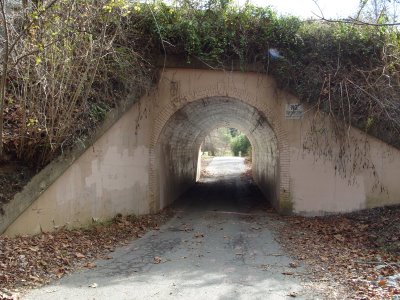
Urban Legend of Bunnyman Bridge

The Bunny Man is an urban legend that probably originated from two incidents in Fairfax County, Virginia in 1970, but has been spread throughout the Washington D.C. area. There are many variations to the legend, but most involve a man wearing a rabbit costume ("bunny suit") who attacks people with an axe. Many variations occur around "Bunny Man Bridge", the concrete tunnel of a Southern Railway overpass on Colchester Road in Clifton. Story variations include the origin of the Bunny Man, names, motives, weapons, victims, description of the bunny suit, and the possible death of the Bunny Man. In some accounts the Bunny Man's ghost or aging spectre is said to come out of his place of death each year on Halloween to commemorate his death. In some accounts, victims' bodies are mutilated.

You sit in your car, your date by your side, wondering just what you're doing here. This place is bad; everyone says so. You've heard the tales of death and spectral madmen that leap from the bushes and separate people's heads from their necks. Yet, you are here, hoping that the crickets that chirp like nervous heartbeats and echoes that sound like whispers will bring her closer to you. And you don't believe the stories anyway, right? They're just made up to scare kids away from here. But then, why is your heart racing in time with hers? Why do the echoes sound more like whispers? And why do the shadows move like inky wraiths across the walls toward your car? Surely it couldn't be real. None of it could be true. Could it?

Tales of terror, believed almost without question, are passed around from friend to friend to friend of a friend, all with the insistence that they are true. Everyone seems to know someone who has a cousin whose boyfriend's sister knows where any given event really happened. We call such stories urban legends, and more often than not, they're not true. But once in a while, the truth rears its head, and that is often the most bizarre part of the story. It becomes something of a widespread practical joke. The Bunnyman Bridge.

The Legend:

Sometime around 1905 near the Fairfax County town of Clifton, Virginia, there was a mental institution that housed the severely disturbed and criminally insane. The citizens of the county wanted no part in such a facility being so close to their homes and protested, prompting the facility to shut down and transfer the inmates to another facility in another county. The bus containing all the inmates, however, never made it to its destination. It was struck by a train, killing several of the inmates and freeing others. It took the wardens and police a few days, but in the end they managed to round up all but two.

In the weeks that followed it became obvious that the two escapees were still hanging around the vicinity as dozens, and soon hundreds, of carcasses of half-eaten rabbits were found strewn about the bridge and the surrounding areas. Another search was ordered, this one widening the search area into the woods. There, hanging in a tree, officers found Marcus Walster, one of the two escapees. He'd been gutted and dressed like a deer in much the same way the rabbits had been. It was then that they began referring to the second escapee, Douglas J. Grifon, as the "Bunnyman."


More on  Urban Legend of Bunnyman Bridge

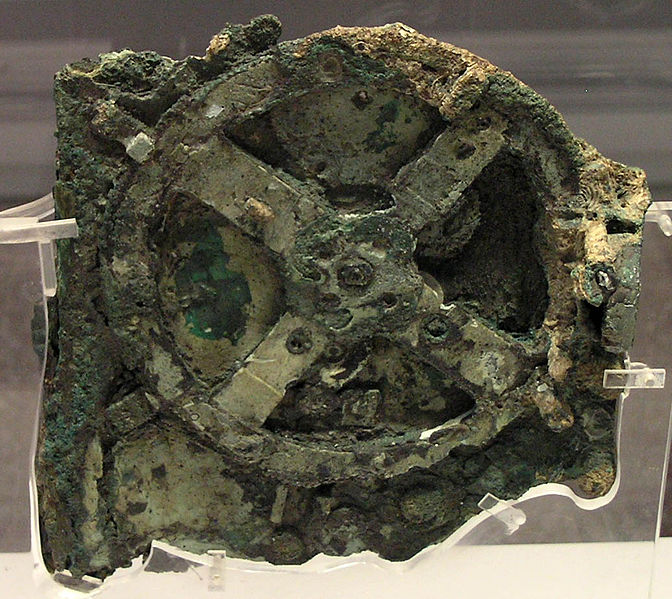
Antikythera Mechanism

Between 1900 and 1901, divers salvaging the wreck of the Antikythera, an archeological undertaking, as this was an ancient wreck, discovered what to all intents and purposes was a mechanical computer of great age, obviously constructed with the aim of calculating astronomical positioning. At the time, it was barely realized how very unusual this was, because, with a date of construction estimated at between 100 and 150 years before Christ, this artifact should have been impossible to build. The sophistication shown in the design and building was comparable with the technologies developed by19th century Swiss clock makers, while most known astronomical clocks began appearing in the 14th century. No satisfactory explanation for this advanced mechanism has yet appeared, but this incredibly rare and exciting object must, in truth, be priceless in terms of value.

The mechanism is the oldest known complex scientific calculator. It contains many gears, and is sometimes called the first known analog computer, although its flawless manufacturing suggests that it may have had a number of undiscovered predecessors during the Hellenistic Period. It appears to be constructed upon theories of astronomy and mathematics developed by Greek astronomers and it is estimated that it was made around 150-100 BC.

Consensus among scholars is that the mechanism itself was made in the Greek-speaking world. All the instructions of the mechanism are written in Koine Greek. One hypothesis is that the device was constructed at an academy founded by the Stoic philosopher Posidonius on the Greek island of Rhodes, which at the time was known as a center of astronomy and mechanical engineering, and that perhaps the astronomer Hipparchus was the engineer who designed it since it contains a lunar mechanism which uses Hipparchus's theory for the motion of the Moon. However, the most recent findings of The Antikythera Mechanism Research Project, as published in the July 31, 2008, edition of Nature alternatively suggest that the concept for the mechanism originated in the colonies of Corinth, which might imply a connection with Archimedes.

Nothing like this instrument is preserved elsewhere. Nothing comparable to it is known. from any ancient scientific text or literary allusion. On the contrary, from all that we know of science and technology in the Hellenistic Age we should have felt that such a device could not exist. Some historians have suggested that the Greeks were not interested in experiment because of a contempt-perhaps induced by the existence of the institution of slavery-for manual labor. On the other hand it has long been recognized that in abstract mathematics and in mathematical astronomy they were no beginners but rather "fellows of another college" who reached great heights of sophistication. Many of the Greek scientific devices known to us from written descriptions show much mathematical ingenuity, but in all cases the purely mechanical part of the design seems relatively crude. Gearing was clearly known to the Greeks, but it was used only in relatively simple applications. They employed pairs of gears to change angular speed or mechanical ad- vantage, or to apply power through a right angle, as in the water-driven mill.

Antikythera-Mechanism

Even the most complex mechanical devices described by the ancient writers Hero of Alexandria and Vitruvius contained only simple gearing. For example, the taximeter used by the Greeks to measure the distance travelled by the wheels of a carriage employed only pairs of gears (or gears and worms) to achieve the necessary ratio of movement. It could be argued that if the Greeks knew the principle of gearing, they should have had no difficulty in constructing mechanisms as complex as epicyclic gears. We now know from the fragments in the National Museum that the Greeks did make such mechanisms, but the knowledge is so unexpected that some scholars at first thought that the fragments must belong to some more modern device. 


More on Antikythera Mechanism

LinkWithin

Related Posts with Thumbnails