A 13th-century letter from Genghis Khan’s grandson demanding homage from the pope is among a collection of documents from the Vatican’s Secret Archives that has been published for the first time.
The Holy See’s archives contain scrolls, parchments and leather-bound volumes with correspondence dating back more than 1,000 years.
High-quality reproductions of 105 documents, 19 of which have never been seen before in public, have now been published in a book. The Vatican Secret Archives features a papal letter to Hitler, an entreaty to Rome written on birch bark by a tribe of North American Indians, and a plea from Mary Queen of Scots.
The book documents the Roman Catholic Church’s often hostile dealings with the world of science and the arts, including documents from the heresy trial against Galileo and correspondence exchanged with Erasmus, Voltaire and Mozart. It also reveals the Church’s relations with princes and potentates in countries far beyond its dominion.
In a letter dated 1246 from Grand Khan Guyuk to Pope Innocent IV, Genghis Khan’s grandson demands that the pontiff travel to central Asia in person – with all of his “kings” in tow – to “pay service and homage to us” as an act of “submission”, threatening that otherwise “you shall be our enemy”.
Another formal letter in the archive highlights the papacy’s political role. In 1863 Jefferson Davis, the president of the Confederate States, wrote to Pope Pius IX claiming that the civil war raging across America was entirely due to “Northern aggression”.
“We desire no evil to our enemies, nor do we covet any of their possessions; but are only struggling to the end that they shall cease to devastate our land and inflict useless and cruel slaughter upon our people.”
Other letters in the archive are more personal. In a 1550 note, Michelangelo demands payment from the papacy which was three months late, and complains that a papal conclave had interrupted his work on the dome of St Peter’s Basilica.
Read more at http://theunexplainedmysteries.com/vatican-secrets.html

Showing posts with label religion. Show all posts
Showing posts with label religion. Show all posts
Tuesday, January 5, 2010


Friday, October 31, 2008
Archeologist finds 3,000-year old Hebrew text
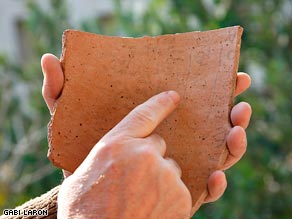
JERUSALEM (CNN) -- An Israeli archaeologist has discovered what he says is the earliest-known Hebrew text, found on a shard of pottery that dates to the time of King David from the Old Testament, about 3,000 years ago.
Professor Yosef Garfinkel of the Hebrew University of Jerusalem says the inscribed pottery shard -- known as an ostracon -- was found during excavations of a fortress from the 10th century BC.
Carbon dating of the ostracon, along with pottery analysis, dates the inscription to time of King David, about a millennium earlier than the famous Dead Sea Scrolls, the university said.
The shard contains five lines of text divided by black lines and measures 15 by 15 centimeters, or about 6 inches square.
Archaeologists have yet to decipher the text, but initial interpretation indicates it formed part of a letter and contains the roots of the words "judge," "slave," and "king," according to the university. That may indicate it was a legal text, which archaeologists say would provide insights into Hebrew law, society, and beliefs.
The researchers say the text was clearly written by a trained scribe.
The shard was discovered at the Elah Fortress in Khirbet Qeiyafa, about 20 miles southwest of Jerusalem. The fortress, measuring 2.3 hectares (about 5.7 acres), is the earliest-known fortified city of the biblical period in Israel.
Excavations began there in June. So far, just four percent of the site has been excavated, the university said.
Because the ostracon is similar to that found in other Israelite settlements, and because no pig bones were found at the site, archaeologists say the site was likely part of the Kingdom of Judea. Jewish dietary laws forbid the eating of pork.
Among the artifacts found at the site are more than 100 jar handles bearing distinct impressions which may indicate a link to royal vessels, the university said. Such a large quantity found in such a small area is "unprecedented," the university said.
The site of Khirbet Qeiyafa is located near the place where the Bible describes the battle between David and Goliath -- the Elah Valley, which shares its name with the fortress.
Garfinkel said it is the only site in Israel in which to investigate King David.
"The chronology and geography of Khirbet Qeiyafa create a unique meeting point between the mythology, history, historiography and archaeology of King David," he said.
The Dead Sea Scrolls are the earliest-known copies of the Bible, some dating back about 2,000 years.
It is widely believed that the first set of Dead Sea Scrolls was discovered in 1947 by a Bedouin shepherd who ventured into a cave in the Judean Desert in search of a lost sheep or goat.
The texts, written on crumbling parchment and papyrus, were found wrapped in linen inside earthenware jarsRead more unexplained mysteries at http://theunexplainedmysteries.com
For more details go to http://www.cnn.com/2008/WORLD/meast/10/30/israel.ancient.text/index.html
Subscribe to:
Posts (Atom)
LinkWithin
