Showing posts with label history. Show all posts

Saturday, June 6, 2009

Mammoths Roasted in Prehistoric Kitchen Pit

Jennifer Viegas, Discovery News

June 3, 2009 -- Central Europe's prehistoric people would likely have been amused by today's hand-sized hamburgers and hot dogs, since archaeologists have just uncovered a 29,000 B.C. well-equipped kitchen where roasted gigantic mammoth was one of the last meals served.

The site, called Pavlov VI in the Czech Republic near the Austrian and Slovak Republic borders, provides a homespun look at the rich culture of some of Europe's first anatomically modern humans.

View a slide show of the prehistoric grill site here.

While contemporaneous populations near this region seemed to prefer reindeer meat, the Gravettian residents of this living complex, described in the latest issue of the journal Antiquity, appeared to seek out more super-sized fare.

"It seems that, in contrast to other Upper Paleolithic societies in Moravia, these people depended heavily on mammoths," project leader Jiri Svoboda told Discovery News.

Svoboda, a professor at the University of Brno and director of its Institute of Archaeology, and colleagues recently excavated Pavlov VI, where they found the remains of a female mammoth and one mammoth calf near a 4-foot-wide roasting pit. Arctic fox, wolverine, bear and hare remains were also found, along with a few horse and reindeer bones.

The meats were cooked luau-style underground. Svoboda said, "We found the heating stones still within the pit and around."

Boiling pits existed near the middle roaster. He thinks "the whole situation -- central roasting pit and the circle of boiling pits -- was sheltered by a teepee or yurt-like structure."

It's unclear if seafood was added to create a surf-and-turf meal, but multiple decorated shells were unearthed. Many showed signs of cut marks, along with red and black coloration. The scientists additionally found numerous stone tools, such as spatulas, blades and saws, which they suggest were good for carving mammoths.

Read more at http://dsc.discovery.com/news/2009/06/03/prehistoric-bbq.html

Friday, March 6, 2009

World's 'oldest' spider web found

Two brothers have discovered what is thought to be the world's oldest recorded spider's web encased in amber on an East Sussex beach.

The amber, which was found in Bexhill, was formed about 140 million years ago in the Cretaceous period.

Amateur fossil hunter Jamie Hiscocks and his brother Jonathan also found the fossilised remains of an Iguanodon jaw bone on the coastline.

The spider web thread is now being studied at Oxford University.

Trapped in resin

Professor Martin Brasier, a palaeobiologist at the university, said: "You can see where the web is attached to the surface.

"If it is confirmed - and we think we have got good evidence for it - then it would be the oldest preserved spider's web and the oldest fossil silk, I think, in the fossil record."

Fossilised charcoal was also found in the fossil beds near to the amber at low tide on the coast between Hastings and Cooden.

Scientists think the web became trapped in conifer resin after a forest fire and then became fossilised inside the resulting amber.

Jamie Hiscocks, who has been hunting for fossils for more than 10 years, said: "The strata beds are actually being broken up all the time.

"Most of the pieces are actually just lying there on the surface. You pick it up, just bend down and pick it up."

Read more at http://news.bbc.co.uk/1/hi/england/sussex/7925629.stm

Thursday, November 13, 2008

4,300-year-old pyramid found in Egypt

A new pyramid has been discovered deep beneath Egyptian sands, archaeologists announced today.

The 4,300-year-old monument is believed to be the tomb of Queen Sesheshet, the mother of Pharaoh Teti, the founder ancient Egypt's 6th dynasty.

Once nearly five stories tall, the pyramid—or at least what remains of it—lay beneath 23 feet (7 meters) of sand.

The discovery is the third known subsidiary, or satellite, pyramid to the tomb of Teti. It's also the second pyramid found this year in Saqqara, an ancient royal burial complex near current-day Cairo.

I always say you never know what the sands of Egypt might hide," said Zahi Hawass, secretary general of Egypt's Supreme Council of Antiquities (SCA).

"This might be the most complete subsidiary pyramid ever found at Saqqara," added Hawass, who is also a National Geographic Society explorer-in-residence. (The National Geographic Society owns National Geographic News.)

Surprise in the Sand

Archaeologists also found remnants of a white limestone casing for the surviving, 16-foot-tall (5-meter-tall) pyramid base. The angle of the base helped them determine that the pyramid's walls stood at a 51-degree angle.

Based on that angle, the team determined that the pyramid was originally 46 feet (14 meters) tall and about 72 feet (22 meters) square at its base.

The researchers were somewhat surprised to find a pyramid at the Teti site, since they thought the area had been thoroughly searched. Archaeologists had already found subsidiary pyramids for Teti's two principal wives Iput I and Khuit, about a hundred years ago and in 1994, respectively.

Teams have been digging in the area for more than 20 years. "One hundred years ago they used to take sand and put it in unexcavated areas," Hawass said.

"The archaeologists in the past used this area as a location for the sand. No one could think there is anything here."

Tomb robbers, however, had known the pyramid was there—archaeologists found that a shaft had been created to allow access to Sesheshet's funerary chamber.

Due to those assumed tomb raids, archaeologists don't expect to find Sesheshet's mummy when they reach the burial chamber weeks from now. But they do anticipate finding inscriptions about the queen, whose name, perhaps coincidentally, evokes the goddess of history and writing, Seshat.

Mother Love

Starting from the 4th dynasty (2616 to 2494 B.C.), pharaohs often built pyramids for their wives and mothers.

"Mothers were revered in ancient Egypt," said Salima Ikram, a professor of Egyptology at the American University in Cairo, who was not involved in the discovery.

"Building pyramids for one's mother in her dead state … was fairly emphasized in the whole vision of kingship that the ancient Egyptians had," Ikram said.

"That was something that was instituted during [a pharaoh's] lifetime and was a very public way of expressing his debt to her, his connection to her, and her importance in Egypt politically and as a symbol for kingship."

Sesheshet's son Teti might have been more motivated than the average pharaoh to pay homage to his mother. Sesheshet had come from a powerful family and probably supported his ascendancy to the throne during turmoil at the end of the 5th dynasty.

"She's one of the important ladies at that time," said Hakim Haddad, general director of excavations in Egypt.

"At the end of the 5th dynasty and the beginning of the 6th dynasty, there was a conflict between two branches of the royal families."

The American University's Ikram added, "I assume Teti thought it would be a good plan to make his mother a pyramid."

Regardless of Teti's motivations, SCA director Hawass says the newfound pyramid is special because of its association with a female ruler.

"You can discover a tomb or a statue, but to discover a pyramid it makes you happy. And a pyramid of a queen—queens have magic."

Complete article at http://news.nationalgeographic.com/news/2008/11/081111-new-pyramid-egypt.html

Read more at http://theunexplainedmysteries.com

Friday, October 31, 2008

Archeologist finds 3,000-year old Hebrew text


JERUSALEM (CNN) -- An Israeli archaeologist has discovered what he says is the earliest-known Hebrew text, found on a shard of pottery that dates to the time of King David from the Old Testament, about 3,000 years ago.

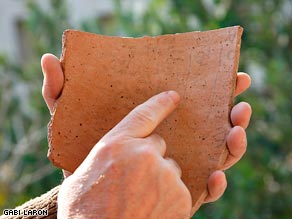
Professor Yosef Garfinkel of the Hebrew University of Jerusalem says the inscribed pottery shard -- known as an ostracon -- was found during excavations of a fortress from the 10th century BC.

Carbon dating of the ostracon, along with pottery analysis, dates the inscription to time of King David, about a millennium earlier than the famous Dead Sea Scrolls, the university said.

The shard contains five lines of text divided by black lines and measures 15 by 15 centimeters, or about 6 inches square.

Archaeologists have yet to decipher the text, but initial interpretation indicates it formed part of a letter and contains the roots of the words "judge," "slave," and "king," according to the university. That may indicate it was a legal text, which archaeologists say would provide insights into Hebrew law, society, and beliefs.

The researchers say the text was clearly written by a trained scribe.

The shard was discovered at the Elah Fortress in Khirbet Qeiyafa, about 20 miles southwest of Jerusalem. The fortress, measuring 2.3 hectares (about 5.7 acres), is the earliest-known fortified city of the biblical period in Israel.

Excavations began there in June. So far, just four percent of the site has been excavated, the university said.

Because the ostracon is similar to that found in other Israelite settlements, and because no pig bones were found at the site, archaeologists say the site was likely part of the Kingdom of Judea. Jewish dietary laws forbid the eating of pork.

Among the artifacts found at the site are more than 100 jar handles bearing distinct impressions which may indicate a link to royal vessels, the university said. Such a large quantity found in such a small area is "unprecedented," the university said.

The site of Khirbet Qeiyafa is located near the place where the Bible describes the battle between David and Goliath -- the Elah Valley, which shares its name with the fortress.

Garfinkel said it is the only site in Israel in which to investigate King David.

"The chronology and geography of Khirbet Qeiyafa create a unique meeting point between the mythology, history, historiography and archaeology of King David," he said.

The Dead Sea Scrolls are the earliest-known copies of the Bible, some dating back about 2,000 years.

It is widely believed that the first set of Dead Sea Scrolls was discovered in 1947 by a Bedouin shepherd who ventured into a cave in the Judean Desert in search of a lost sheep or goat.

The texts, written on crumbling parchment and papyrus, were found wrapped in linen inside earthenware jars

Read more unexplained mysteries at http://theunexplainedmysteries.com

For more details go to http://www.cnn.com/2008/WORLD/meast/10/30/israel.ancient.text/index.html

LinkWithin

Related Posts with Thumbnails