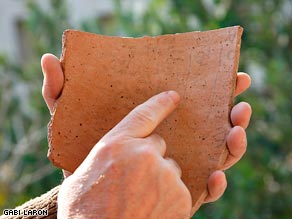
A new pyramid has been discovered deep beneath Egyptian sands, archaeologists announced today.
The 4,300-year-old monument is believed to be the tomb of Queen Sesheshet, the mother of Pharaoh Teti, the founder ancient Egypt's 6th dynasty.
Once nearly five stories tall, the pyramid—or at least what remains of it—lay beneath 23 feet (7 meters) of sand.
The discovery is the third known subsidiary, or satellite, pyramid to the tomb of Teti. It's also the second pyramid found this year in Saqqara, an ancient royal burial complex near current-day Cairo.
I always say you never know what the sands of Egypt might hide," said Zahi Hawass, secretary general of Egypt's Supreme Council of Antiquities (SCA).
"This might be the most complete subsidiary pyramid ever found at Saqqara," added Hawass, who is also a National Geographic Society explorer-in-residence. (The National Geographic Society owns National Geographic News.)
Surprise in the Sand
Archaeologists also found remnants of a white limestone casing for the surviving, 16-foot-tall (5-meter-tall) pyramid base. The angle of the base helped them determine that the pyramid's walls stood at a 51-degree angle.
Based on that angle, the team determined that the pyramid was originally 46 feet (14 meters) tall and about 72 feet (22 meters) square at its base.
The researchers were somewhat surprised to find a pyramid at the Teti site, since they thought the area had been thoroughly searched. Archaeologists had already found subsidiary pyramids for Teti's two principal wives Iput I and Khuit, about a hundred years ago and in 1994, respectively.
Teams have been digging in the area for more than 20 years. "One hundred years ago they used to take sand and put it in unexcavated areas," Hawass said.
"The archaeologists in the past used this area as a location for the sand. No one could think there is anything here."
Tomb robbers, however, had known the pyramid was there—archaeologists found that a shaft had been created to allow access to Sesheshet's funerary chamber.
Due to those assumed tomb raids, archaeologists don't expect to find Sesheshet's mummy when they reach the burial chamber weeks from now. But they do anticipate finding inscriptions about the queen, whose name, perhaps coincidentally, evokes the goddess of history and writing, Seshat.
Mother Love
Starting from the 4th dynasty (2616 to 2494 B.C.), pharaohs often built pyramids for their wives and mothers.
"Mothers were revered in ancient Egypt," said Salima Ikram, a professor of Egyptology at the American University in Cairo, who was not involved in the discovery.
"Building pyramids for one's mother in her dead state … was fairly emphasized in the whole vision of kingship that the ancient Egyptians had," Ikram said.
"That was something that was instituted during [a pharaoh's] lifetime and was a very public way of expressing his debt to her, his connection to her, and her importance in Egypt politically and as a symbol for kingship."
Sesheshet's son Teti might have been more motivated than the average pharaoh to pay homage to his mother. Sesheshet had come from a powerful family and probably supported his ascendancy to the throne during turmoil at the end of the 5th dynasty.
"She's one of the important ladies at that time," said Hakim Haddad, general director of excavations in Egypt.
"At the end of the 5th dynasty and the beginning of the 6th dynasty, there was a conflict between two branches of the royal families."
The American University's Ikram added, "I assume Teti thought it would be a good plan to make his mother a pyramid."
Regardless of Teti's motivations, SCA director Hawass says the newfound pyramid is special because of its association with a female ruler.
"You can discover a tomb or a statue, but to discover a pyramid it makes you happy. And a pyramid of a queen—queens have magic."
Complete article at http://news.nationalgeographic.com/news/2008/11/081111-new-pyramid-egypt.html
Read more at http://theunexplainedmysteries.com