Showing posts with label jesus shroud. Show all posts

Monday, December 15, 2008

Did Noah's Flood start in the Carmel?


A deluge that swept the Land of Israel more than 7,000 years ago, submerging six Neolithic villages opposite the Carmel Mountains, is the origin of the biblical flood of Noah, a British marine archeologist said Tuesday.

The new theory about the source of the great flood detailed in the Book of Genesis comes amid continuing controversy among scholars over whether the inundation of the Black Sea more than seven millennia ago was the biblical flood.

In the theory posited by British marine archeologist Dr. Sean Kingsley and published in the Bulletin of the Anglo-Israeli Archaeological Society, the drowning of the Carmel Mountains villages - which include houses, temples, graves, water wells, workshops and stone tools - is by far "the most compelling" archeological evidence exposed to date for Noah's flood.

"What's more convincing scientifically, a flood in the Black Sea, so far away from Israel and the fantasy of a supposed ark marooned on the slopes of Mount Ararat, or six submerged Neolithic villages smack-bang in the middle of the Bible Land?" Kingsley said in a telephone interview with The Jerusalem Post.

He added that the site, which has been excavated by Israeli archeologist Dr. Ehud Galili over the last quarter-century, offers a "pretty convincing cocktail of coincidences," including submerged layers of villages in a critical location, and one that was known for its nautical revolution.

But Galili rejected Kingsley's theory, saying Tuesday that it could not be true.

"Based on our archeological finds, the village was not abandoned due to a catastrophic event, but due to the slow rise of sea levels which occurred all over the world," he said. "The pace of the increase in the sea level was very slow, so that it would not be significant enough for people to remember it in the course of their lifetime."

Galili noted that, following the major tsunami that hit Asia, there was a scientific trend in the world to hunt for mega-disasters that happened in the past.

"We did not find any proofs which indicate that a tsunami or other such catastrophe flooded the villages, even though there are proofs that a tsunami did occur in the Mediterranean Sea," he said.

Kingsley, a self-declared atheist, said he had begun studying the origins of Noah's flood five years ago as a result of his interest into "how mythologies came into existence," as well as a desire to connect the biblical story with global warming.

The alternate theory that the inundation of the Black Sea around 5,600 BCE was the source of the biblical flood is called into question by the fact that no villages, houses, cemeteries or graves have ever been found under its waves, Kingsley said.

Scholars agree the Black Sea flooded when rising world sea levels caused the Mediterranean to burst over land, turning the freshwater lake into a saltwater sea. The flood was so monstrous that it raised water levels by 155 meters and submerged up to 150,000 square kilometers of land.

But scholars are divided on when the flood occurred, and how rapidly. Most believe it took place about 9,000 years ago and was gradual.

The date of the massive flooding on the Carmel Coast, which Kingsley estimates to have taken place between the sixth and fifth millennia BCE, is another unknown.

"The precise timing of this localized flooding is still being worked out, but there is no doubt that the villages of the Carmel were lost not to earthquakes or tectonic movements but to killer waves," Kingsley said.

The lost villages cluster opposite the Carmel Mountains in depths of 12 meters. Atlit-Yam, 10 meters south of Haifa, is the largest submerged Neolithic village in the Mediterranean Sea.

Kingsley's theory about the origin of Noah's flood, an independent archeologist said, is interesting but dubious.

"Whether or not one can make a direct link between the biblical story and the submerged Neolithic sites is doubtful," said Prof. Shimon Gibson, an archeologist with the University of North Carolina at Charlotte. "But it does show that episodes of substantial flooding did occur in these parts of the world and that that kind of fear would have existed within the cultural conscientiousness [sic] of ancient peoples.

"The bottom line," he concluded, "is that overall evidence of [a] world submerged in flood does not exist."

Wednesday, August 20, 2008

Shroud of Turin stirs new controversy

A Colorado couple researching the shroud dispute radiocarbon dating of the alleged burial cloth of Jesus, and Oxford has agreed to help them reexamine the findings.
COLORADO SPRINGS, COLO. -- The tie that binds John and Rebecca Jackson is about 4 feet by 14 feet, woven of herringbone twill linen. It once led to their romance; years later, it still dominates their thoughts and fills their conversations. It brought Rebecca, an Orthodox Jew, to the Catholic Church; it led John to suspend himself from an 8-foot-tall cross to study how blood might have stained the cloth. Together, the two have committed to memory every crease, scorch mark and unexplained stain in their years-long pursuit of the mystery: Is the Shroud of Turin -- which allegedly bears the image of a crucifixion victim -- the burial cloth of Jesus? In 1988, science seemed to put that question to rest. Radiocarbon dating by three separate laboratories showed that the shroud originated in the Middle Ages, leaving the "shroud crowd" reeling. Shroud skeptics responded, "We told you so." The Catholic Church admitted that it could not be authentic. Many scientists backed away.

But John Jackson, one of the shroud's most prominent researchers, was among those who insisted that the results made no sense. Too much else about the shroud, they said, including characteristics of the cloth and details in the image, suggested that it was much older. Twenty years later, Jackson, 62, is getting his chance to challenge the radiocarbon dating. Oxford University, which participated in the original radiocarbon testing, has agreed to work with him in reconsidering the age of the shroud.

If the challenge is successful, Jackson hopes to be allowed to reexamine the shroud, which is owned by the Vatican and stored in a protective chamber in the Cathedral of St. John the Baptist in Turin, Italy. Jackson, a physicist who teaches at the University of Colorado, hypothesizes that contamination of the cloth by elevated levels of carbon monoxide skewed the 1988 carbon-14 dating by 1,300 years.

"It's the radiocarbon date that to our minds is like a square peg in a round hole. It's not fitting properly, and the question is why," he said. On that point of Shroud of Turin, Christopher Ramsey, head of the Oxford Radiocarbon Accelerator Unit, seems to agree. "There is a lot of other evidence that suggests to many that the shroud is older than the radiocarbon dates allow, and so further research is certainly needed," says a statement on his website. "Only by doing this will people be able to arrive at a coherent history of the shroud which takes into account and explains all of the available scientific and historical information."
Read complete article at http://theunexplainedmysteries.com/shroud-of-turin-1.html

Wednesday, June 4, 2008

Unexplained Mysteries of Shroud of Turin


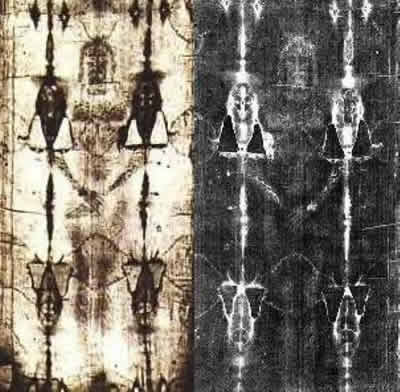
The Shroud of Turin (or Turin Shroud) is a linen cloth bearing the image of a man who appears to have been physically traumatized in a manner consistent with crucifixion. It is kept in the royal chapel of the Cathedral of Saint John the Baptist in Turin, Italy. It is believed by many to be a cloth worn by Jesus of Nazareth at the time of his burial, two days prior to his alleged resurrection.


The image on the shroud is much clearer in black-and-white negative than in its natural sepia color. The striking negative image was first observed on the evening of May 28, 1898 on the reverse photographic plate of amateur photographer Secondo Pia who was allowed to photograph it while it was being exhibited in the Turin Cathedral. According to Pia, he almost dropped and broke the photographic plate from the shock of seeing an image of a person on it.


The shroud is the subject of intense debate among some scientists, people of faith, historians, and writers regarding where, when, and how the shroud and its images were created. From a religious standpoint, in 1958 Pope Pius XII approved of the image in association with the Roman Catholic devotion to the Holy Face of Jesus, celebrated every year on Shrove Tuesday. Some believe the shroud is the cloth that covered Jesus when he was placed in his tomb and that his image was recorded on its fibers at or near the time of his alleged resurrection. Skeptics, on the other hand, contend the shroud is a medieval forgery; others attribute the forming of the image to chemical reactions or other natural processes.


Various tests have been performed on the shroud, yet the debates about its origin continue. Radiocarbon dating in 1988 by three independent teams of scientists yielded results published in Nature indicating that the shroud was made during the Middle Ages, approximately 1300 years after Jesus lived. Claims of bias and error in the testing were raised almost immediately, and were answered by Harry E. Gove ] and others. Yet the dating controversy has continued. Follow-up analysis published in 2005, for example, claimed that the sample dated by the teams was taken from an area of the shroud that was not a part of the original cloth. This analysis itself is questioned by skeptics such as Joe Nickell, who reason that the conclusions of the author, Raymond Rogers, result from "starting with the desired conclusion and working backward to the evidence". Former Nature or Philip Ball has said that the idea that Rogers steered his study to a preconceived conclusion is "unfair" and Rogers "has a history of respectable work".


LinkWithin

Related Posts with Thumbnails