Friday, January 29, 2010
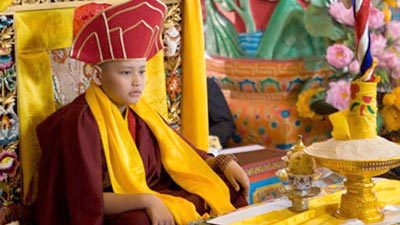
US Boy, 11, declared reincarnated holy man
Boston-born Jigme Wangchuk, 11, has now moved to India where he has been made the head of a Buddhist sect in the country's eastern Darjeeling city.
His parents say they discovered their son was not like other children two years ago when he started talking about his "past life". At first, they dismissed it as a childish fantasy, but began taking it seriously during a trip to a monastery in Mysore, southern India.At one point, he went into a trance in which he described a celebrated Buddhist monastery with a 35ft dragon on the roof.
After hearing his description of the temple he had never visited, the monks proclaimed he was the reincarnation of the 'Rinpoche' or high priest Galwa Lorepa, the founder of one of the four main schools of Tibetan Buddhism.Now he will spent the next ten years in virtual seclusion and only be able to communicate with his former school friends by email."It has been a very difficult period for us over the past two years. I have been crying for the past five months, but have, at last, come to terms with it," said his mother Dechen."When we were in New Delhi on our way to Darjeeling, I asked him whether he would like to go back to Boston. He said he has to fulfil his responsibilities to his people."But for 'His Holiness' Jigme, there's no regrets: "I will miss my school days but I am happy in my new role. I like it here," he said.
The drone of gyaling (a Tibetan musical instrument) reverberated across Darjeeling and masked dancers performed the traditional cham as 11-year-old Jigme Wangchuk from Boston was enthroned today as the reincarnation of Gyalwa Lorepa, more than 750 years after the monk of the Drukpa sect died.
For Wangchuk, a fifth grader at St Peter’s School, Boston, the recognition as the incarnate of the monk who passed away in 1250 AD, had come two years ago. From today, however, Wangchuk’s seat will be the Druk-Sa-Ngag Choeling monastery at Dali in Darjeeling. “It is after 700 years that the reincarnation has arrived,” said Karma Rinpoche, who is the boy’s uncle.
Reincarnations are identified through an elaborate procedure. In 2007, when Wangchuk was visiting the Kagyu-Nalanda monastery near Mysore he had spoken of his past life describing his vision of monasteries as they stood then, including one in Bhutan.
“He talked about the monastery (in Bhutan) being situated in a rocky area of the Himalayas with a 35-foot long dragon adorning its rooftop,” recalled Karma Rinpoche. Four hours after Wangchuk recited his vision, the 12th incarnate of Tsangpa Gyare — another Drukpa monk — sent word to the family, recognising the boy as Gyalwa Lorepa.
Complete story at http://theunexplainedmysteries.com/reincarnate-buddha.html
Thursday, November 27, 2008
'Buddha's skull' found in Nanjing
Chinese archaeologists have claimed that a 1,000-year-old miniature pagoda, unearthed in Nanjing, holds a piece of skull belonging to Siddhartha Gautama, the founder of Buddhism.
The pagoda was wedged tightly inside an iron case that was discovered at the site of a former temple in the city in August.
The four-storey pagoda, which is almost four feet high and one-and-a-half feet wide, is thought by archaeologists to be one of the 84,000 pagodas commissioned by Ashoka the Great in the second century BC to house the remains of the Buddha.
Ashoka, one of India's greatest emperors, converted to Buddhism after waging a bloody war in the eastern state of Orissa. He is widely credited with spreading Buddhism throughout Asia, and across his kingdom, which stretched from Pakistan through Afghanistan and into Iran.
The pagoda found in Nanjing is crafted from wood, gilded with silver and inlaid with gold, coloured glass and amber. It matches a description of another of Ashoka's pagodas which used to be housed underneath the Changgan Buddhist temple in Nanjing.
A description of the contents of the pagoda was also found: a gold coffin bearing part of Buddha's skull inside a silver box. Although scans have confirmed that there are two small metal boxes inside the pagoda, experts have not yet peered inside. The pagoda is currently on display in the museum.
Qi Haining, the head of archaeology at Nanjing Museum, told state media: "This pagoda may be unique, the only one known to contain parts of Buddha's skull".
But he said there would be a lengthy process before the cases could be opened. In 2001, Chinese authorities found a case that was said to contain a relic of Buddha's hair, but declined to open the welded box in case it damaged the contents.
De Qing, an expert in Buddhism in Nanjing, said: “The discovery of the relic will have a huge influence on the cultural history of Buddhism in China and will establish Nanjing as a premier site. It will be a great encouragement for Buddhists as well as for future studies. It is important for Buddhism as a religion to have these sarira, or relics, to show its followers. The more a Buddhist practises, the more relics will remain of him after his death. I am hugely excited. I think they should take the skull outside of the container, it is a sacred item, but it is not an untouchable item.”
Siddhartha Gautama, who is believed to have been born in the fifth century BC, was a spiritual teacher and recognised by Buddhists as the Supreme Buddha of our age. Also known as Shakyamuni, or the Sage of the Sakyas, his teachings are contained in the Tripitaka, the canon of Buddhist thought.
He is said to have attained Enlightenment, or to have become a Buddha, which means "Awakened One", at the age of 35, after 49 days meditating underneath a pipal tree.
The second World Buddhist Forum, a gathering of monks and scholars from around the world, will take place near Nanjing next year in Wuxi.