Showing posts with label blood sucking vampire. Show all posts

Tuesday, February 9, 2010

Unexplained Mysteries - Arnold Paole - Real Vampire Story

Arnold Paole (Arnont Paule in the original documents; an early German rendition of a Serbian name or nickname, perhaps Arnaut Pavle; died c. 1726) was a Serbian hajduk who was believed to have become a vampire after his death, initiating an epidemic of supposed vampirism that killed at least 16 people in his native village of Meduegna (also rendered as Metwett; likely a German rendition of Serbian Medveda, not to be confused with the modern Southern Serbian town of Medveda), located at the Morava river near the town of Paracin. His case, like the similar case of Peter Plogojowitz, became famous because of the direct involvement of the Austrian authorities and the documentation by Austrian physicians and officers, who confirmed the reality of vampires. Their report of the case was distributed in Western Europe and contributed to the spread of vampire belief among educated Europeans. The report and its significance for the subsequent Eighteenth century vampire controversy are nowadays explained with the poor understanding of the process of corpse decomposition at the time.

Knowledge of the case is based mostly on the reports of two Austrian military doctors, Glaser and Flückinger, who were successively sent to investigate the case.

Background

With the Treaty of Passarowitz (Požarevac, 1718), the Habsburg Monarchy annexed most of Serbia and the northern part of Bosnia, territories which had been part of the Ottoman Empire. These remained in Austrian control until the Treaty of Belgrade (1739), when the Austrians were forced to cede them back to the Turks. During this 20-year period, these newly conquered boundary districts were subject to direct military rule from Vienna for strategical, as well as fiscal and other reasons. As a result of the devastation brought about by previous Austrian-Ottoman wars, these areas were in a poor condition, with scarce and partly nomadic population, little agriculture and an emphasis on cattle-breeding. The Austrian authorities sought to further economic development and attract German-speaking as well as Serbian and Bulgarian settlers to the new territories. Many of the Serbs, especially those who had immigrated from Ottoman-held areas, were recruited as militiamen (hajduks) for the protection of the boundaries in peace-time as well as regular military service at war in exchange for unalienable lots of land. It was in these communities that the earliest well-documented alleged vampire attacks were attested.

The first outbreak

This outbreak is only known from Flückinger's report about the second epidemic and its prehistory. According to the account of the Medveda locals as retold there, Arnold Paole was a hajduk who had moved to the village from the Turkish-controlled part of Serbia. He reportedly mentioned often that he had been plagued by a vampire at a location named Gossowa (perhaps Kosovo) but that he had cured himself by eating soil from the vampire's grave and smearing himself with his blood. About 1725, he broke his neck in a fall from a haywagon. Within 20 or 30 days after Paole's death, four persons complained that they had been plagued by him. These people died shortly after. Still ten days later villagers, advised by their hadnack (a military/administrative title) who had witnessed such events before, opened his grave.

They saw that the corpse was undecomposed "and that fresh blood had flowed from his eyes, nose, mouth, and ears; that the shirt, the covering, and the coffin were completely bloody; that the old nails on his hands and feet, along with the skin, had fallen off, and that new ones had grown". Concluding that Paole was indeed a vampire, they drove a stake through his heart, to which he reacted by groaning and bleeding, and burned the body. They then disinterred Paole's four supposed victims and performed the same procedure, to prevent them from becoming vampires.

The second outbreak

About 5 years later, in the winter of 1731, a new epidemic occurred, with more than ten people dying within several weeks, some of them in just two or three days without any previous illness. The numbers and the age of the deceased vary somewhat between the two main sources.

Glaser's report on the case states that by 12 December, 13 people had died in the course of 6 weeks. Glaser names the following victims (here rearranged chronologically): Miliza (Serbian Milica, a 50-year-old woman); Milloi (Serbian Miloje, a 14-year-old boy); Joachim (a 15-year-old boy); Petter (Serbian Petar, a 15-day-old boy); Stanno (Serbian Stana, a 20-year-old woman) as well as her newborn child, which Glaser notes was buried "behind a fence, where the mother had lived" due to not having lived long enough to be baptized; Wutschiza (Serbian Vucica, a 9-year-old boy), Milosova (Serbian Milošova, actually "Miloš's /wife/", a 30-year-old wife of a hajduk), Radi (Serbian Rade, a twenty-four-year-old man), and Ruschiza (Serbian Ružica, a forty-year-old woman). The sick had complained of stabs in the sides and pain in the chest, prolonged fever and jerks of the limbs. Glaser reports that the locals considered Milica and Stana to have started the vampirism epidemic.


Read more at http://theunexplainedmysteries.com/arnold-paole-real-vampire.html

Saturday, March 7, 2009

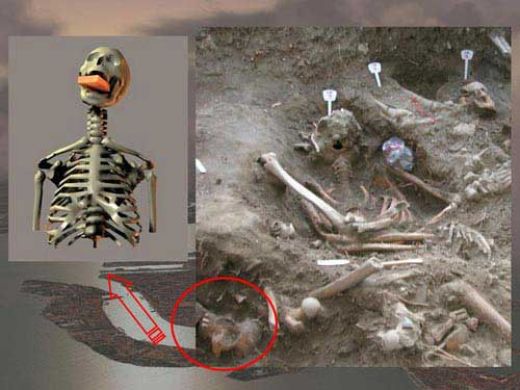
'Vampire' discovered in mass grave

A SKELETON exhumed from a grave in Venice is being claimed as the first known example of the "vampires" widely referred to in contemporary documents.
Matteo Borrini of the University of Florence in Italy found the skeleton of a woman with a small brick in her mouth (see right) while excavating mass graves of plague victims from the Middle Ages on Lazzaretto Nuovo Island in Venice (see second image here).
At the time the woman died, many people believed that the plague was spread by "vampires" which, rather than drinking people's blood, spread disease by chewing on their shrouds after dying. Grave-diggers put bricks in the mouths of suspected vampires to stop them doing this, Borrini says.
The belief in vampires probably arose because blood is sometimes

Read complete story at http://www.newscientist.com/article/mg20126985.200-vampire-discovered-in-mass-grave.html?DCMP=OTC-rss&nsref=online-news

Tuesday, August 26, 2008

The Vampire's ghost of Guadalajara

Maria was always an inquisitive girl. She liked to poke and prod around everything she encountered ever since she was a young child. Her family had lived on Nardo street in Guadalajara, Mexico all of her young life.

Like most of the children in her neighborhood the streets were their playground and she had explored every nook and cranny of the streets that surrounded her home. One spot that truly fascinated her was the cemetery that was only a few blocks away, El Panteon de Belen. It is an ancient cemetery with many supernatural legends surrounding its occupants. Maria was only two years old when she first went there on November 2nd during a festival for the day of the dead. The cemetery had been turned into a museum long ago and the day of the dead celebrations would go on into the night with puppet shows and plays preformed throughout the graveyards property. She didn’t know when she first heard the story of the Vampire’s grave, it seemed as though it had been a part of her experience of El Panteon de Belen for as long as she could remember.

The story is told that long ago there was a vampire who stalked the countryside of Guadalajara in the early 19th century. Livestock and newborn babies were attacked in the middle of the night and all of their blood was drained from their lifeless bodies. The local citizens were on alert and during the dark hours of early morning a man was seen skulking back into his house after another reported attack of El Vampiro. A mob was formed and they burst into his house and killed him while he lay in his bed. A crude wooden stake was driven through his heart and he was buried unceremoniously in El Panteon de Belen. The stick was fed by his preternatural blood and soon it grew into a massive tree that burst open the tomb of El Vampiro. Legend has it that if you cut a limb from the tree you will see blood mingled with the sap ooze from the stump. An old prophecy claims that one the tree completely overgrows the grave and pushes the coffin up to the ground, El Vampiro will be free to rise again and take his revenge upon the citizens of Guadalajara.

This story fascinated and frightened Maria, and she would often stare at the opened hole of the crypt of El Vampiro whenever she visited the cemetery. Sometimes she was sure she thought something moved in the shadows, but her mother told her that her imagination was overactive from watching too many movies on television. But as she grew, the fascination with the crypt and the certainty that something was moving in its stygian darkness motivated her to visit the grave more frequently.

When she was 11 she her curiosity about the site was peaked and she decided to investigate the grave up close without anyone to bother her. After her parents had gone to bed she snuck out of the house after midnight and stealthfully walked the busy streets of Guadalajara and climbed the walls of El Panteon de Belen. The caretaker was usually guarding the grounds with his dog but luckily for her they had retreated to some location or another and she was not harassed as she made her way through the moldy and decaying crypts to the great tree. When she arrived at the grave of El Vampiro she stood undecided for a few moments as fear gripped her heart, but she then cast these feelings aside and boldly skirted the makeshift fence that was erected to keep out the curious and vandals during normal visiting hours.

Read complete article at http://theunexplainedmysteries.com/Guadalajara-Ghost.html

Thursday, June 19, 2008

Spells to become a vampire

A vampire is a mortal creature that has for some reason rejected its soul, expelling it from and giving control of its actions to the sensual body, the source of the reaction, the remnants of the soul, or a conglomerate of all three. While the most common way to become a vampire is to be initiated by another vampire, or to become a source via demon possession or disease, there are also some magical methods which can be used.

Vampires are born out of a fundamental change which can occur in the physical bodies of creatures which possess a soul. In most mortals the soul is the fundamental source for action, creating the original impulses which eventually become the person's acts. It is also a passage through which the creature can gain a small amount of the infinite power underlying the universe, power which is necessary for the functioning of a self conscious being.

A vampire is born when a mortal creature undergoes a change which causes the sensual physical body to revolt against the soul, usually expelling it, and taking control of the creature. The actions of the being are then controlled by either the remaining physical brain, the remnant of the soul, whatever caused the expelling of the soul, or a conglomerate of these forces. It is this emphasis on the physical body to the exclusion of the soul, which causes many vampires to be obsessively sensual and addicted to their own suddenly intense perceptions.

There are many things which can cause a creature to become a vampire. These include certain forms of intimate demonic possession, various viruses, the casting of spells to become a vampire, or mental disease. Each of these causes has its own peculiar nature, and can result in very different outcomes for the victim.


LinkWithin

Related Posts with Thumbnails